SEC C / ROOFING & ENVELOPE
Roofing contractor in Bali
We build new roofs and replace failing ones across Bali — structure, covering, insulation and gutters as one engineered system by our own roofing crew, not four subcontractors pointing at each other. Metal roof systems from IDR 485,000/m², clay tile from IDR 650,000/m², every roof hose-tested before we leave and covered by a 10-year written workmanship warranty on structure. Send your roof size and covering on WhatsApp for a guide price and a free inspection.
- New roofs & full re-roofing
- 10-year workmanship warranty on structure
- Gutters & rainwater design included
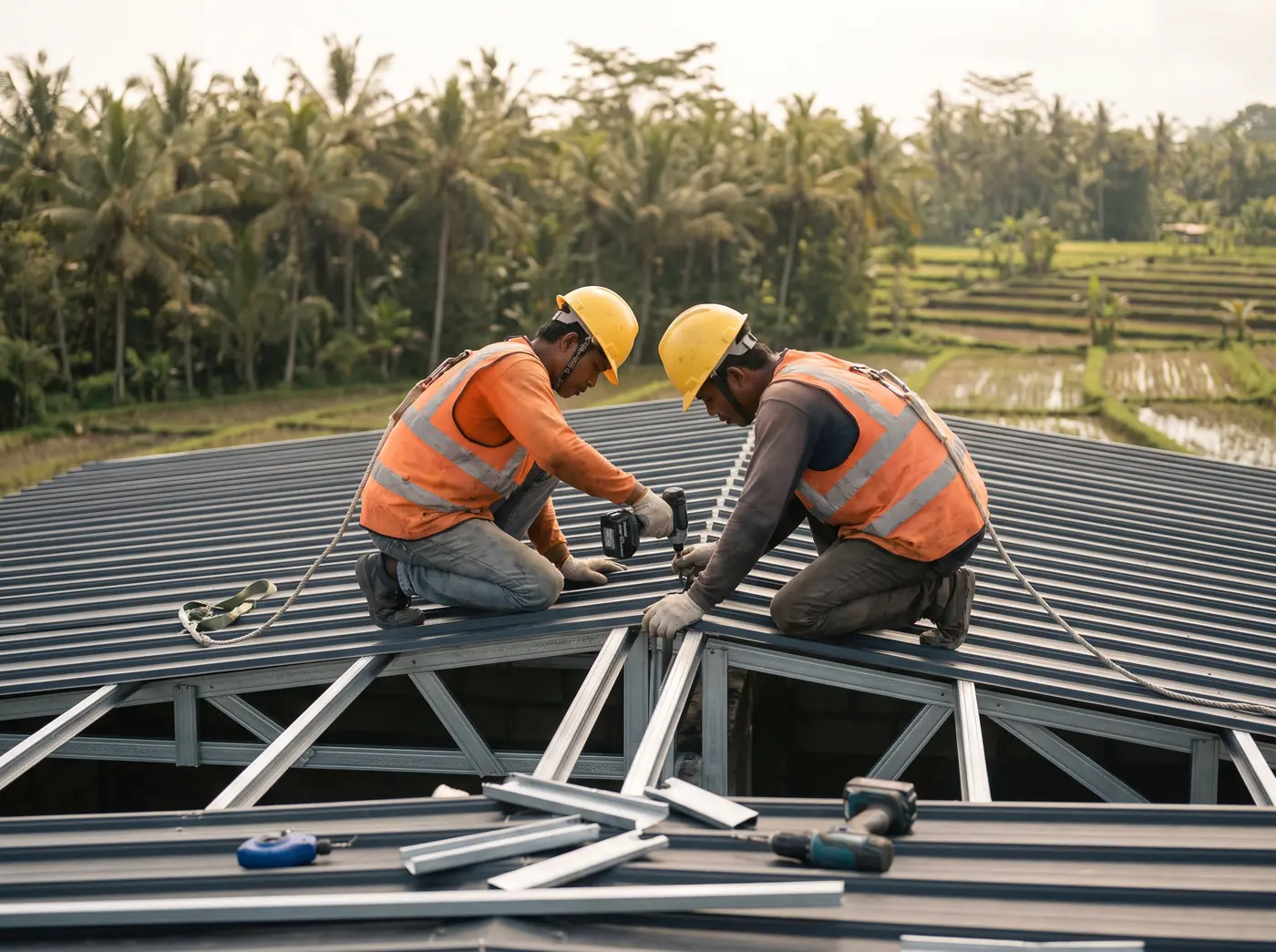
Most roof problems we're called to fix were built in on day one: undersized gutters, tile laps that assume drizzle rather than a cloudburst, steel battens that started rusting the week they were installed. So we begin every roofing job at the drawing stage — calculating rain loads for the real catchment area, choosing fixings rated for coastal air, and detailing the boring parts (flashings, penetrations, valleys) where 90% of leaks are born.
We work across every covering commonly used on the island — colour-coated metal sheeting, clay and concrete tile, asphalt shingle, and reinforced-concrete flat roofs with proper falls and membranes. If your architecture calls for an alang-alang look without the maintenance, we'll show you the hybrid build-ups that deliver it.
What Bali does to roofs
The island's roofing enemies are specific. Rain arrives in bursts of 80–100 mm per hour, which turns undersized gutters into waterfalls that soak walls from the top down. UV at these latitudes chalks cheap coatings within three years. Salt air within a couple of kilometres of the coast eats unprotected fasteners long before the sheeting fails. And afternoon heat cycles make every material expand and contract daily — loosening whatever was fixed without allowance for movement.
None of this is exotic engineering; it just has to be respected line by line. Zincalume-grade steel or better, Class 4 coastal fasteners, laps sized for intensity rather than habit, and movement joints where the maths says so. That's the difference between a roof you forget about and a roof you meet every wet season.
Re-roofing without wrecking your weeks
Replacing a roof over an occupied villa is a logistics job as much as a construction one. We strip and close in sections so the building is never open overnight, protect interiors with temporary membranes, and sequence noisy work away from guest hours where villas trade. A typical 300 m² re-roof runs 3–5 weeks depending on structure condition — and you'll know the schedule before we lift a single tile.
Repair or replace? What we check on site
Many owners call us asking for a new roof when a targeted repair would do — and sometimes the reverse. The inspection decides, and it is free island-wide. We go up with a camera and a moisture meter and write down what we find, so the recommendation comes with photographs rather than opinions:
- Covering: rust and chalking on metal, cracked or slipped tiles, brittle shingles
- Fixings: corroded screws, lost washers, nails backing out of battens
- Structure: termite damage in timber, rust at steel truss joints, sagging ridges
- Flashings, valleys and every pipe or cable penetration
- Gutters and downpipes checked against the real catchment area
- Ceilings mapped for stains to trace where water actually enters
A repair is the honest answer when the structure is sound and the leaks trace to details — a flashing, a valley, a run of failed fixings. Replacement makes sense when the structure is compromised, when the covering has reached the end of its life across the whole roof, or when the drainage was undersized from day one and every wet season proves it. Flat concrete roofs get a flood test and moisture readings first; our note on why flat roofs leak in Bali explains what we look for. For a line-by-line view of what a new roof or re-roof costs, see our roofing cost guide for Bali.
SCOPE OF WORK
What's included
Roof structure
Light-gauge steel or treated timber trusses, engineered for span, covering weight and wind uplift.
Covering installation
Metal sheet, clay/concrete tile or shingle laid to manufacturer specs — laps, fixings and expansion allowed for.
Flat roof systems
Concrete decks with screed-to-falls, waterproofing membrane and protected outlets.
Flashings & detailing
Ridges, valleys, wall abutments and every pipe or cable penetration sealed as a detail, not with a tube of sealant.
Gutters & downpipes
Sized from rainfall data for your actual roof area, with leaf protection where trees demand it.
Insulation & ventilation
Reflective and bulk insulation options plus ridge/eave ventilation that keeps rooms measurably cooler.
PROCESS
How the job runs
- 01
Inspection & measurement
We survey the existing roof or drawings, measure catchments and photograph problem points — free, island-wide.
- 02
Engineering & quote
Structure calcs, covering options at two or three price points, and a fixed itemised quote.
- 03
Build or replace
Our own roofing crew installs structure, covering, flashings and gutters; occupied buildings are sectioned and protected.
- 04
Water test & warranty
Hose-testing on valleys and penetrations before we leave, plus a written warranty on structure and workmanship.
INDICATIVE PRICING
Roofing prices in Bali per m² (2026)
| Scope | Guide price |
|---|---|
| Metal roof system (structure + covering) | from IDR 485,000 / m² |
| Clay or concrete tile system | from IDR 650,000 / m² |
| Asphalt shingle system | from IDR 1,000,000 / m² |
| Flat roof: screed-to-falls + membrane | from IDR 425,000 / m² |
| Re-roof in metal: strip-out, new covering, flashings (sound structure) | from IDR 485,000 / m² |
| Gutter & downpipe package | from IDR 350,000 / m |
Guide prices for typical spans and access, 2026 — a guide, not a quote: the fixed price follows a free roof inspection. What moves the number (pitch, height, access, structure repairs, insulation) is explained in our roofing cost guide.
Request an exact quoteFAQ
Roofing in Bali — what owners ask
Which roof covering lasts longest in Bali?
Properly fixed clay tile and quality colour-coated steel both give 25+ years here. Steel wins on weight, speed and cyclonic fixing; tile wins on heat mass and looks. What actually decides lifespan is the detailing — fasteners, flashings and gutters fail years before good coverings do.
Can you re-roof while we stay in the house?
Yes — that's the normal case. We open and close the roof in sections, never leave it exposed overnight, and use interior protection where ceilings come down. Most families notice noise more than disruption.
Do you fix leaks, or only build full roofs?
We do both, honestly. If a leak needs a flashing rebuilt rather than a new roof, that's what we'll quote. Chronic leak patterns usually trace to design faults, and we'll show you photos of exactly what we found before recommending anything bigger.
How much does a new roof cost in Bali?
As a guide: complete metal roof systems from IDR 485,000/m², clay tile systems from IDR 650,000/m², including structure. Flat concrete roofs price by deck and membrane spec. Every quote is fixed after a free inspection — the guide prices exist so you're not negotiating blind.
How long does a re-roof take?
A typical 300 m² re-roof runs three to five weeks, depending on how much of the structure needs repair once the old covering is off. We strip and close in sections so the building is never open overnight, and you receive the schedule with the quote.
What is the price difference between metal and clay tile roofs?
As 2026 guide prices including structure: metal roof systems from IDR 485,000/m², clay or concrete tile from IDR 650,000/m² and asphalt shingle from IDR 1,000,000/m². Tile is heavier, so it needs a stronger structure; metal is lighter and faster to install but needs insulation to keep rooms cool.
Do you give a written warranty on roofing?
Yes. Every roof is hose-tested on valleys and penetrations before we leave, and the contract carries a written workmanship warranty — 10 years on the roof structure. If something we built leaks within the warranty period, we come back and fix it at our cost.
Can you make a metal roof cooler and quieter?
Yes — with reflective foil and bulk insulation under the sheeting, plus ridge and eave ventilation that lets hot air escape. It is cheapest to do during a new roof or re-roof, when the sheets are off anyway, and it also cuts rain noise noticeably.
RELATED SERVICES
Often booked together
FROM THE BLOG