SEC E / WATERPROOFING & PROTECTION
Swimming pool leak detection and repair in Bali
A pool losing water tells you nothing about why. Evaporation, a weeping return fitting, a cracked skimmer throat and a split pipe under the deck all look identical from a sun lounger: a falling level and a rising bill. We work out which one it is by measurement rather than by chipping tiles off, then repair the specific fault. Most pools we survey need one fitting or one metre of pipe — not a rebuild.
- Measured detection before any repair is quoted
- Line-by-line pressure testing, results on paper
- Targeted repairs — no full re-tile by default
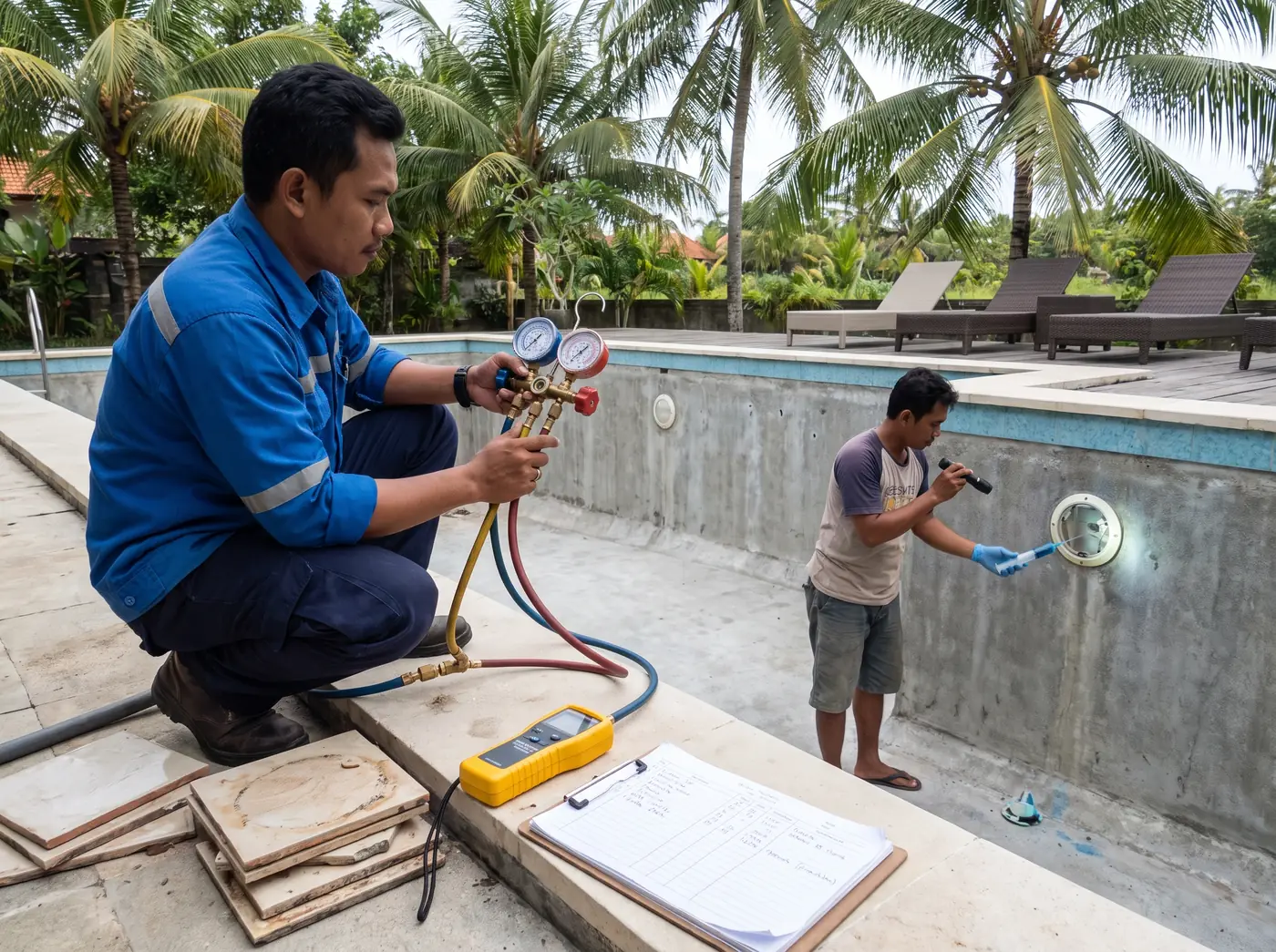
Detection runs in a fixed order, because the cheap tests eliminate the expensive theories. A bucket test separates evaporation from a genuine loss. Isolating the pump and comparing drop rates tells us whether the water is leaving through the shell or through the circulation. Then each line — skimmer, main drain, returns, cleaner — is plugged and pressure-tested individually and held, so a failing pipe announces itself on a gauge instead of in an estimate.
Only then do we go looking with dye and acoustic listening, at the places the earlier tests point to: light niches, floor-return fittings, the tile band at waterline, structural cracks in the shell. You receive a written report with the drop rate in millimetres per day, the pressure result for every line, photographs, and a repair quote covering only what actually failed. If your pool is simply meeting the dry season, the report says that too.
Evaporation or a leak — the number that settles it
An open pool in Bali loses water with nothing wrong at all. Through the dry season, with sun, breeze and 30 °C afternoons, 4–7 mm a day is ordinary — roughly 5,000 litres a month on a 25 m² pool. Add splash-out from a full villa and a wind-exposed Bukit site and the figure climbs further. Plenty of pools get opened up on suspicion when the arithmetic says nothing is wrong.
The bucket test settles it in two days. A bucket of pool water stands on the top step with the level marked inside and out; both surfaces face the same air, so whatever the pool loses beyond the bucket is a leak. Anything above about 10 mm a day over the bucket rate is worth investigating. We begin every job here because it costs almost nothing and it stops us selling you a survey you do not need.
Where Bali pools actually fail
The pattern is consistent across the island. Roughly half of confirmed leaks sit in the plumbing — glued PVC joints stressed during backfill, or pipe runs crushed where a deck was later built over them. Another third are fittings: return eyeballs, main-drain collars, light-niche conduits and skimmer throats cracked when the surrounding deck settled onto soft fill.
Genuine shell failure is the minority, and it is usually differential settlement on a slope site or a construction joint that was never waterstopped. That matters commercially, because the shell crack is the repair owners fear. When we find one we photograph it, explain whether it is structural or cosmetic, and repair by injection and localised re-tiling wherever the structure allows. Full re-tiling is a last resort here, not an opening offer.
SCOPE OF WORK
What's included
Loss measurement
Calibrated bucket test over 24–48 hours to establish whether you are losing water or simply meeting the dry season.
Circulation isolation
Pump-on against pump-off drop rates, which shows within a day whether the fault sits in the shell or in the pipework.
Line pressure testing
Skimmer, main drain, return and cleaner lines plugged and pressurised one at a time, each held and logged on a gauge.
Shell inspection
Dye tracing at fittings, light niches and waterline tiles, with acoustic listening where a buried line is the suspect.
Targeted repair
Fitting replacement, pipe-section renewal, crack repair or re-grouting — priced against the fault, not against the pool.
Retest & report
The repair is retested at pressure and the level re-monitored, then the whole job is written up with photographs.
PROCESS
How the job runs
- 01
Bucket test & brief
We set up the loss measurement and record your pump schedule, top-up habits and any recent works — free callout island-wide.
- 02
Detection survey
Drop-rate comparison, line-by-line pressure testing, dye tracing and listening until the fault has an actual location.
- 03
Report & repair quote
Findings, photographs and gauge results in writing, with a fixed price covering only the components that failed.
- 04
Repair & retest
We carry out the repair, retest the line or shell at pressure, then re-monitor the level before the job is closed.
INDICATIVE PRICING
Honest numbers, before the survey
| Scope | Guide price |
|---|---|
| Full leak detection survey with report | from IDR 3,500,000 |
| Pressure test, single circulation line | from IDR 1,850,000 |
| Typical fitting or pipe-section repair | from IDR 4,500,000 |
Pool size, deck build-up and access set the final figure, quoted after a free first callout and bucket test.
Request an exact quoteFAQ
Pool leaks in Bali — what owners ask
How do I know if my pool is really leaking?
Run a bucket test before calling anyone. Fill a bucket with pool water, stand it on the top step, mark the level inside and outside, and let the pool run normally for 48 hours. If both levels drop by the same amount you are watching evaporation, and 4–7 mm a day is normal here. If the pool drops noticeably faster, book a survey.
Do you have to break tiles to find a leak?
No. Detection is done with gauges, dye and listening equipment, all of it non-destructive. Tiles come off only once we know exactly where the fault is, and then only over the affected area. Cutting first and looking afterwards is how pools end up half re-tiled for the sake of one leaking return fitting.
The leak is under the deck — does the whole terrace come up?
Rarely. Once the failing line is identified by pressure test and located acoustically, we open a small section of deck above that point, or bypass the damaged run with new pipe on a shorter route. On stone or timber decks we lift and relay the same units wherever they can be salvaged, and photograph the sequence so the repair can be checked later.
What does leak detection cost in Bali?
A full detection survey starts at IDR 3,500,000 and covers the loss measurement, line testing, dye work and the written report. A single line pressure test is IDR 1,850,000 where the scope is narrower. Typical fitting repairs run from IDR 4,500,000. If the survey finds no leak you still get the report — and a pool you can stop watching.
RELATED SERVICES
Often booked together
FROM THE BLOG