SEC B / STRUCTURAL WORKS
Masonry and wall construction in Bali
Walls look like the simplest part of a building and generate more remedial work than almost anything else on site: cracks above openings, blockwork out of plumb by fifteen millimetres, chases hacked through a lintel after the fact. We lay AAC, clay brick and batako to the structural drawings, tie the masonry properly into the frame around it, and hand over walls straight enough for whatever finish comes next.
- AAC, clay brick and batako laid to drawings
- Ring beams, stiffening columns and control joints included
- Plumb, level and line checked panel by panel
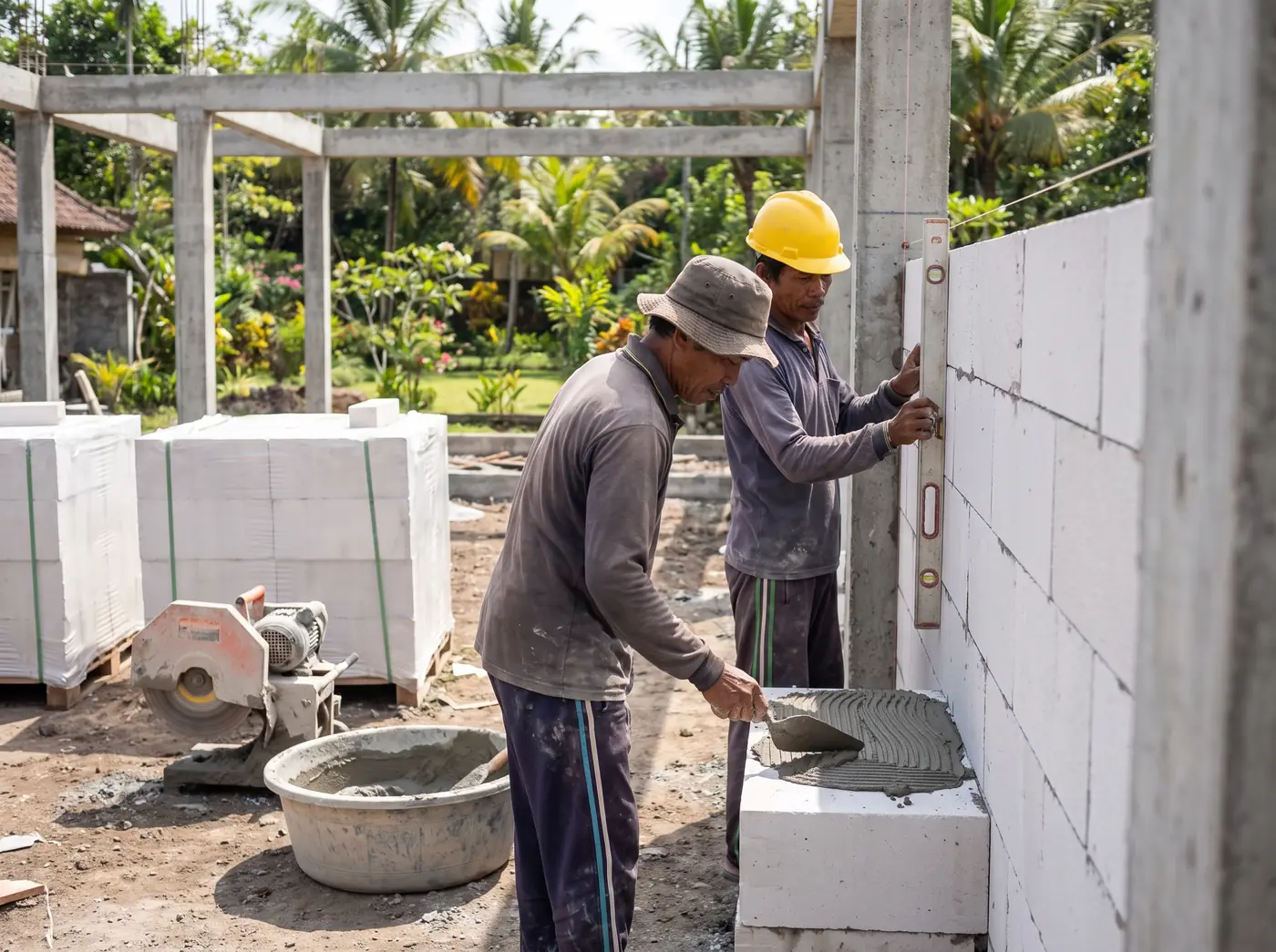
Material choice is a genuine decision here, not a default. AAC — bata ringan — is light, fast, accurate and thermally the kindest of the three, but it wants thin-bed adhesive, dry storage and the correct anchors for anything you intend to hang on it. Clay brick is heavy, slower and excellent: dense, robust, forgiving of drilling, still the right answer for boundary and party walls. Batako costs least per square metre and behaves best in short internal runs. We price all three against your actual layout.
The engineering lives where walls meet everything else. Stiffening columns and ring beams frame long panels so masonry never spans further than it should. Control joints break up runs before thermal movement does it for you. Lintels sit over every opening with proper bearing at both ends. Wall ties connect infill panels to the concrete frame instead of relying on friction. None of it is visible afterwards, and all of it explains why some walls crack in their first wet season and others never do.
AAC, brick and batako — the honest comparison
AAC blocks weigh roughly a quarter of clay brick, which lightens the frame and the foundation beneath it, and their closed-cell structure keeps a west-facing bedroom measurably cooler through the afternoon. They lay quickly in thin-bed adhesive with millimetre joints. The trade-offs are equally real: AAC is thirsty and must be stored dry and protected on site, and it needs the correct anchors — an ordinary plug in AAC will not hold a wall-mounted television, let alone a run of kitchen cabinets.
Clay brick costs more per square metre and lays slower, but it takes a fixing anywhere, resists impact and remains the sensible choice for boundary walls, wet areas and anything weathered on both faces. Batako, the cement block, is the budget option and performs honestly in short internal runs. Mixing materials across one building is normal and sensible — we specify wall by wall, by exposure and by what each one has to carry.
Why masonry cracks here, and how it is prevented
Three causes account for nearly all the cracking we are asked to inspect. Long unrestrained panels: masonry run ten metres without a stiffener or a control joint eventually finds its own joint, usually stepping diagonally away from a window corner. Poor tie-in to the concrete frame: an infill panel that merely touches its column has nowhere to transfer movement and separates along the interface. And openings without proper lintel bearing, where a beam sits on 50 mm of block and cracks the wall beneath the moment the roof load arrives.
Prevention is unglamorous and cheap at the right moment. Stiffening columns at the spacing the code requires, ring beams at head height on long walls, ties into the frame every few courses, lintels with at least 150 mm of bearing, and control joints designed into the elevation rather than sawn in after the crack has arrived. All of it adds a small percentage to the wall cost and removes most reasons to come back.
SCOPE OF WORK
What's included
Setting-out
Wall lines chalked from the structural grid, with door and window positions confirmed against the drawings before the first course.
Masonry laying
AAC in thin-bed adhesive, or brick and batako in mortar, with joints, laps and coursing to specification.
Stiffening columns & ring beams
Reinforced concrete stiffeners cast at the spacings the design requires, tied into both frame and foundation.
Openings & lintels
Lintels sized and bedded with full bearing, plus corner reinforcement where cracking normally starts.
Chases & service routes
Conduit and pipe routes cut in coordination with the electrical and plumbing rough-in, never hacked in afterwards.
Tolerance check & handover
Every panel checked for plumb, level and line, with deviations corrected before another trade arrives.
PROCESS
How the job runs
- 01
Layout & material choice
We mark wall lines from the frame, confirm openings against the drawings, and agree material per wall — AAC, brick or batako.
- 02
Stiffeners & first lifts
Column starters set, then masonry laid in controlled lifts so adhesive and mortar cure before the wall gains height.
- 03
Openings, beams & services
Lintels bedded, ring beams cast, and chases cut alongside the electrical and plumbing rough-in.
- 04
Check & hand over
Plumb, level and line checked panel by panel, with any deviation corrected before finishing trades begin.
INDICATIVE PRICING
Batako, hebel (AAC) or red brick — price per m²
| Scope | Guide price |
|---|---|
| Hebel / AAC (bata ringan) wall, laid | from IDR 285,000 / m² |
| Red clay brick wall, laid | from IDR 315,000 / m² |
| Batako block wall, laid | from IDR 235,000 / m² |
Stiffening columns, ring beams and lintels are itemised by quantity; the full package is fixed after a free site survey.
Request an exact quoteFAQ
Masonry walls in Bali — what owners ask
AAC or clay brick for a house in Bali?
Usually both. AAC for internal partitions and upper-floor walls where weight matters and afternoon heat is the enemy; clay brick for boundary walls, wet areas and elevations that take weather on both faces. Costs land close once adhesive, mortar and the lighter structure AAC allows are counted. We specify wall by wall rather than building by building.
Can you build walls into an existing structure?
Yes. New masonry tied into an existing frame needs starter bars drilled and resin-anchored into sound concrete, a movement allowance at the head where the old structure will keep deflecting, and scanning before drilling so nobody hits a bar or a live conduit. It is routine work, and it is how most internal reconfigurations begin.
How straight will the walls actually be?
We work to plumb within about 5 mm over a storey height and line within 5 mm on a three-metre straightedge, checked panel by panel and corrected before handover. That matters commercially as well as visually: every millimetre of deviation gets paid for later in thicker finishing coats, so an accurate wall is a cheaper wall.
What do masonry walls cost per square metre?
Laid and complete: AAC from IDR 285,000/m², clay brick from IDR 315,000/m², batako from IDR 235,000/m². Stiffening columns, ring beams and lintels are itemised separately, because their quantity depends on panel sizes and opening counts. The whole package is fixed after a free site survey and a look at your layout drawings.
RELATED SERVICES
Often booked together
FROM THE BLOG