SEC B / STRUCTURAL WORKS
Bore pile and piling contractor in Bali
Some ground simply refuses to carry a building near the surface. Soft clay over an old river channel, fill nobody ever compacted, a cliff plot at Bingin where the competent layer sits six metres down — the answer in each case is the same: take the load past the weak material to something that can hold it. That is the whole purpose of a pile, and it is most of what our piling crews install.
- Machine-bored piles Ø30–60 cm and hand-augered strauss
- Tight-access and slope sites, Uluwatu to Ubud
- Concrete volume and depth logged pile by pile
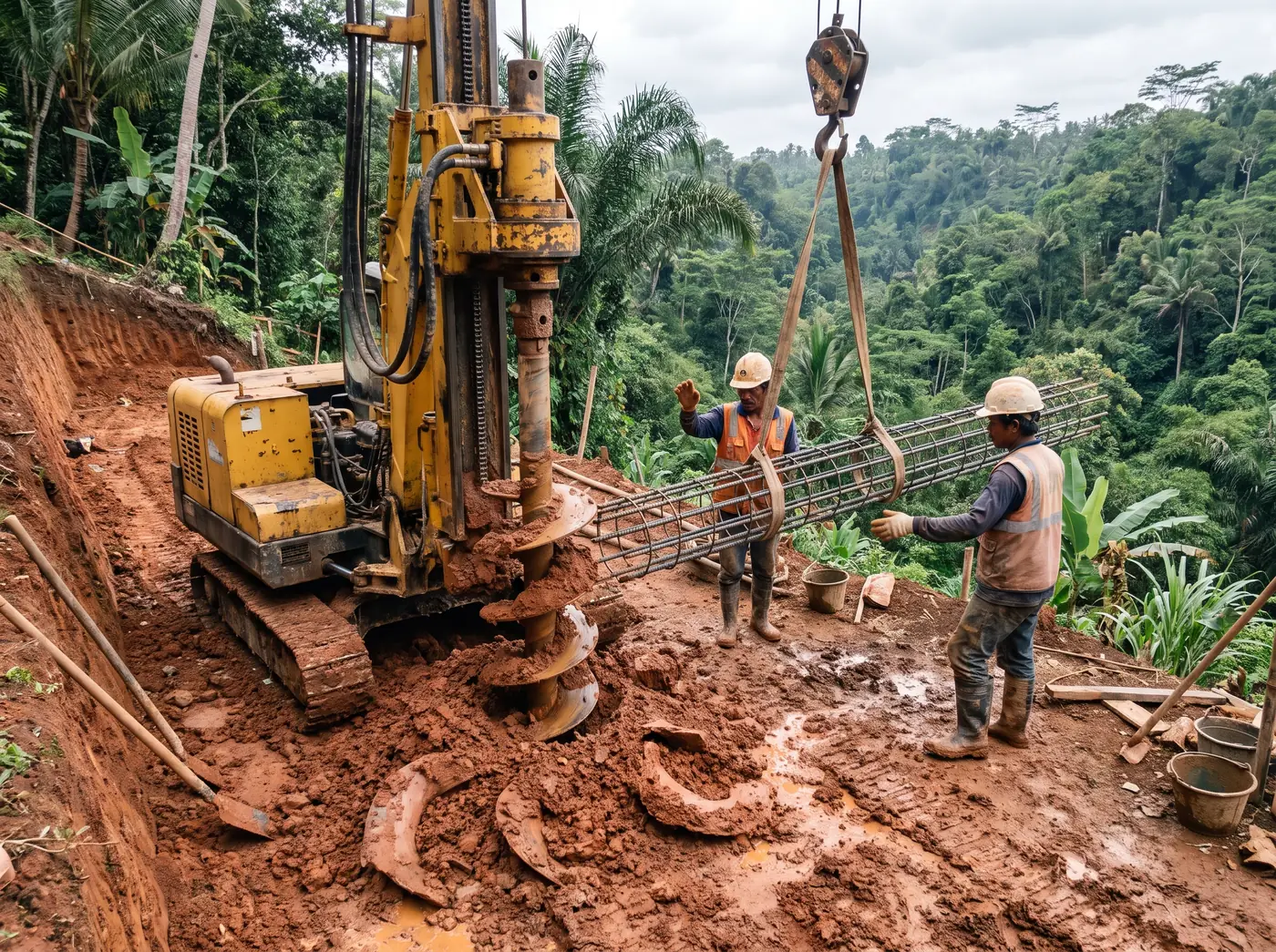
We work with two families of pile. Machine-bored piles, Ø30 to 60 cm, drilled with a mini rig, cased or slurry-supported where the bore wants to collapse, reinforced with a full-length cage and cast in one continuous pour. And strauss piles, hand-augered at around Ø30, needing no crane, no wide gate and no turning circle for a truck — the tool for a plot at the end of a Seminyak gang where a rig would never arrive at all.
Depth comes from the ground investigation, never from a round number. Sondir refusal, SPT counts and layer thicknesses tell the engineer what each pile can carry, and we install until that stratum is reached rather than until the programme says stop. Concrete volume per pile is logged against theoretical volume, because a shortfall or a large overbreak is the earliest signal of a hole that misbehaved — far better found on the day than under a finished column.
When piles beat a bigger footing
Piling is not automatically the expensive route. Once competent ground sits three metres or more below formation, mass concrete stops making sense: you are paying for excavation, shoring, dewatering and cubic metres of concrete whose only job is to reach depth. A ring of Ø40 piles carrying the same column load frequently costs less, takes a fraction of the time and puts far fewer trucks on a narrow lane.
The second argument is slope. On the plots above Bingin, Uluwatu and the Ayung gorge, a spread footing needs a bench cut into the hillside — which means retaining whatever you just cut, then draining it. Piles let the structure step down the slope on its own legs, with a fraction of the earthworks and much less disturbed ground to stabilise afterwards. Where the two approaches genuinely compete we price both, with the earthworks and haulage counted honestly on each side.
Strauss piles, and their honest limits
The strauss pile — a hand-augered bore, typically Ø25 to 30 cm, reinforced and cast in place — exists because much of Bali is unreachable by machine. Gangs a metre and a half wide, courtyards behind a family temple, an extension inside a hotel that is still trading: a crew with a tripod and augers gets there when a rig cannot, works quietly and leaves no track marks across your garden.
They are not a universal substitute, and we would rather say so before you buy one. Hand augering stalls in gravel, coral rock and cemented layers, and practical depths run to roughly eight metres. Capacity per pile is a fraction of a machine-bored Ø40, so the count rises and the pile cap grows with it. Where ground or loads exceed what hand augering can honestly do, we price the machine option instead — including the real cost of getting a mini rig through your gate.
SCOPE OF WORK
What's included
Pile layout & design check
Positions, diameters and depths cross-checked against the structural design and the soil investigation before mobilisation.
Access & mobilisation
Rig, tools and materials brought in by whatever method the lane allows — mini rig, tripod rigs or manual carry on stepped sites.
Drilling
Bored or hand-augered to the specified stratum, with temporary casing or slurry support wherever the bore is unstable.
Reinforcement & concrete
Cages fabricated to length with spacers, then a continuous tremie or free-fall pour at the specified grade.
Pile caps & connections
Heads cropped to level, starter bars set, and pile caps or ground beams tied into the foundation design.
Records & testing
A log for every pile — depth, timing, concrete volume — plus integrity or load testing where the engineer calls for it.
PROCESS
How the job runs
- 01
Ground data & pile schedule
Soil report and structural design reviewed, then a pile schedule agreed: diameter, depth, count and method for the access you have.
- 02
Access plan & mobilisation
Route, gate widths and working platform confirmed, equipment brought in, and buried services located before the first bore.
- 03
Drill, reinforce, pour
Each pile drilled to the specified stratum, cage set with spacers, concrete placed continuously and volumes logged as we go.
- 04
Crop, test & hand over
Heads cropped to level, integrity or load testing where specified, and the complete pile log handed over with your foundation records.
INDICATIVE PRICING
Bore pile & strauss pile price per metre
| Scope | Guide price |
|---|---|
| Strauss pile Ø30, hand-augered | from IDR 475,000 / m |
| Machine-bored pile Ø40 | from IDR 725,000 / m |
| Rig mobilisation to site | from IDR 8,500,000 |
Pile count, depth and access decide the total; the itemised fixed quote follows a free site survey and a read of your soil report.
Request an exact quoteFAQ
Piling in Bali — what owners ask
Do I need piles, or will footings do?
The soil test decides. If sondir shows firm resistance within roughly two metres, footings are usually cheaper. If a weak layer sits over competent ground further down, piles carry the load past it for less than digging to it costs. We read the graph with you and price both routes rather than selling the one we happen to own a rig for.
Can you pile on a site with no vehicle access?
Yes — that is exactly what strauss piling is for. Crews hand-auger with a tripod rig that carries in through a gang or down steps, so plots behind existing buildings stay workable. Depths reach roughly eight metres and capacity per pile is lower, so the pile count rises; the schedule and the quote reflect that from the start.
How deep will the piles go?
To the stratum the engineer nominates, which around Bali commonly lands between six and eighteen metres depending on where you are. The Bukit often meets rock early; paddy-land plots and river corridors go deeper. We install until design depth or the specified resistance is met, and each pile's actual depth is written into the log.
What does piling cost?
Guide rates: strauss piles Ø30 from IDR 475,000 per metre, machine-bored Ø40 from IDR 725,000 per metre, plus mobilisation from IDR 8,500,000 for rig and equipment. The total follows pile count and depth, so it is the soil report and pile schedule that turn these rates into a fixed number after a free site visit.
RELATED SERVICES
Often booked together
FROM THE BLOG