SEC F / SPECIALIST FINISHES
Epoxy flooring contractor in Bali
Epoxy either bonds to a slab or it does not, and in the tropics that is decided before anyone opens a tin. Concrete here can still be pushing water vapour upward months after it looks dry, and vapour trapped under a sealed coating becomes blisters, then flakes, then a floor you pay for twice. So we test the slab, prepare it mechanically and pick the build-up to match what the meter says — garages, kitchens, gyms, workshops and showroom floors across the island. Systems from IDR 185,000/m²: send the floor size and how it is used on WhatsApp, and we book a free slab moisture test.
- Slab moisture tested before we quote a system
- Mechanical preparation — grinding or shot-blasting
- Anti-slip grade chosen room by room
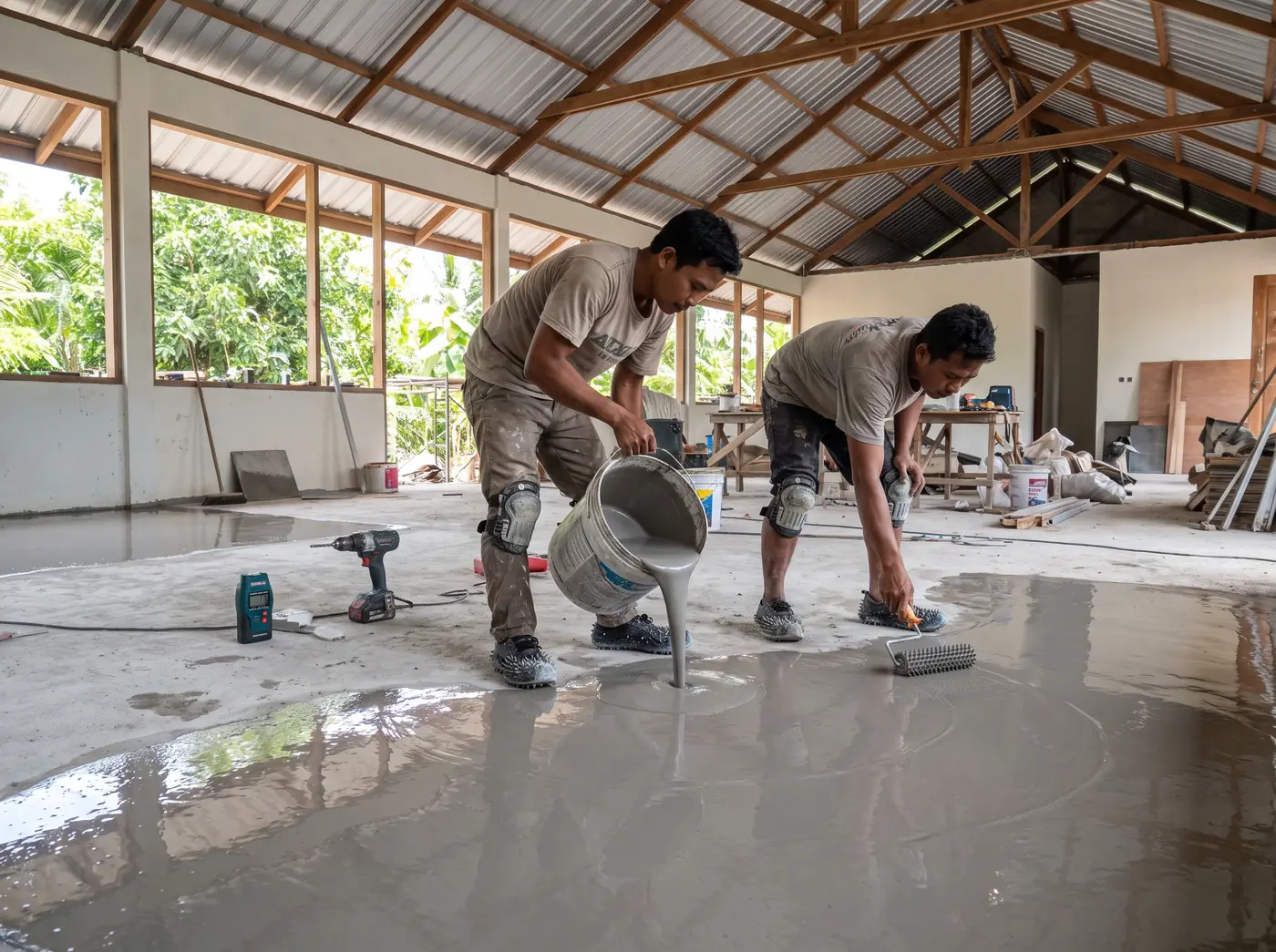
Preparation is the trade. Slabs are diamond-ground or shot-blasted to an open profile rather than acid-etched and hoped for, cracks are routed out and filled with resin mortar, and every edge, gully and upstand is detailed before the first primer goes down. Where moisture readings come back high, we specify a vapour-tolerant primer or a suppressant membrane instead of pretending the number will improve. That single step separates a floor that lasts eight years from one that peels in its second wet season.
Build-ups run from a two-coat roller system for light-duty rooms, through self-levelling resin at 2–3 mm for a flat, joint-free finish, up to trowel-applied industrial systems for forklift traffic and commercial kitchens. Anti-slip grade is chosen deliberately: broadcast aggregate where floors get wet or greasy, a finer grade where cleaning matters more than grip. We will tell you which one your room actually needs, including when the cheaper answer is the right one.
Why epoxy fails on tropical slabs
Nearly every failed epoxy floor we are asked to strip failed for the same reason: moisture. A 150 mm slab poured on Bali ground and covered before it dried holds enough water to push a coating off months later. Ground-bearing slabs without a working vapour barrier keep supplying it indefinitely, drawn up from soil that never really dries out between wet seasons.
The symptoms are always the same — small blisters that pop underfoot, then sheets lifting at edges and around drains. It is not a product fault, and no number of extra coats fixes it. The answer is measurement before specification: relative humidity probes set into the slab, pull-off adhesion tests on the surface, and a decision made on those readings. If the slab is wet, either it dries, or it gets a moisture-tolerant primer or suppressant membrane, or we recommend a different floor entirely and say why.
Choosing a system for the room, not the brochure
A domestic garage, a restaurant kitchen and a warehouse aisle punish a floor in completely different ways, so we specify by duty. Light rooms and storage take a two-coat roller system: cheap, fast, easy to recoat in a few years. Homes, gyms and showrooms usually want self-levelling resin at 2–3 mm, which hides slab imperfections and gives a flat surface that mops clean without grout lines.
Kitchens and production areas need a trowelled build-up at 4–6 mm with quartz broadcast for grip, coved up the wall so there is no dirt trap at floor level and falls kept true toward the gully. Forklift traffic wants the same thickness for impact rather than hygiene. Getting the direction wrong costs money twice: over-specify and you paid for thickness nobody uses, under-specify and the floor is worn through inside a season.
SCOPE OF WORK
What's included
Slab testing
In-slab relative humidity readings plus pull-off adhesion tests, recorded before any system is proposed or priced.
Surface preparation
Diamond grinding or shot-blasting to an open profile, with laitance, old coatings and contamination removed rather than sealed in.
Repairs & detailing
Cracks routed and filled with resin mortar, joints treated, coves and upstands formed where hygiene or drainage demand them.
Primer & moisture control
Epoxy primer matched to the moisture reading, or a suppressant membrane where the slab is still giving up water.
Build-up application
Two-part coating, self-levelling resin at 2–3 mm or a trowelled industrial system, laid in controlled passes.
Finish & handover
Anti-slip grade, gloss level and line marking applied, then a cure schedule you can plan a reopening date around.
PROCESS
How the job runs
- 01
Site visit & slab tests
We measure moisture, check adhesion and inspect falls, drains and existing coatings — free, anywhere on the island.
- 02
System proposal & quote
Build-up, thickness, anti-slip grade and colour set out with an itemised fixed price and a realistic downtime window.
- 03
Preparation & application
Grinding or blasting, repairs, priming and application in controlled passes, with humidity and temperature logged.
- 04
Cure & handover
Foot traffic, loading and full-service times given in writing, along with product data sheets and the warranty.
INDICATIVE PRICING
Epoxy systems and prices
| System · best for | Guide price |
|---|---|
| Two-part epoxy coating · storage, light-duty rooms | from IDR 185,000 / m² |
| Anti-slip coating, quartz broadcast · wet areas, pool plant rooms | from IDR 215,000 / m² |
| Flake / chip system · garages, showrooms | from IDR 245,000 / m² |
| Self-levelling epoxy, 2–3 mm · homes, gyms, showrooms | from IDR 350,000 / m² |
| Food-grade trowelled system, 4–6 mm with coving · kitchens, production | from IDR 650,000 / m² |
| Industrial trowelled build-up · forklift aisles, warehouses | from IDR 650,000 / m² |
Guide prices, 2026 — slab condition and preparation drive the final number, fixed after a free site visit and moisture test. Stripping an old coating or repairing a cracked slab is priced separately.
Request an exact quoteFAQ
Epoxy floors in Bali — what owners ask
Why do you test the slab before quoting?
Because moisture decides whether the floor bonds at all. We take relative humidity readings inside the slab and pull-off adhesion tests on the surface. If those readings are high, a standard primer will fail no matter how carefully the resin goes down, and you would be buying a floor with a countdown on it. Testing takes an hour and changes the specification, not just the price.
How long before we can use the floor?
In Bali conditions: light foot traffic at 24 hours, furniture and racking at 48–72, full chemical and mechanical service at seven days. Humidity stretches those windows — resin cures by reaction rather than evaporation, but damp still air can leave an amine bloom on the surface. We plan applications around your opening date and say what is realistic before starting.
Is epoxy slippery when wet?
A smooth gloss floor is, which is exactly why the anti-slip grade is chosen per room. Kitchens, washdown areas and pool plant rooms get quartz or aluminium-oxide aggregate broadcast into the coat and sealed, giving grip that survives daily cleaning. Showrooms and interiors, where spills are rare and appearance leads, take a finer grade or none at all.
What does epoxy flooring cost in Bali?
Guide prices: a two-part coating system from IDR 185,000/m², self-levelling resin at 2–3 mm from IDR 350,000/m², and a heavy-duty industrial build-up from IDR 650,000/m². Preparation is the variable — a sound new slab needs a light grind, while stripping a failed coating or repairing a cracked floor adds days. The fixed quote follows the free slab test.
How long before I can drive on it?
On a garage floor, allow seven days — the full cure. Foot traffic is fine after 24 hours and furniture after 48–72, but hot tyres on a floor that has not fully cured can leave marks and lift the finish. In humid weeks we add a day or two and tell you before we start, so you can plan where the car sleeps.
RELATED SERVICES
Often booked together
FROM THE BLOG