SEC F / SPECIALIST FINISHES
Timber decking in Bali: installation and restoration
A deck here takes two metres of rain a year, hard UV and salt air, and still has to be comfortable under bare feet. Most of the failures we are called to look at have nothing to do with the species: a frame that sat too close to the ground, boards fixed without a drainage gap, and an oiling routine that quietly stopped after the first year. We build decks that dry between downpours, and we restore the ones that never could.
- Bengkirai, merbau, ulin and composite decks
- Ventilated frames on pedestals, never on soil
- Grey deck restoration: sand, repair, re-oil
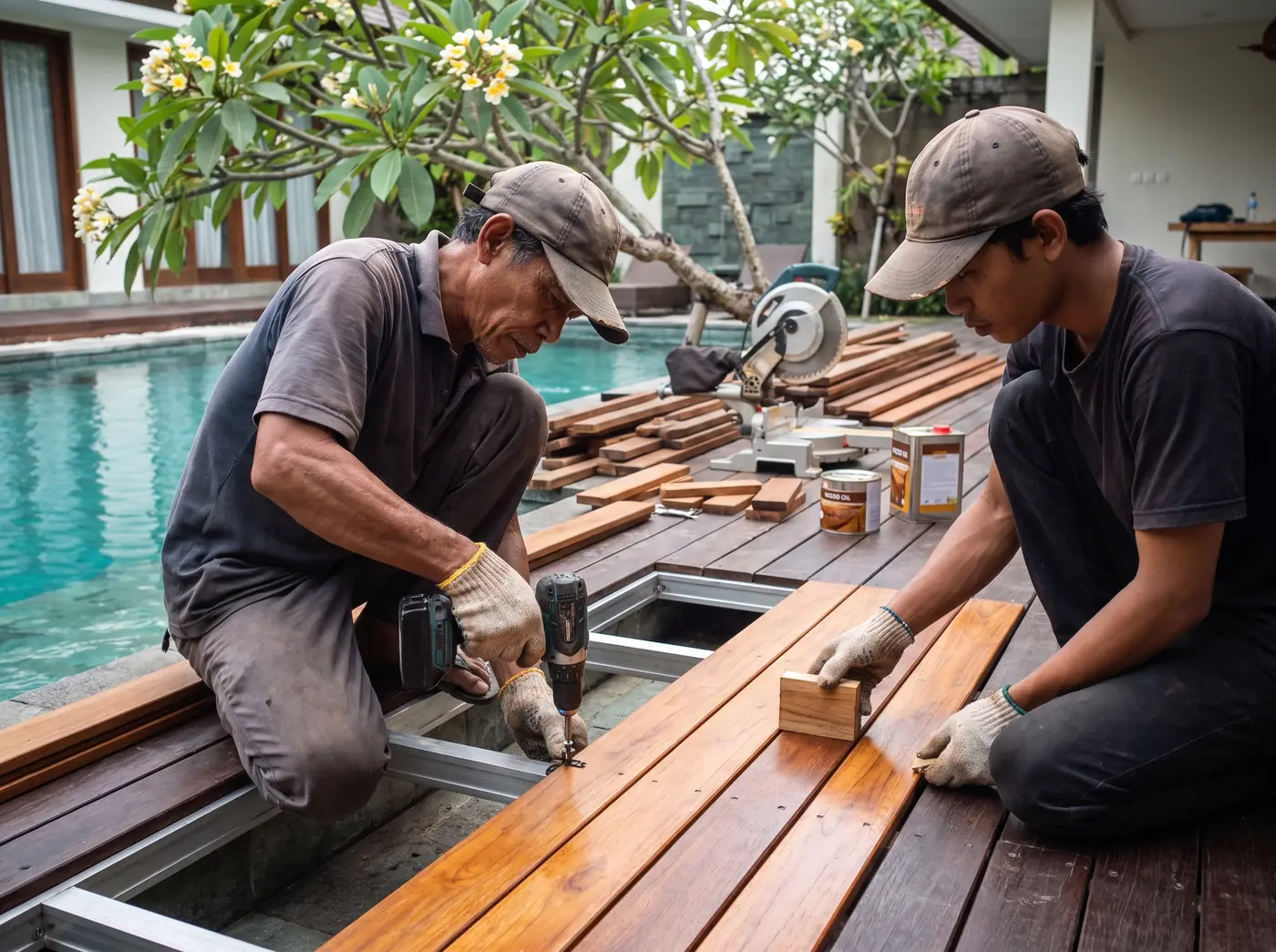
Species choice comes with a real trade-off, and we would rather explain it than sell it. Bengkirai is the value option — dense, locally available, silvers quickly and wants oiling twice a year. Merbau is more stable and darker, but it bleeds tannin onto pale stone for the first few months. Ulin, Bornean ironwood, lasts decades untreated and is priced accordingly, with sourcing that needs checking. Composite removes the oiling entirely and gets hot in afternoon sun.
Underneath, the build-up decides the lifespan. Frames are set clear of the ground on adjustable pedestals or galvanised shoes, never straight onto soil. Every member is treated before it is installed. Boards are spaced for drainage and airflow rather than butted tight for the photograph. Fixings are stainless within reach of salt air, because galvanised screws bleed rust streaks down a deck inside a year — and hidden clips go in where the surface should stay clean.
Why decks fail here, and it is rarely the timber
Lift a failed Bali deck and the story repeats. Joists laid on the ground or on a slab with no gap, so the underside never dries and rots from below while the top still looks presentable. Boards butted tight because it photographed well, trapping water in every joint. Galvanised screws within a kilometre of the sea, weeping rust down each fixing line by the second year.
The species is usually innocent. Bengkirai, merbau and ulin are all durable enough for this climate when they are allowed to dry, and none of them survives being kept permanently damp. So the money goes underneath: pedestals or shoes that lift the frame, cross-ventilation paths that actually connect to open air, drainage falls that send water off the deck rather than into it, and stainless fixings as standard anywhere near the coast.
Bringing a grey deck back
Silvering is cosmetic — UV breaking down lignin in the top fraction of a millimetre. Underneath, the timber is usually sound, which is why restoration so often beats replacement on value. The sequence is: strip any failed coating, refix or replace boards that have split or cupped badly, sand through two or three grits, then saturate with a penetrating oil while the timber is genuinely dry.
Timing matters more than people expect. Oiling damp timber traps moisture and the finish lifts within weeks, so we schedule restoration into dry-season windows or after a run of clear days, with moisture readings taken before the first coat goes on. After that, expect to re-oil every six to twelve months depending on exposure — a pool deck in full sun works far harder than a shaded terrace, and we will tell you which one you have.
SCOPE OF WORK
What's included
Species & spec advice
An honest comparison of bengkirai, merbau, ulin and composite against your exposure, budget and appetite for maintenance.
Frame & ventilation
Treated joists on pedestals or galvanised shoes, held clear of soil with a real airflow path under every board.
Board installation
Hidden clip or top-fixed stainless installation, board gaps set for drainage, expansion allowed at ends and edges.
Pool & wet-area detailing
Falls run away from the building, splash zones protected and coping junctions detailed to stay dry underneath.
Finishing
Sanding and oiling, or left to silver by choice — with a written maintenance interval for the product actually used.
Restoration
Grey and cupped decks stripped and sanded, loose boards refixed or replaced, then oiled back to colour.
PROCESS
How the job runs
- 01
Site visit & options
We measure, check the substrate and exposure and price two or three species options against maintenance reality — free.
- 02
Design & fixed quote
Frame layout, board direction, fixing method and drainage detailed, with an itemised fixed price.
- 03
Build or restore
Frames set and treated and boards laid and fixed; or an existing deck stripped, repaired and sanded ready for oil.
- 04
Finish & schedule
Oil applied on dry timber with moisture checked first, then a written re-coat interval for your exposure.
INDICATIVE PRICING
Honest numbers, before the survey
| Scope | Guide price |
|---|---|
| Bengkirai deck installed with frame | from IDR 1,950,000 / m² |
| Composite decking installed | from IDR 2,350,000 / m² |
| Deck restoration: sand, repair & oil | from IDR 425,000 / m² |
Species, height above ground and substructure set the price — fixed after a free site visit and measure-up.
Request an exact quoteFAQ
Decking in Bali — what owners ask
Which decking timber is best for Bali?
There is no single winner. Bengkirai gives the best price and is widely available, at the cost of oiling twice a year. Merbau is more stable and richer in colour but bleeds tannin early on. Ulin lasts longest untreated and costs the most, with sourcing that needs checking. If you want no maintenance and can accept a hotter surface, composite is a legitimate answer.
How often does a deck need oiling?
Six to twelve months here, driven by sun rather than rain. A pool deck in full afternoon sun may want two coats a year; a shaded terrace can stretch to eighteen months. Oiling is a maintenance job, not a rescue — done on schedule it takes a clean and a couple of hours, while a deck left for three years needs sanding first.
Can our grey, splintery deck be saved?
Usually. Silvering is surface-deep and sanding removes it, and splintering means the fibres have lifted, which the same sanding fixes. What decides it is the frame underneath and whether boards are rotting from below. We sound the boards and inspect the joists at survey — if the frame is sound, restoration costs roughly a fifth of a new deck.
What does decking cost in Bali?
Bengkirai decking installed on a treated, ventilated frame starts at IDR 1,950,000/m². Composite is from IDR 2,350,000/m², with no oiling to budget for afterwards. Restoration of an existing deck — sand, repair and oil — runs from IDR 425,000/m². Height above ground, substructure work and board width move the figures, which the free site visit settles.
RELATED SERVICES
Often booked together
FROM THE BLOG