SEC D / MEP & UTILITIES
Electrical contractor for construction projects in Bali
Wiring a building is not the same trade as fixing a socket. On a construction project the electrical work starts months before anyone sees a switch: load schedules, cable routes, a panel that has to feed every future air-conditioner and pool pump, and conduit cast into concrete nobody will ever open again. We take that whole package on — design, rough-in, panels, testing and the drawings that outlive us.
- Whole-project packages, not call-outs
- Megger, RCD and earth tests at handover
- As-built drawings of every circuit
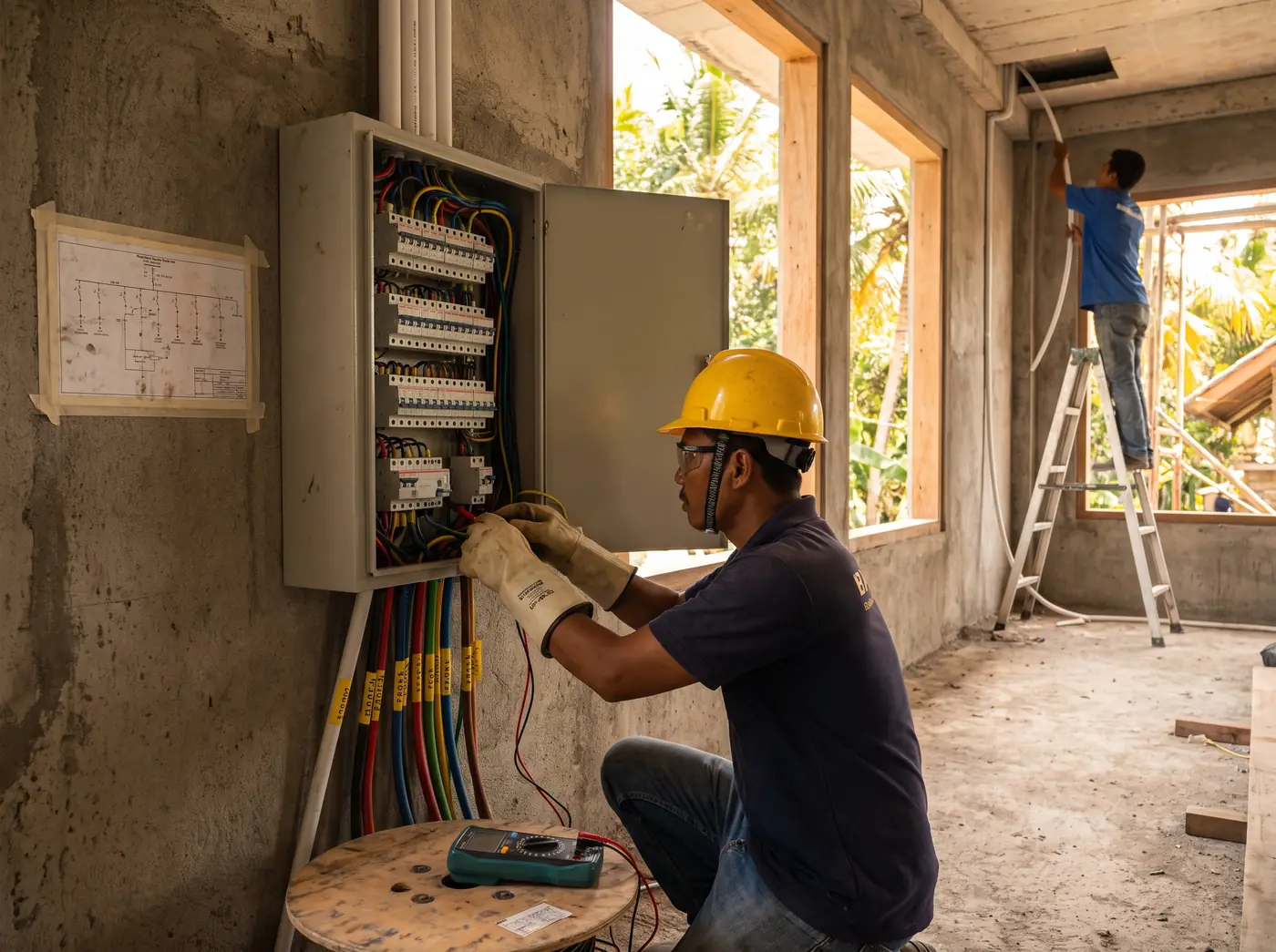
We begin with arithmetic rather than sockets. Every circuit lands on a load schedule — lighting, sockets, air-conditioning, water pump, kitchen equipment, EV charging if it is coming — then gets summed with diversity to size the supply you need from PLN and the cable that feeds it. Runs in a Bali house are long, so conductors are sized for voltage drop rather than for the price list, and the board is drawn with spare ways for the things owners always add later.
Then the permanent part. Conduit and back-boxes are set out before the slab is poured and before walls are plastered, because those are the only two moments when it is cheap. Every circuit gets its own MCB and sits under residual-current protection, since damp buildings and bare feet on wet terrazzo are an unforgiving combination. At handover you receive megger readings, RCD trip times, an earth-resistance figure and an as-built drawing of what is actually buried in your walls.
What tropical buildings do to wiring
Electrical faults here are rarely dramatic. They are slow: humid air pushing moisture into unsealed outdoor boxes, salt within a couple of kilometres of the coast greening terminals until they run hot, ants and geckos nesting in warm panels, and ground that swings from bone dry to saturated, quietly changing what your earth electrode is connected to. Add a supply that sags during evening peaks and a wet season that puts surges onto every overhead line, and the failure modes stop being mysterious.
The answers are specification decisions, not clever gadgets. IP-rated enclosures with glanded entries outside, properly torqued terminations near the coast, sealed gland plates so nothing crawls in, electrodes driven deep enough to stay in moist soil, and surge protection at the board where the energy arrives. None of it costs much at rough-in stage. All of it is expensive once the plaster is on.
Rough-in is the part you cannot redo
There are exactly two windows in a build when electrical work is cheap: before the concrete is poured, and before the walls are plastered. Sleeves and conduit set during those windows cost almost nothing. The same routes cut in afterwards mean core drilling, chased walls, patched finishes and a bill that dwarfs the original work — which is why we push for the furniture and appliance layout early, down to which side of the bed a reading light goes.
Coordination is the other half. Our rough-in is sequenced with the concrete crew and the plumbers so nothing collides inside a wall, and every buried run is photographed against a tape measure before it disappears. Those photos go into the handover file beside the as-builts, so the next person drilling into your wall — for a mirror, a curtain track, an extra socket — knows what is behind it.
SCOPE OF WORK
What's included
Load design & single line
Every circuit scheduled, diversity applied and the supply sized before a metre of cable is bought.
Conduit & rough-in
Sleeves through slabs, conduit in walls and back-boxes set to the furniture layout rather than to habit.
Cabling & containment
Copper sized for voltage drop over real distances, run in tray and conduit that stay accessible.
Distribution panels
Boards built to the schedule, labelled circuit by circuit, RCD-protected and left with spare ways.
PLN supply coordination
Connection capacity, meter position and incoming route agreed with the utility at project scale, three-phase where the load demands it.
Testing & as-builts
Insulation resistance, RCD trip times and earth readings recorded, then handed over with drawings that match the building.
PROCESS
How the job runs
- 01
Load schedule & design
We take your layout and appliance list, build the load schedule and single-line diagram, then quote the package itemised.
- 02
First fix
Sleeves cast into slabs, conduit and boxes installed and photographed before concrete and plaster close them in.
- 03
Second fix & panels
Cables pulled, boards built and labelled, devices and fittings installed once finishes are dry.
- 04
Test, certify & hand over
Insulation, RCD and earth tests run in front of you, results recorded, as-builts and written warranty issued.
INDICATIVE PRICING
Honest numbers, before the survey
| Scope | Guide price |
|---|---|
| Complete installation, per point (conduit, cable, device) | from IDR 450,000 / point |
| Distribution panel, built and installed | from IDR 8,500,000 |
| Load design & documentation package | from IDR 6,500,000 |
Point counts and cable runs come from your drawings; the fixed quote follows a free site survey.
Request an exact quoteFAQ
Project electrical work in Bali — what owners ask
How much PLN supply will the house need?
It comes out of the load schedule, not a rule of thumb. A four-bedroom house with five air-conditioners, a water pump and a pool usually lands between 7,700 and 16,500 VA, and anything much above 11,000 VA is generally better taken as three-phase. We calculate it, apply diversity, then coordinate the connection so you are not upgrading a year later.
Can you take over wiring another crew started?
Often, but we survey first. We open the boards, megger the existing circuits and trace what is genuinely in the walls, then say plainly what can be kept and what has to be re-pulled. Where an installation has no earth continuity or shares neutrals across circuits, patching it is false economy, and we put that in writing rather than in a conversation.
What tests do you run before handover?
Insulation resistance on every circuit with a megger, RCD trip-time and trip-current checks, earth electrode resistance, polarity and continuity, then a functional run of every device. Readings go on a signed test sheet in the handover file with the as-built drawings and panel schedule. If a figure is borderline, we fix it before we write it down.
What does a full electrical installation cost in Bali?
As a guide, complete installation runs from IDR 450,000 per point — a point being one outlet, switch or fixed connection, including conduit, cable and its share of the board. A distribution panel built and installed starts at IDR 8,500,000, and the load design package at IDR 6,500,000. Point counts come off your drawings, so the quote is fixed, not estimated.
RELATED SERVICES
Often booked together
FROM THE BLOG