SEC C / ROOFING & ENVELOPE
Tensile and membrane canopies in Bali
A fabric roof either works as a structure or it works as a sail. The difference is prestress: a membrane pulled into double curvature between masts and cables stays taut through a squall, while the same fabric hung flat ponds after twenty minutes of rain and tears out its corners by the second wet season. We engineer, pattern and install the tensioned kind.
- Form-found and patterned, never draped
- Galvanised steel with footings sized for uplift
- PVDF membranes rated 10–15 years in this climate
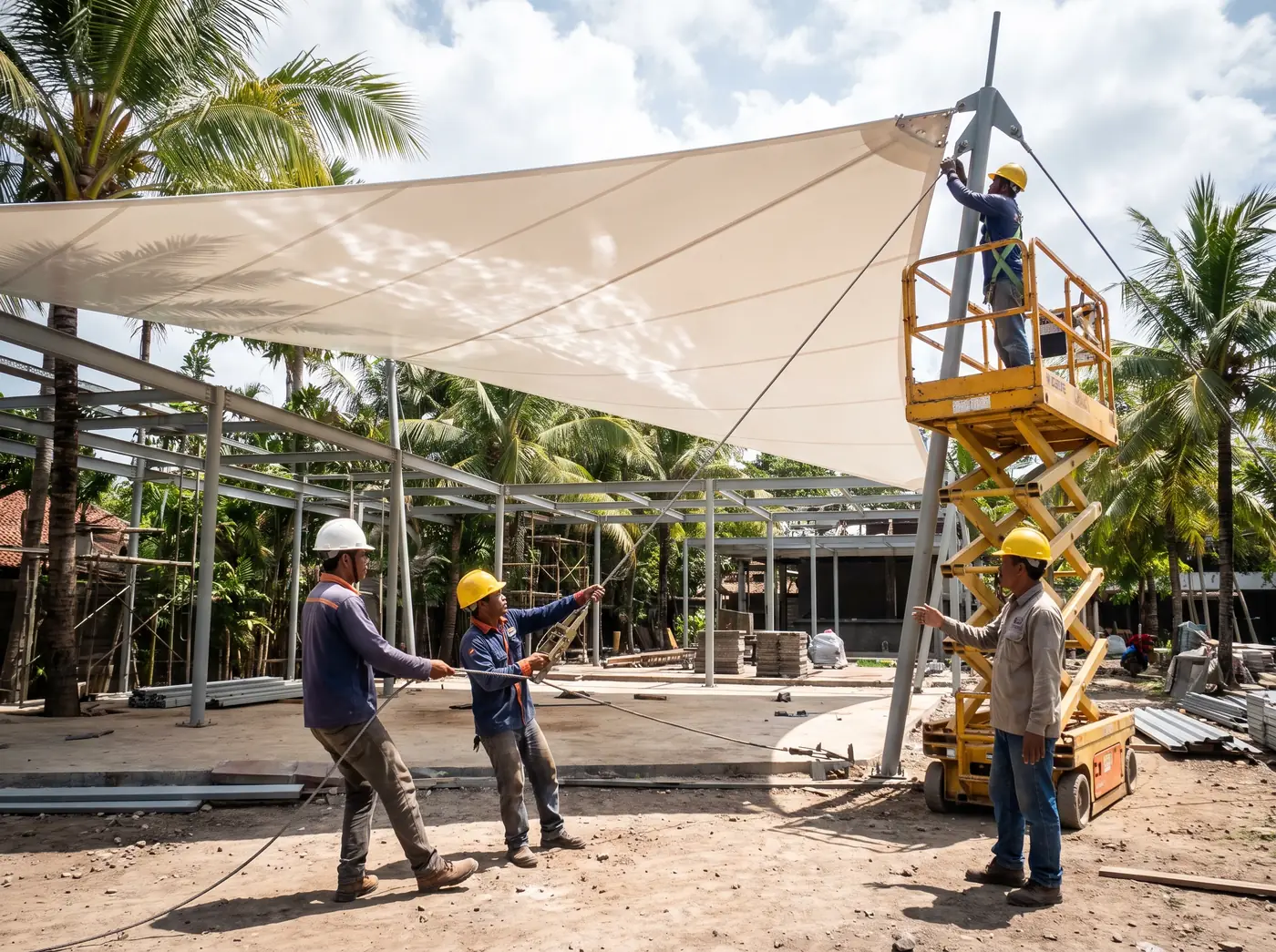
The work covers restaurant terraces, pool decks, entrance canopies, event pavilions and parking — spans from a four-metre umbrella to well over a hundred square metres above a dining room. Masts, arms, plates and cable ends are fabricated in our own workshop and hot-dip galvanised before coating, because on this island it is the connection that corrodes, not the fabric. Footings are sized for uplift, which on a canopy is the load that decides everything.
Fabric choice is where honesty saves money. PVC-coated polyester with a PVDF lacquer at 900–1,100 g/m² is the sensible default here: ten to fifteen years of service, weldable, repairable and cleanable when the algae arrive. Knitted HDPE shade cloth costs a fraction and makes a perfectly good sun screen, but it is not a rain roof, and anyone selling it as one is arranging a puddle over your guests.
Wind, not weight, sizes the structure
A membrane canopy weighs almost nothing, which tempts people into treating the footings as an afterthought. The governing load is uplift: a gust catching the underside of a 60 m² canopy pulls upward at every mast, and the collapses we get asked to repair are nearly always foundations and baseplates rather than fabric. We calculate reactions for the real exposure — an open beachfront at Cemagi is a different problem from a walled courtyard in Ubud — and pour footings that match those numbers.
The other half of the calculation is drainage. Bali delivers 80–100 mm in an hour often enough that any flat spot in a membrane becomes a hundred litres of standing water, which stretches the fabric, deepens the pond and finishes the job. Double curvature plus a defined low point with a real outlet is what prevents it, and both are decided at form-finding, long before a panel is cut.
What a membrane actually costs to own
A PVDF-lacquered PVC membrane in this climate gives ten to fifteen years before the coating surrenders, and it does so gradually: surface chalking first, then staining, then weakening welds. Budget a wash every year or two, a retension around year three, and a replacement skin somewhere in the second decade. That is the whole cost of ownership, and it is far cheaper than the steelwork holding it up.
PTFE-coated glass fibre runs twenty-five years and looks better doing it, but fabrication is specialist and the price roughly doubles; it belongs on hotel-scale landmarks and rarely on a villa terrace. Where the brief is shade rather than shelter, knitted HDPE at a quarter of the cost is the honest answer — as long as nobody pretends it will keep the table dry.
SCOPE OF WORK
What's included
Form-finding & engineering
Shape, prestress and reaction forces calculated for your span, support points and wind exposure.
Steel & foundations
Masts, arms and baseplates fabricated and galvanised; footings sized for uplift rather than dead weight.
Patterning & fabrication
Panels cut with compensation for fabric stretch, HF-welded and edged with catenary cables or keder.
Membrane installation
Rigged and tensioned in stages, with turnbuckles set to the calculated prestress and recorded.
Water management
Falls, valleys and outlets designed for 100 mm/hr bursts so nothing ponds or sheets onto a walkway.
Maintenance & retension
Annual inspection, cleaning and retensioning, plus re-skinning of structures we did not build.
PROCESS
How the job runs
- 01
Brief & site survey
We measure the area, check supports and exposure, and agree what the canopy must do in the rain, not just in the sun.
- 02
Form-finding & fixed quote
Shape and prestress resolved, steel sized, drainage decided, and an itemised quote with fabric options priced.
- 03
Fabricate & build
Steel galvanised in the workshop and fabric patterned and welded while footings cure on site.
- 04
Tension & hand over
Tensioned to the calculated prestress, drainage hose-tested, warranty issued on fabric and steel.
INDICATIVE PRICING
Honest numbers, before the survey
| Scope | Guide price |
|---|---|
| Membrane canopy complete (steel + fabric + footings) | from IDR 2,200,000 / m² covered |
| Free-standing double carport | from IDR 38,500,000 |
| Engineering & patterning package | from IDR 12,000,000 |
| Re-skin of an existing structure | from IDR 980,000 / m² |
| Knitted HDPE shade sail (shade only) | from IDR 650,000 / m² |
Span, mast count and access move these numbers; the fixed quote follows a free site survey and exposure check.
Request an exact quoteFAQ
Membrane canopies in Bali — what clients ask
How long does a membrane last in Bali?
A PVDF-lacquered PVC membrane gives ten to fifteen years here, with UV and algae the limiting factors rather than rain itself. PTFE-coated fibreglass reaches twenty-five but costs roughly double. Unlacquered PVC starts staining in two years and stays stained. We put the fabric weight and lacquer type in the quote so you can see exactly which one you are buying.
Will it hold in a storm?
It holds when the engineering has done its job. We calculate uplift for your exposure, size footings and baseplates to those reactions, and tension the fabric hard enough that it cannot flap, because flapping is what destroys membranes. Where a site is genuinely extreme we say so and design a demountable panel rather than sell you a structure that will not last.
Can you re-skin a canopy someone else built?
Usually. We survey the steel first — mast plumb, weld condition, baseplate corrosion and anchor integrity — because a new membrane over tired steel is money spent twice. If the frame checks out we template it, pattern a new skin to the geometry that actually exists rather than the drawing, and retension the lot, normally in two or three days on site.
What does a membrane canopy cost?
Complete canopies run from IDR 2,200,000/m² of covered area including steel, fabric and footings, and a free-standing double carport starts near IDR 38,500,000. Engineering and patterning packages for architect-led projects are from IDR 12,000,000. Span, mast count and access drive the total — a courtyard reached only through a house costs more to build than an open car park.
RELATED SERVICES
Often booked together
FROM THE BLOG