SEC D / MEP & UTILITIES
Plumbing and drainage for new builds in Bali
Nearly every plumbing complaint in a Bali house traces back to a decision made during first fix: a waste run laid at the wrong fall, a stack that was never vented, a pump chosen for its price rather than its pressure. We install complete water and drainage systems in new builds and extensions — set out on drawings, pressure tested before anything is covered, and documented so the next trade knows where the pipes are.
- Rough-in set out from drawings, not improvised
- Pressure and flood tested before covering
- Pump and tank sized to real demand
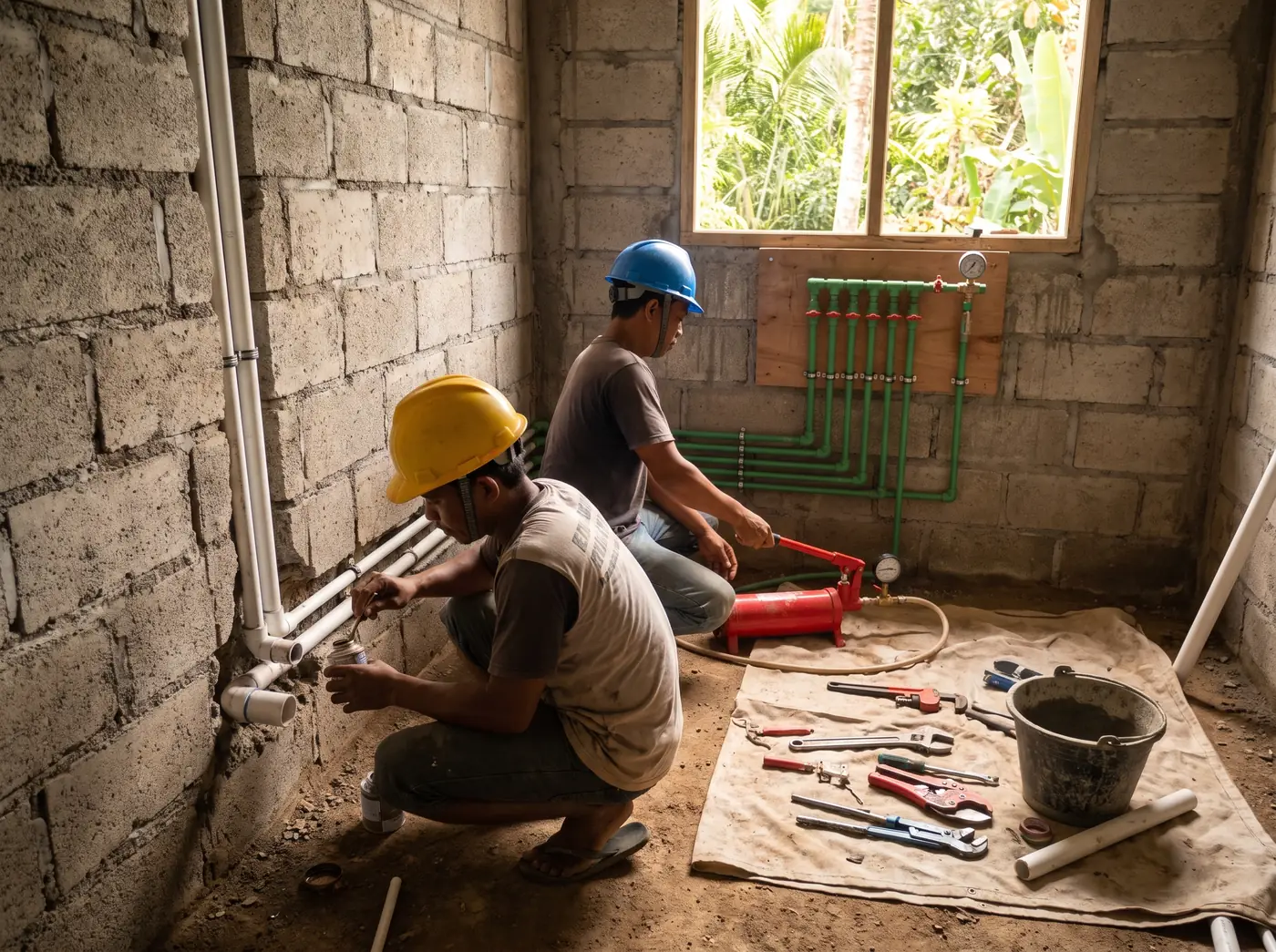
Water side: fusion-welded PPR for hot and cold, sized so two showers and a kitchen tap can run at once without the temperature lurching, with isolation valves at every wet area instead of one master valve that shuts the whole house down over a tap washer. Manifolds where the layout suits them, insulation on hot runs, and every buried joint photographed against a tape before the screed goes down.
Drainage side: thick-wall PVC in the right class, soil pipe falling at around one in sixty, waste at two per cent, sweeping bends instead of tight elbows, and — the item most often missing here — real venting. A stack that cannot breathe siphons water out of the traps below it, which is why so many otherwise decent houses smell faintly of drain by their second wet season. Vents go up through the roof and stay there.
Pressure, storage and the power-cut problem
Two supply realities shape every water system on this island. Mains pressure, where PDAM reaches at all, is unreliable and often arrives at night; and power cuts stop pumps, which stops water. So the standard answer is storage plus pressurisation: a ground tank holding at least a day of use, a pump matched to fixture demand, and a pressure vessel so the pump is not cycling every time somebody washes their hands.
Sizing is arithmetic rather than opinion. A four-bedroom house with a kitchen, staff bathroom and garden taps rarely needs more than a one-horsepower booster, but it does need the right tank — undersized storage is why guests find a dead shower at seven in the morning. Where the supply is a well, the submersible and the booster are two different pumps doing two different jobs, and combining them is the most common false economy we are asked to unpick.
Getting the falls and the vents right
Gravity drainage has almost no tolerance for optimism. Too flat and solids strand; too steep and the water runs away from them with the same result. We set soil pipes at roughly one in sixty and waste at two per cent, then check every run with a level rather than an eye, because a ceiling void hides a sagging pipe until the day it stops hiding it.
Venting is the other half, and it is what quietly gets deleted from budget builds. Every trap needs air behind it, or the next discharge pulls its seal out and leaves the septic tank breathing into your bathroom. We run vent stacks above roof level, use anti-siphon valves only where a stack genuinely cannot reach the roof, and fit cleanouts at every change of direction — because in twenty years somebody will need to rod that line, and they should not have to demolish a wall to do it.
SCOPE OF WORK
What's included
Setting out & coordination
Pipe routes drawn against the structure and the electrical rough-in, so nothing meets unexpectedly inside a wall.
Water rough-in
PPR mains, branches and manifolds welded, clipped and tested; sleeves cast through slabs and beams before the pour.
Drainage & venting
Soil, waste and rainwater in graded PVC with genuine vent stacks, cleanouts and deep-seal floor gullies.
Pump, tank & pressure
Ground tank, submersible or booster pump and pressure vessel sized from fixture units and the height of the run.
Greywater separation
Showers, basins and laundry piped on their own line to a nominated point, ready for treatment or irrigation.
Testing & records
Pressure and flood tests witnessed and certificated, plus as-built pipe drawings and photographs of every buried run.
PROCESS
How the job runs
- 01
Drawings & fixture schedule
We work from the layout and the fixtures you have actually chosen, set out routes and quote by point.
- 02
First fix
Sleeves through slabs, pipework installed, clipped and photographed against a measure before concrete and screed.
- 03
Pressure & flood tests
Water lines held under pressure and drainage flood-tested with you or the site engineer watching; results recorded.
- 04
Second fix & commissioning
Fixtures fitted, pump and tank commissioned, flow and pressure checked at every outlet before handover.
INDICATIVE PRICING
Honest numbers, before the survey
| Scope | Guide price |
|---|---|
| Complete rough-in, per plumbing point | from IDR 950,000 / point |
| Ground tank, booster pump & pressure vessel | from IDR 14,500,000 |
| Pressure and flood testing with certificate | from IDR 2,500,000 |
Point counts and pipe runs come off your drawings; the fixed quote follows a free site survey.
Request an exact quoteFAQ
Plumbing a new build in Bali — what owners ask
What counts as a plumbing point?
One connection: a tap, a shower mixer, a toilet, a floor gully, a washing-machine outlet. The rate covers the pipework, fittings, clips and testing that bring water to it and take waste away — not the fixture itself. Counting points off the drawings is why we can quote a fixed figure instead of an allowance that grows during the build.
Why does our current house smell of drains?
Almost always missing or blocked venting. When a stack cannot draw air, discharge from an upper fixture siphons the water seal out of a trap below, and the drain line then has an open route into the room. Dry gullies in rarely used bathrooms do the same thing. Both are fixable, and both cost nothing to avoid at rough-in stage.
Do you supply the tank and pump as well?
Yes — sized, installed and commissioned. A package with ground tank, booster pump and pressure vessel starts at IDR 14,500,000, and where a well feeds the house the submersible is specified alongside it. We publish the flow and pressure figures we designed to, so a future plumber replacing the pump has something to match rather than guess.
Can you leave the house ready for greywater reuse?
That is standard on our jobs. Shower, basin and laundry waste run on their own line to a nominated point outside, capped and labelled, so a treatment unit or irrigation system can be added later without opening floors. Kitchen and toilet waste stay separate — grease and blackwater belong in the septic system, not on your garden.
RELATED SERVICES
Often booked together
FROM THE BLOG