SEC G / WELLNESS CONSTRUCTION
Commercial ice bath construction in Bali
An ice bath that serves paying customers is a small piece of civil engineering, not a tub with a chiller dropped in. We construct cold plunges in reinforced concrete — waterproofed, tiled, plumbed to real drainage — then match chiller capacity, filtration and sanitation to the number of bodies you expect per day. Gyms, spas and recovery studios across Bali run plunges we built from the slab up.
- Concrete shells built for commercial duty
- Chillers & filtration sized to bather load
- Written warranty on shell and waterproofing
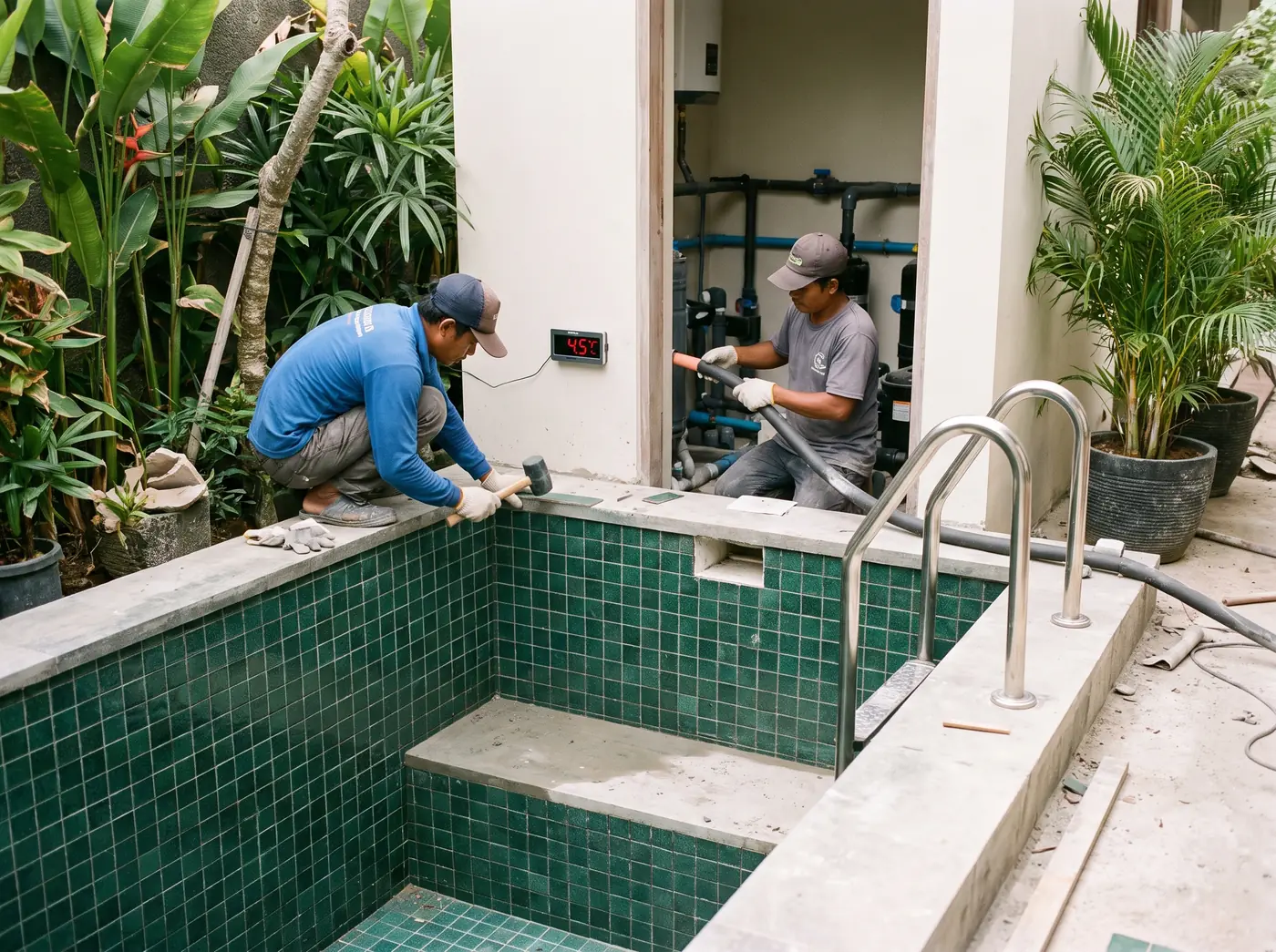
A supplied tub — teak, plastic or stainless — is a fair answer for a private home with one or two users a day. Commercial duty is a different problem. Forty sessions between opening and close means constant heat load, constant contamination and constant splash-out, and household-grade chillers lose their set point by mid-morning. So we build instead: a reinforced concrete shell cast into the structure, tiled falls to a floor drain, and refrigeration sized in kilowatts against your actual booking sheet.
The engineering happens before the tiling. We calculate chiller capacity from water volume, target temperature and bather load — a 1,500-litre plunge holding 5 °C through a Bali afternoon typically needs 3–5 kW of real refrigeration, not the nameplate number. Filtration is specified for turnover every 30–60 minutes, with ozone or UV ahead of the chlorine so the water stays clear at commercial throughput. Finishes are yours to choose: full porcelain tile, natural stone copings, or a glass viewing panel cast into the shell.
Built plunge or bought tub — the honest comparison
A portable tub costs less on day one and arrives in a week; for a private terrace that maths often wins, and we'll say so. A recovery studio runs different numbers. Commercial plunges see 30–60 immersions a day, every one adding sweat, sunscreen and heat that the system has to remove before the next guest steps in. Household tubs and their chillers are simply not specified for that duty, which is why so many businesses quietly replace them within the first year.
A constructed plunge is a fixed asset with a service life measured in decades. The concrete shell doesn't fade, warp or wander around the floor; the plant sits in its own ventilated cupboard where a technician can actually reach it; and the finish matches the rest of your fit-out instead of arriving as someone else's product. When it needs work, any part can be isolated and swapped — nothing is glued inside a moulded shell.
Cold water in a hot climate — the numbers that matter
Bali never helps a plunge. Mains and well water arrive at 26–28 °C, ambient air sits around 30 °C, and every guest deposits roughly 300 watts of body heat into the water for the minutes they're in it. To hold 5–8 °C, the refrigeration has to beat all of that continuously — so we insulate the shell and pipe runs, specify chillers with margin over the calculated load, and duct condenser heat out of the room instead of letting it cook the plant cupboard.
Sanitation is the other half. Cold slows bacteria but doesn't stop it, and a busy plunge takes more organic load per litre than most swimming pools. We design for full water turnover every 30–60 minutes, put ozone or UV ahead of a light chlorine residual, and pipe the system so staff can dump, rinse and refill in under an hour. You get the design calculations in writing — volumes, kilowatts, flow rates — not a brochure.
SCOPE OF WORK
What's included
Structural shell
Reinforced concrete plunge cast into or onto the slab, engineered for water load, with waterstops at every construction joint.
Waterproofing & flood test
Crystalline or membrane waterproofing, then a 48-hour flood test with levels logged before a single tile goes on.
Refrigeration plant
Commercial chiller sized from volume, set point and bather load, with titanium heat exchangers where water chemistry demands them.
Filtration & sanitation
Pump and filter sets giving full turnover every 30–60 minutes, with ozone or UV stages so chlorine does less of the work.
Drainage & fast refill
Full-bore drains, splash-zone falls and fill lines that let staff dump and refill the plunge between sessions.
Finishes & access
Porcelain tile, natural stone or cast-in glass panels, plus steps, grab rails and non-slip surrounds for wet barefoot traffic.
PROCESS
How the job runs
- 01
Site visit & duty brief
We measure the space, check structure, drainage and power capacity, and agree the sessions-per-day figure everything else is sized from — the visit costs nothing.
- 02
Design & fixed quote
Shell drawings, a plant schematic with chiller kW and flow rates, finish options, and an itemised fixed price.
- 03
Build & fit-out
Our crews cast and waterproof the shell, run drainage and plant lines, set the chiller and filtration, then tile and finish.
- 04
Commissioning & handover
48-hour flood test, a logged temperature pull-down run against spec, staff training on the daily routine, and a written warranty.
INDICATIVE PRICING
Honest numbers, before the survey
| Scope | Guide price |
|---|---|
| Single commercial plunge, built complete | from IDR 95,000,000 |
| Twin contrast setup (cold plunge + hot soak) | from IDR 165,000,000 |
| Chiller + filtration plant package | from IDR 55,000,000 |
Guide prices for typical volumes and plant-room adjacency; final fixed quote after a free site survey and duty assessment.
Request an exact quoteFAQ
Commercial ice baths in Bali — what operators ask
Why build a plunge instead of buying a tub?
Duty. A supplied tub suits a home; a studio runs dozens of immersions a day, and both the shell and the chiller need to be specified for that. A concrete plunge is also plumbed to real drainage, sits flush with your floor finishes, and outlives several generations of portable equipment. For low-traffic private use, we'll honestly tell you a tub is the cheaper answer.
What temperature can you hold, and what does it cost to run?
Properly sized plant holds 3–8 °C through a full trading day. Running cost depends on insulation and traffic: a typical 1,500-litre plunge with a 4 kW chiller draws in the region of 40–60 kWh per day in Bali conditions. Insulating the shell and covering the water overnight cuts that noticeably, which is why both are in our standard spec.
How do you keep the water safe with so many users?
Three layers: mechanical filtration turning the full volume over every 30–60 minutes, an ozone or UV stage that does the heavy sterilising, and a light chlorine residual as the safety net. We pipe every plunge for fast dump-and-refill, and hand over a written daily test routine so your staff can prove the water is safe rather than assume it.
How much does a commercial ice bath cost in Bali?
As a guide: a single built plunge from IDR 95,000,000 including shell, waterproofing, tiling and plant; twin hot–cold contrast setups from IDR 165,000,000. The spread comes from size, finish and chiller capacity. Every job gets a free site visit first and a fixed itemised quote after — the guide figures are for budgeting, not negotiation.
RELATED SERVICES
Often booked together
FROM THE BLOG