SEC B / STRUCTURAL WORKS
Foundation contractor in Bali
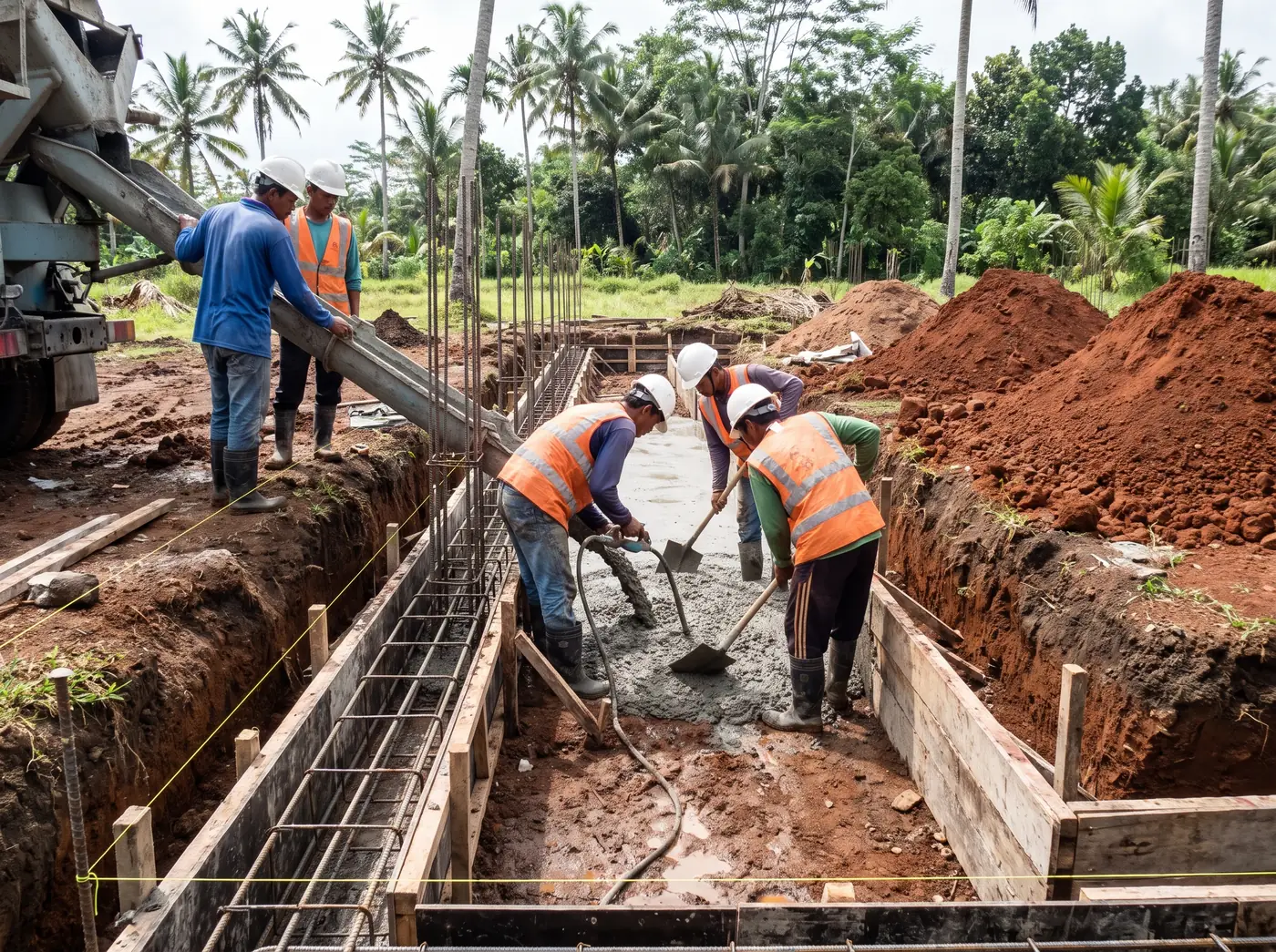
A foundation is the one part of a building you never get to revisit. Once the slab is down, whatever was left out — a compaction pass, a layer of blinding, forty kilos of steel — stays out for the life of the house. We build strip, pad and raft foundations to the ground data rather than to a standard detail, and we test what we pour, because the cheapest place to fix a foundation is before it exists.
- Strip, pad and raft foundations, engineered
- Cube-tested concrete, steel checked before every pour
- Excavation, dewatering and compaction by our own crews
Work begins with the sondir graph, not with a drawing borrowed from the last project. Bearing capacity, the depth of any soft layer and the wet-season water table decide whether your building sits on strips at 1.2 m, on spread pads under each column, or on a raft that floats the whole footprint across weak ground. On paddy clay around Canggu that single decision routinely moves foundation cost by half, in either direction, so we price the options side by side rather than defaulting to the quickest thing to build.
After that it is execution and evidence. Excavation checked against survey benchmarks, ground compacted in layers and proof-rolled, lean concrete blinding so steel never touches soil, bar diameters and spacings counted against the schedule before anyone calls the batching plant. Cubes go to an independent laboratory at 7 and 28 days, and the certificates reach you with the photo record — a foundation you can read on paper afterwards, not simply take on trust.
What Bali ground does under a footing
The ground here rarely behaves like the textbook. Old paddy land around Canggu, Pererenan and Kerobokan holds clays that swell through the rains and shrink back in August, lifting and dropping light footings until the wall above cracks diagonally from a window corner. Volcanic sand inland carries load well but scours wherever water runs across it. River corridors hide soft channels of ash and silt that read as solid until an excavator opens them. And the water table shifts metres between February and September, which alone decides whether a trench stays dry or needs pumping for a fortnight.
Design follows those numbers. Where clay dominates, footings go below the seasonal movement zone or the load spreads onto a raft. Where a weak layer sits over firm ground within reach, piles usually beat mass concrete on both cost and truck movements. Where the table is high, the method changes before the design does: dewatering, blinding and a pour planned into a real dry window rather than an optimistic one.
The pour is a checklist, not an event
Most failed foundations we are called to inspect were not undone by bad concrete. They were undone by a step nobody witnessed: fill tipped in a metre lift and never compacted, reinforcement resting on soil with no cover, a pour started at two in the afternoon with a squall already visible over the ridge. So we run foundations as a chain of hold points. Formation level surveyed and signed off. Compaction verified. Steel counted, cover blocks in place, photographs taken with a scale in frame before the ready-mix is even ordered.
Concrete then gets the dull attention this climate demands: slump checked at the truck, no water added on site, poker vibration to specification, and curing kept wet under hessian or membrane for a minimum of seven days. A slab left to dry out in 32-degree afternoon heat loses strength it never recovers, whatever the delivery ticket claimed. The cube results tell you which one you got.
SCOPE OF WORK
What's included
Setting-out & excavation
Grid pegged from survey benchmarks, then excavation to design level with battered or shored sides as depth demands.
Ground preparation
Soft spots dug out, fill placed and compacted in layers, and the formation proof-rolled before anything is cast.
Blinding & protection
Lean concrete under every mat, plus membrane or crystalline additive where the water table sits close to the underside.
Reinforcement
Bar sizes, laps and cover fixed to the engineer's schedule, then counted and photographed as a formal hold point.
Concrete placement & curing
Ready-mix or supervised site batch at the specified grade, vibrated properly and kept wet through Bali's heat.
Testing & documentation
Cube samples to an independent laboratory, a level survey of the finished formation, and an as-built record.
PROCESS
How the job runs
- 01
Data & design check
We read your soil report and structural drawings, confirm bearing depth on site, and price the foundation that fits the ground.
- 02
Excavate & prepare
Setting-out from benchmarks, excavation, dewatering where needed, then compaction and blinding to a surveyed formation.
- 03
Reinforce & pour
Steel fixed and inspected against the schedule, concrete placed at grade, vibrated and cured, with cubes taken at every pour.
- 04
Test & hand over
Laboratory cube results, a level survey of the finished work, the photo record and a written warranty on structure and workmanship.
INDICATIVE PRICING
Honest numbers, before the survey
| Scope | Guide price |
|---|---|
| Strip foundations, complete | from IDR 5,500,000 / m³ |
| Reinforced raft slab | from IDR 1,450,000 / m² |
| Excavation and earthworks | from IDR 145,000 / m³ |
Depth, groundwater and access set the final figure; a fixed itemised quote follows a free site survey.
Request an exact quoteFAQ
Foundations in Bali — what owners ask
Which foundation type will my plot need?
The sondir graph answers it. Firm ground close to the surface suits strip and pad footings; uniformly modest resistance usually makes a raft the economical choice; a soft layer over firm ground points to piles. We price the realistic options against each other once the soil report exists, so the decision rests on ground and cost rather than habit.
Can foundations be built during the rainy season?
Yes, with adjustments. Trenches open in shorter runs, pumps stay on site, and pours are booked into forecast dry windows instead of started hopefully at midday. Deep excavation in saturated clay is the one job we may ask you to move, because shoring and continuous pumping often cost more than waiting three weeks for the ground to drain.
How do I know the concrete is the grade I paid for?
Cubes. Samples come from the actual pour, cure properly and are crushed at an independent laboratory at 7 and 28 days, and the certificates go to you. Slump is checked at the truck before discharge and nothing is watered down on site. If a result underperforms, we core-test the element and carry the consequences ourselves.
What does a foundation cost in Bali?
As a guide: complete strip foundations from IDR 5,500,000/m³ including excavation, steel and formwork, raft slabs from IDR 1,450,000/m², bulk excavation from IDR 145,000/m³. Depth, access and groundwater move the figure far more than floor area does. Every job is quoted fixed and itemised after a free site survey, which is where those variables get measured rather than assumed.
RELATED SERVICES
Often booked together
FROM THE BLOG