SEC E / WATERPROOFING & PROTECTION
Basement & underground parking waterproofing in Bali
Below ground, water does not drip — it pushes. A metre of saturated soil against a basement wall applies pressure all day, every wet season, and it will find the construction joint, the tie-hole or the shrinkage crack you cannot see. We waterproof structures that live under the water table: basements, underground parking, lift pits and retaining structures, using systems built to resist head pressure rather than shed rain.
- Basements, lift pits and underground car parks
- Crack injection into structures already leaking
- Flood-tested and photographed before handover
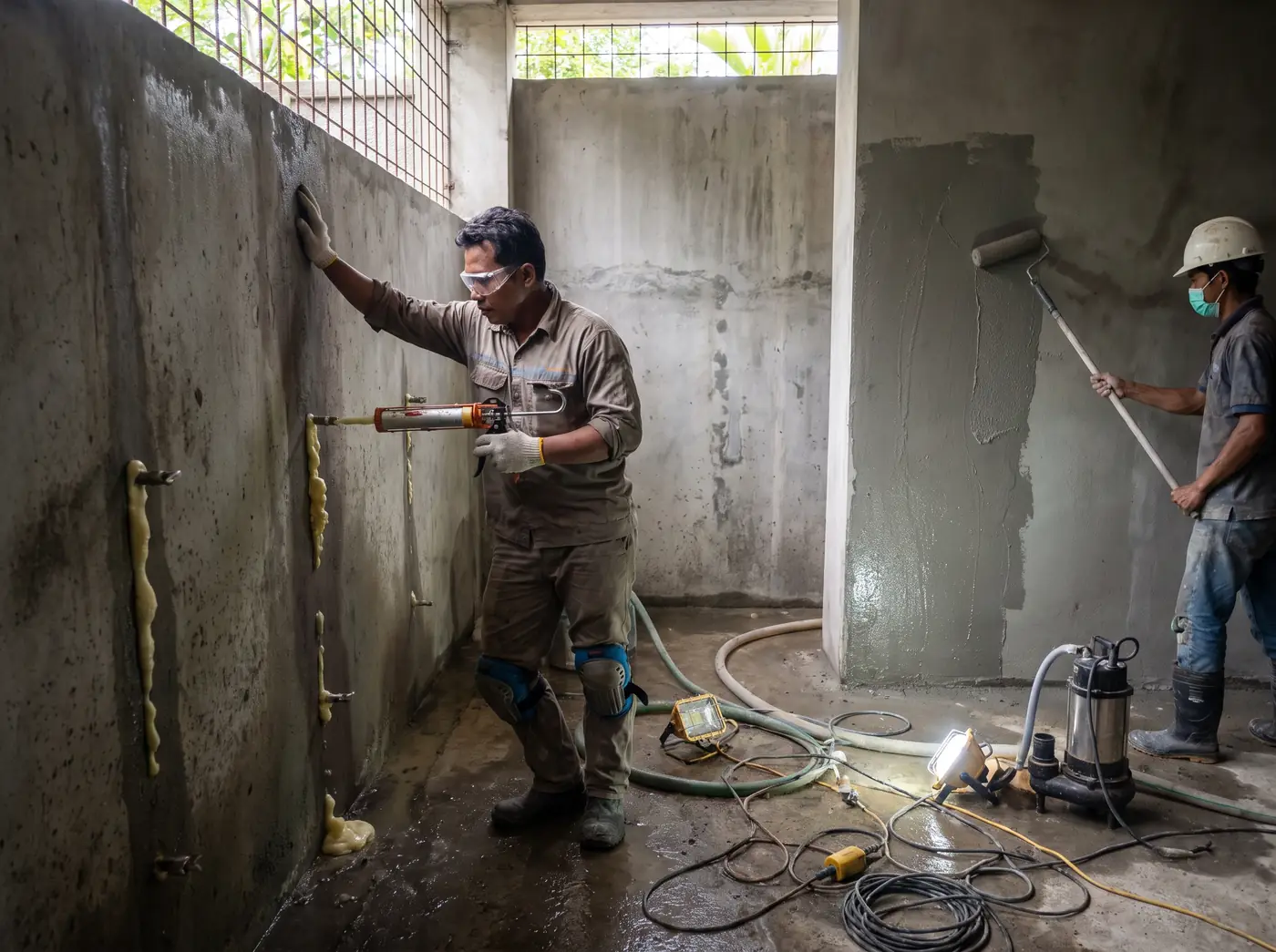
Our scope is the structure itself, and the systems match that. Crystalline slurries and admixtures seal the concrete matrix from within, so the wall stays waterproof even if a coating is later damaged. Swellable and PVC waterstops are cast into every construction joint, because joints leak long before concrete does. Membranes go to the external face while the excavation still allows access. And for structures already built and already wet, resin injection follows the water back to its entry point.
Every job ends with a test rather than an opinion. Lift pits, tanks and plant rooms are flood-tested over 24–48 hours with the level marked, dated and photographed. Basement slabs and walls get a documented dry-out period and a moisture survey before any finish goes near them. You receive product data sheets, batch records, photographs of every joint before it was buried, and a written warranty on the applied system.
Why underground water behaves differently here
Bali's water table moves. Through the wet season it can climb several metres in a fortnight, so a basement that stayed bone dry from June to October starts weeping in January. Add soils that hold water — the paddy clays behind Canggu, the weathered volcanic silts of the central belt — and a wall coated only on the inside is holding back hydrostatic pressure with a paint film.
The second factor is the concrete itself. Pours happen in 30 °C heat at high humidity, often at pace, and the result is plastic shrinkage cracking and the occasional honeycombed patch behind formwork. Neither is a scandal; both are water paths. That is why we treat the concrete as part of the waterproofing rather than as the substrate underneath it — crystalline chemistry inside the matrix, waterstops at every joint, and a survey that finds the honeycombing before backfill hides it for the life of the building.
Fixing a structure that is already leaking
Most of our injection work happens in buildings other people built, usually after two or three attempts with surface products have failed. The sequence is unglamorous. We chase the water back to its real entry point — rarely where the damp patch appears — then drill a staggered pattern of ports either side of the crack, flush the void, and inject polyurethane resin that foams on contact with water and stops the flow against pressure. Once the structure is dry, epoxy can follow to restore the structural knit.
All of it is done from inside, which matters when the alternative is excavating against a retaining wall your building sits on. A typical lift pit takes two days; a 30-metre run of cracked basement wall around a week. We then monitor for a fortnight through the next real rain, because the honest test of an injection is never the day it was done.
SCOPE OF WORK
What's included
Structural survey
We map the water path first — head levels, joint lines, honeycombing and previous repairs — before any product is specified.
Crystalline waterproofing
Slurry or admixture that grows crystals inside the concrete pores, sealing the matrix instead of sitting on top of it.
Waterstops & joints
Swellable strip or PVC waterstop cast into construction joints, with preparation photographed before every pour.
Membrane systems
Sheet or liquid membranes to external faces where excavation allows, protected against backfill damage.
Crack & joint injection
Polyurethane resin to stop live water under pressure, epoxy afterwards to restore structural continuity.
Drainage & testing
Cavity drainage, sumps and pumps where the water table demands them, then a flood or hose test with results in writing.
PROCESS
How the job runs
- 01
Leak survey
We inspect the structure wet where possible, map crack patterns and water levels and photograph everything — free, island-wide.
- 02
Specification & fixed quote
System chosen against head pressure, access and programme, with quantities you can check and a fixed itemised price.
- 03
Application or injection
Our own crew applies the system or injects the cracks, working from inside wherever excavation would put the structure at risk.
- 04
Test & warranty
Flood test, hose test or a monitored wet-season period, then a written warranty and the complete photo record.
INDICATIVE PRICING
Honest numbers, before the survey
| Scope | Guide price |
|---|---|
| Basement membrane & crystalline system | from IDR 425,000 / m² |
| Crack injection, PU or epoxy | from IDR 650,000 / m of crack |
| Lift pit: seal, drain and flood test | from IDR 18,500,000 |
Head pressure, access and concrete condition set the final figure — fixed after a free leak survey.
Request an exact quoteFAQ
Underground waterproofing in Bali — what builders ask
Can you stop a basement leaking without digging outside?
Usually, yes. Injection works against the water rather than away from it: resin is pumped into the crack from inside and cures on contact with moisture, sealing the path at its narrowest point. External excavation is reserved for structures that are failing rather than leaking, or where landscaping makes digging cheaper than working overhead in a car park.
Is crystalline waterproofing better than a membrane?
They solve different problems. Crystalline chemistry lives inside the concrete, survives backfill damage and self-seals hairline cracks, which suits walls nobody will ever reach again. Membranes give a continuous barrier on the wet face and cope better with structures that move. On most basements here we specify both: crystalline in the concrete, membrane on the external face while access still exists.
How do you prove it works before we finish the space?
By testing rather than promising. Lift pits, tanks and plant rooms are filled and monitored for 24–48 hours with the level marked, dated and photographed. Slabs and walls are checked with a moisture meter after the dry-out period. Nothing gets covered until the readings are recorded, and that record is handed over with the warranty.
What does basement waterproofing cost in Bali?
As a guide: membrane and crystalline systems to basement walls and slabs from IDR 425,000/m², crack injection from IDR 650,000 per metre of crack, and a complete lift pit package from IDR 18,500,000. Head pressure, access and whether the structure is new or already wet all move the figure. Every quote is fixed after a free leak survey.
RELATED SERVICES
Often booked together
FROM THE BLOG