SEC B / STRUCTURAL WORKS
Reinforced concrete structures in Bali
Everything above the foundation hangs off the frame: columns carrying the roof, beams holding the openings open, slabs that become your floors. We build reinforced concrete structures for houses, apartment blocks and commercial buildings across the island — formwork, steel and concrete run as one controlled operation, with the test results to show that what came out of the truck matched what was specified.
- Columns, beams and suspended slabs, K250–K350
- Cubes crushed at 7 and 28 days, certificates to you
- Formwork systems that leave a finish worth keeping
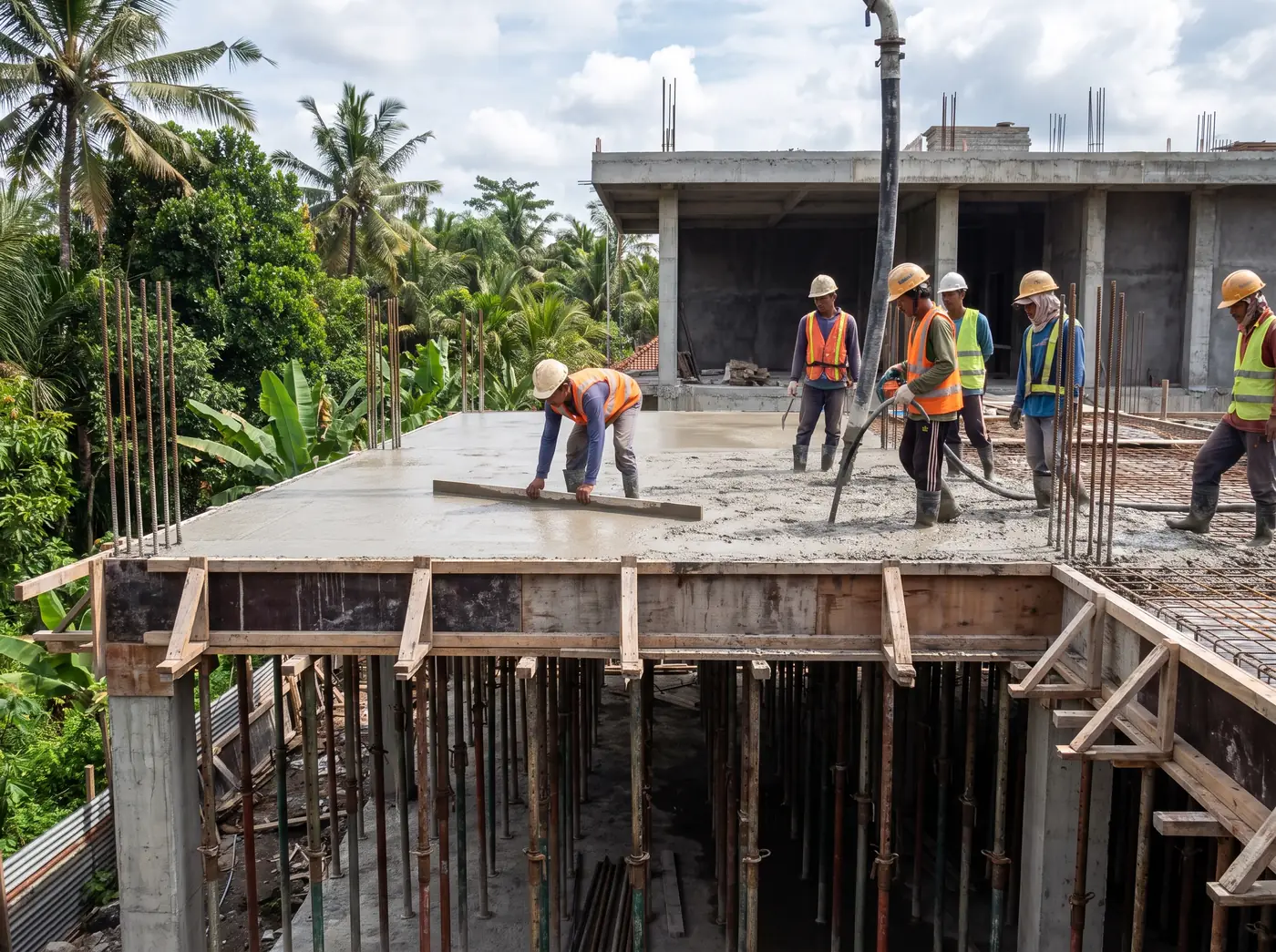
Grade is where the honesty starts. Structural work here is specified in K-grades: K250 for modest residential frames, K300 as the everyday workhorse, K350 and above for long spans, transfer beams and pool decks. Ready-mix from a batching plant brings consistency and paperwork; site-mixed concrete is occasionally the only option up a lane no truck can enter, and then it needs a designed mix, batching by weight and much closer supervision. We use both methods, and we tell you which one your access dictates.
Formwork decides what you look at afterwards. Plywood and steel systems, properly braced and struck to a schedule rather than whenever someone needs the panels elsewhere, produce the flat soffits and sharp arrises that make exposed concrete worth exposing. Where the architecture asks for board-marked or fair-faced work, that is a conversation held over the formwork drawings before the pour, not a decision anyone can retrofit afterwards.
Concrete at 32 degrees and 80 per cent humidity
Tropical conditions attack concrete at both ends of its life. Fresh concrete placed at midday reaches initial set far quicker than any European timeline assumes, which shortens the window for placing, vibrating and finishing a large slab. Plastic shrinkage cracks open across the surface within hours when hot wind meets a wet finish. And water added at the truck to make a stiff mix easier to move — the most common site sin in Indonesia — quietly removes a fifth of the strength you paid for.
The answers are procedural rather than clever. Large pours start early and run continuously with the truck sequence booked in advance. Admixtures buy working time in place of water. Slump is measured, recorded and refused when it is wrong. Curing starts the moment the surface can take it and stays wet for a week, because concrete allowed to dry at three days in this climate never reaches design strength, whatever the mix ticket says.
Reinforcement is where the money hides
Steel is the biggest single cost in a concrete frame and the easiest place to lose value invisibly. Bars one size down, stirrups opened from 100 to 150 mm through a column head, laps shortened by a few diameters, cover blocks omitted so the cage rests against the formwork — none of it shows once concrete is placed, and all of it shortens the life of the building. Near the coast, missing cover is precisely why a ten-year-old beam runs rust stains along its soffit.
So we treat the steel inspection as a formal gate rather than a glance. Bar diameters and spacings checked against the bending schedule, laps measured, cover blocks counted, and the whole cage photographed with a scale in frame before formwork closes or concrete is ordered. Your own engineer is welcome at that inspection, and the photographs go into the handover file whether anybody attends or not.
SCOPE OF WORK
What's included
Formwork & falsework
Plywood and steel systems set to line and level, braced for the pour and struck to a schedule, not to convenience.
Reinforcement
Bar schedules cut and fixed to the drawings — laps, cover blocks and column starters checked as a hold point.
Concrete supply
Ready-mix at the specified K-grade, or batching by weight with a designed mix where trucks cannot reach the pour.
Placement & compaction
Pump or skip placement, poker vibration to specification, and construction joints planned rather than improvised.
Curing in tropical heat
Wet hessian, ponding or curing membrane for at least seven days, because heat steals strength before it steals water.
Testing & records
Slump at the truck, cubes to an independent laboratory, and a pour record per element with dates and results.
PROCESS
How the job runs
- 01
Drawings & method
Bar schedules, formwork layout, pour sequence and construction joints agreed with your engineer before anything is set out.
- 02
Formwork & steel
Forms erected to line and level, reinforcement fixed, then a joint inspection with photographs before concrete is ordered.
- 03
Pour & cure
Concrete placed and vibrated in a continuous sequence, finished to the specified tolerance and kept wet for at least seven days.
- 04
Strike, test & record
Forms struck on schedule, laboratory cube results returned, and each element documented in the handover file.
INDICATIVE PRICING
Honest numbers, before the survey
| Scope | Guide price |
|---|---|
| Reinforced concrete complete (formwork + steel + K300) | from IDR 7,500,000 / m³ |
| Suspended slab, in place | from IDR 1,650,000 / m² |
| Concrete pump, per day | from IDR 7,500,000 |
Spans, grade and access drive the rate; the fixed itemised quote follows a free site survey and a read of the structural drawings.
Request an exact quoteFAQ
Concrete structures in Bali — what owners ask
Ready-mix or site-mixed concrete — which is better?
Ready-mix wins on consistency, batching accuracy and paperwork, and it is our default wherever a truck and pump can reach the work. Site mixing is legitimate when access rules trucks out, but only with a designed mix, batching by weight and a supervisor who counts. Shovel-counted mixing for structural elements is never acceptable, and we will not do it.
Which K-grade does my house need?
Your structural engineer specifies it, and in Bali the answer usually falls between K250 and K300 for typical residential frames, K350 or higher for long spans, transfer beams, pools and anything within reach of salt spray. Higher grade also means denser concrete, which slows chloride and carbonation attack — worth paying for on a coastal building.
How soon can we build on the slab?
Formwork under a suspended slab typically stays two to three weeks depending on span and propping, and the concrete reaches design strength at 28 days. Wall trades can start earlier on backpropped slabs. We publish the striking and loading schedule with the programme, because rushing props is the quickest route to a permanent deflection.
What does a concrete frame cost?
Complete reinforced concrete — formwork, steel and K300 concrete in place — runs from IDR 7,500,000 per cubic metre, suspended slabs from IDR 1,650,000 per square metre, and a concrete pump day from IDR 7,500,000 where the pour needs reach. Steel prices move, so quotes are itemised and valid for a stated period after a free site survey.
RELATED SERVICES
Often booked together
FROM THE BLOG