SEC D / MEP & UTILITIES
Rainwater harvesting in Bali
Two metres of rain falls on Bali every year and most of it leaves down a lane, taking topsoil with it, while the same households pump harder on their wells come September. Harvesting closes part of that loop. A 200 square-metre roof yields somewhere near 300 cubic metres a year here — enough to cover a garden, a laundry and every toilet in the house without touching the aquifer.
- Yield calculated from your actual roof
- First-flush and mosquito-sealing as standard
- Overflow recharges the aquifer, not the lane
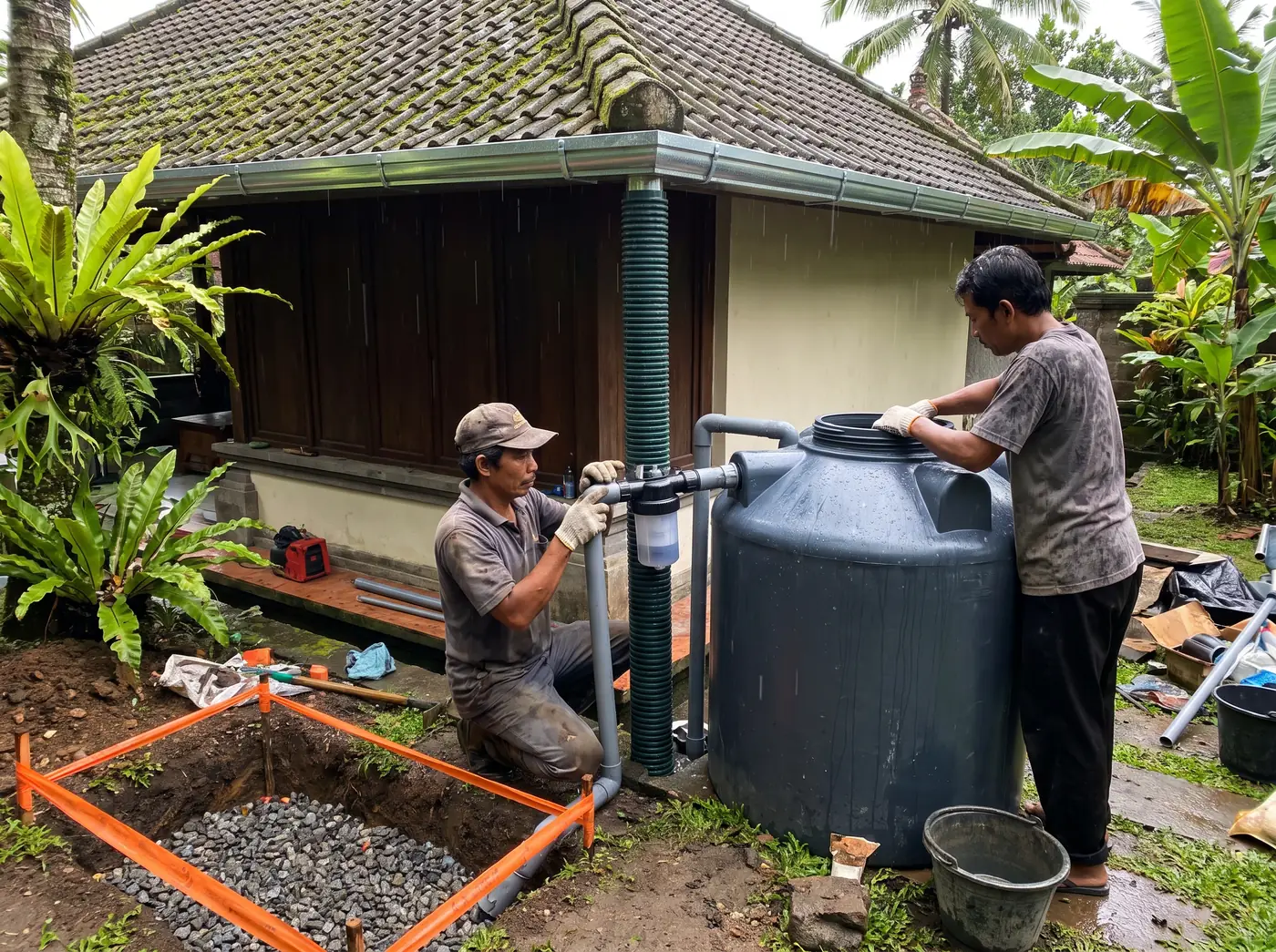
The arithmetic is simple and we do it before quoting: roof plan area multiplied by rainfall, multiplied by a runoff coefficient of about 0.85 for metal or tile. The complication is timing, not volume. Roughly three-quarters of the island's rain arrives between November and March, and August can deliver almost nothing, so tank sizing is really a question of how many dry days you want to bridge.
A working system is four parts: clean collection with leaf screens and a first-flush diverter that dumps the opening millimetre off the roof along with its dust, salt and gecko droppings; storage sized to the gap you are bridging; filtration matched to the use; and an overflow that goes to a recharge pit rather than to the road. Everything is mosquito-sealed as standard, because standing water and dengue are not a theoretical pairing here.
What a Bali roof is actually worth
Run the numbers on an ordinary house. Two hundred square metres of roof plan, about 1,700 millimetres of usable rainfall once evaporation and first-flush losses are taken off, and a runoff coefficient of 0.85 gives roughly 290 cubic metres a year — close to 800 litres a day averaged out. Toilets, laundry and a garden on a modest property rarely need more than that. Where the average stops helping is the calendar: the wet months deliver most of it, and September delivers next to nothing.
Which is why storage sizing is the real design decision. Ten cubic metres bridges roughly a fortnight of dry weather for a household flushing and irrigating on rainwater; going fully off-well through a Bali dry season needs storage most plots cannot fit. We are straight about the split — harvest for what the volume genuinely covers, and keep the well or mains as backup instead of pretending otherwise.
Clean enough for what you want to use it for
Rainwater arrives fairly clean and gets dirty on the way in. Roof dust, salt carried in coastal air, leaf litter, bird and gecko droppings all wash off in the opening minutes of a storm, which is exactly what the first-flush diverter exists for: discard 20 to 40 litres per hundred square metres and what follows is dramatically better water. After that, treatment is a question of use.
Garden and toilet flushing need screening and settlement, nothing more. Laundry and showers want sediment and carbon filtration. Drinking water needs ultrafiltration or reverse osmosis with UV disinfection, plus a laboratory test to prove it — and a tank that is dark, sealed and screened, because sunlight and open inlets grow algae and mosquitoes in that order. We build the storage right first; filtration is far easier to upgrade later than a buried tank. Overflow, first-flush and reuse lines are laid with the rest of the plumbing and drainage rough-in, so they are pressure-tested and documented like any other pipe in the building.
SCOPE OF WORK
What's included
Yield & storage sizing
Roof area, local rainfall and intended use turned into a storage figure with the dry-season gap accounted for.
Collection & first flush
Gutter screens, downpipe filters and first-flush diverters that discard the dirtiest millimetre of every event.
Storage installation
Modular buried tanks or ferro-concrete cisterns, sealed and screened, with calmed inlet and floating draw-off.
Pump & distribution
Pressurised supply to garden taps, laundry and cisterns, with automatic changeover to well or mains when the tank runs low.
Filtration & treatment
Sediment and carbon stages for household use, or ultrafiltration with UV where the water reaches taps people drink from.
Recharge & overflow
Infiltration pits sized to your catchment so the overflow goes back into the ground instead of down the road.
PROCESS
How the job runs
- 01
Roof survey & calculation
We measure the catchment, check gutters and downpipes, and model yield against your intended use before quoting.
- 02
Design & fixed quote
Storage volume, filtration tier, pump and recharge pit specified and itemised at a fixed price.
- 03
Installation
Tanks set, downpipes diverted, first-flush and filtration installed, distribution plumbed and overflow taken to recharge.
- 04
Commission & test
Flow, changeover and filtration checked; where the system feeds drinking water, a laboratory sample completes handover.
INDICATIVE PRICING
Honest numbers, before the survey
| Scope | Guide price |
|---|---|
| Harvesting system 10 m³, garden & flush use | from IDR 24,500,000 |
| Potable-tier filtration & UV add-on | from IDR 9,500,000 |
| Infiltration recharge pit | from IDR 6,500,000 |
Roof area, storage volume and excavation access set the price; fixed quote after a free roof and site survey.
Request an exact quoteFAQ
Rainwater harvesting in Bali — what owners ask
Can we run the whole house on rainwater?
Through the wet season, usually. Across a full year, rarely — the dry season here is long enough that full independence needs storage most plots cannot accommodate. The practical target is covering garden irrigation, laundry and toilets year-round and rather more than that through the rains, with the well or mains switching in automatically.
Is the water safe to drink?
It can be, with the right treatment and a test to prove it. First-flush diversion, a sealed dark tank, sediment and carbon filtration, then ultrafiltration or reverse osmosis with UV. We finish with a laboratory analysis so the answer is a result rather than an opinion. The potable-tier package runs from IDR 9,500,000 on top of the base system.
We have no space for a tank — what then?
Most of our storage goes underground. Modular crate cisterns and buried polyethylene tanks sit beneath a driveway, terrace or lawn with only an access cover showing, and they keep the water cool and dark, which helps quality. Where even that is impossible, a recharge pit alone still earns its keep: it stops your roof flooding the lane and returns water to the aquifer.
What does a rainwater system cost in Bali?
A ten-cubic-metre system for garden and toilet use — collection, first flush, buried storage, pump and controls — starts at IDR 24,500,000 installed. Potable-tier filtration adds from IDR 9,500,000, and a standalone recharge pit runs from IDR 6,500,000. Roof area, tank position and excavation access set the final figure.
RELATED SERVICES
Often booked together
FROM THE BLOG