SEC F / SPECIALIST FINISHES
Semi-dry floor screed contractor in Bali
Semi-dry screed is a method, not a material. Mixed at low water content, pumped through a hose to wherever the floor happens to be, compacted in layers and then levelled off a rotating laser by a crew that does nothing else, it goes down at 300–500 m² a day and takes foot traffic the following morning. That combination is why it has taken over large floors here — houses, hotels, warehouses, anywhere hand-laid mortar would cost a fortnight.
- 300–500 m² placed in a working day
- Laser-levelled to ±3 mm, tile-ready
- Pumped to upper floors — no barrow runs
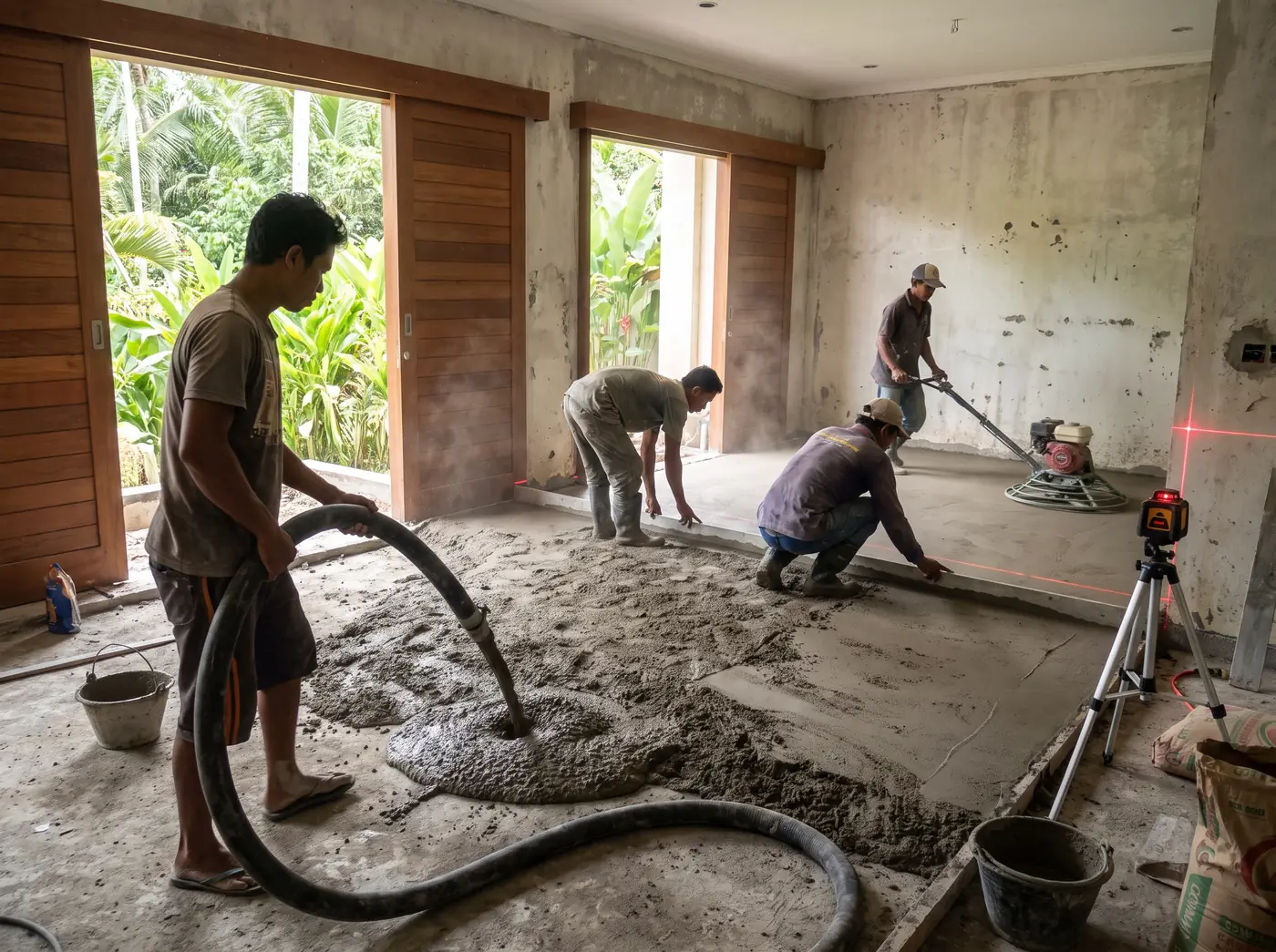
The advantages come from the low water. Less water means less shrinkage, so a semi-dry screed curls and cracks far less than a wet mix, and it dries faster — which in a climate sitting at 80 per cent humidity is worth weeks on a programme. Compaction is what gives it strength: the mix is placed in layers, tamped or power-floated, then levelled to the laser rather than to a string line and somebody's judgement.
We work to tile-ready tolerances of ±3 mm under a 2 m straightedge, with falls formed accurately in wet areas and movement joints set out where bay sizes and column lines call for them rather than where they are convenient. Underfloor pipework, insulation and acoustic layers are built into the make-up when the design includes them. And the pump reaches upper floors without a single barrow going up a ramp, which on a three-storey house removes days of labour and most of the mess.
Semi-dry against a hand-laid wet mix
The traditional Bali floor screed is mixed on the ground, barrowed in, spread between screed rails and rubbed off by hand. It works, and on a 40 m² room it is the sensible answer. On 400 m² it becomes a different job: a gang of eight, a fortnight of labour, cold joints between yesterday's work and today's, and levels that drift because the datum was a string line and an experienced eye.
Above roughly 150 m² the machine method changes the economics. One crew and a pump place the same area in a day. Levels come off a rotating laser, so tolerance holds from the first bay to the last regardless of who is on the trowel. Water content sits near the minimum needed for hydration, so shrinkage is small and edge curling is rare, and the floor dries in a fraction of the time. On tiled floors that means the tiler starts sooner and the tiles stay flat afterwards.
Drying time is the number that runs your programme
Screed strength arrives in days; dryness takes much longer, and it is dryness that decides when tiles, stone, vinyl or resin can go down. The working rule of one day per millimetre for the first 50 mm assumes moderate conditions. Bali at 80 per cent relative humidity with no air movement slows it considerably — a 50 mm screed in a closed-up house can still be wet at week eight, which is how tiles end up lifting six months after handover.
So we plan around it. A semi-dry mix starts with far less free water than a wet screed, which is most of the battle won. Then we ventilate, bring in dehumidifiers on tight programmes, and take moisture readings before the next trade rather than counting days on a calendar. Where an early handover is genuinely needed, we specify a fast-drying binder that accepts tiles inside a week and price it honestly against the time it buys.
SCOPE OF WORK
What's included
Substrate preparation
Slab cleaned, laitance removed, levels surveyed and the build-up decided — bonded, unbonded or floating on insulation.
Datum & bay setting-out
Finished floor levels transferred by laser, bays and movement joints set against columns, doorways and bay dimensions.
Services & layers
Underfloor pipework, acoustic mats, insulation and separating membranes laid and protected before screed arrives.
Mixing & pumping
Site-batched semi-dry mix pumped through hose to the placement point at a steady rate, upper floors included.
Compaction & levelling
Placed in layers, compacted and power-floated, then levelled to the laser and checked with a straightedge as work proceeds.
Curing & protection
Covered and cured on schedule, with drying times stated and a moisture check before tiling or resin follows.
PROCESS
How the job runs
- 01
Measure & method
We check slab levels, the thickness available and the finish going on top, then confirm the build-up — free site visit.
- 02
Programme & fixed quote
Areas, thicknesses, mesh or fibre, day rates and pump mobilisation priced as one itemised figure.
- 03
Place & level
The crew batches, pumps, compacts and laser-levels bay by bay, with levels checked continuously against the datum.
- 04
Cure, test, hand over
Protected curing, moisture readings before the following trade, and a flatness check you are welcome to witness.
INDICATIVE PRICING
Honest numbers, before the survey
| Scope | Guide price |
|---|---|
| Semi-dry screed, 50 mm, laser-levelled | from IDR 115,000 / m² |
| Screed with reinforcing mesh | from IDR 145,000 / m² |
| Day-rate crew with mixer and pump | from IDR 18,500,000 / day |
Area, thickness and access set the rate; the price is fixed after a free site visit and level survey.
Request an exact quoteFAQ
Screeding in Bali — what contractors ask
How is semi-dry screed different from ordinary floor screed?
Same cement and sand, far less water, placed by machine instead of by hand. Low water means low shrinkage and quicker drying; the pump means large areas and upper floors without barrows; the laser means the whole floor holds one tolerance. On small rooms it is not worth mobilising a pump, and we will tell you that rather than quote for it.
How flat will the floor be?
Our standard is ±3 mm under a 2 m straightedge, comfortably tile-ready and suited to large-format tiles that expose every deviation. Tighter tolerances are achievable where vinyl or resin is going down, using a levelling compound over the screed. We check with a straightedge as we work, and you are welcome to witness the check at handover.
When can we tile on it?
Foot traffic the next morning, light loading in three to four days. Tiling depends on drying rather than strength — allow roughly a day per millimetre for the first 50 mm in reasonable conditions, longer in a closed building through the wet season. We take moisture readings before the tiler starts, and can specify a fast-drying binder where the programme is tight.
What does semi-dry screed cost in Bali?
From IDR 115,000/m² at 50 mm thickness, from IDR 145,000/m² with reinforcing mesh, and a day-rate crew with mixer and pump from IDR 18,500,000 for contractors who want plant and labour only. Thickness, access and total area move the rate — larger floors come out cheaper per square metre because mobilisation is spread. Quotes are fixed after a free site visit.
RELATED SERVICES
Often booked together
FROM THE BLOG