SEC D / MEP & UTILITIES
Wastewater treatment plants for villas, hotels and complexes in Bali
We design, install and commission wastewater treatment plants (STP / WWTP) for Bali villas, hotels, guesthouses and villa complexes — sized from guests, staff and kitchen load, built with aeration and disinfection stages, and handed over with commissioning records and a written service log. Treatment plants from IDR 65,000,000. Send your room or unit count on WhatsApp and we reply with a first sizing.
- Sized by occupancy, not bedroom count
- Commissioned, flow-tested and logged
- Quarterly service with written logs
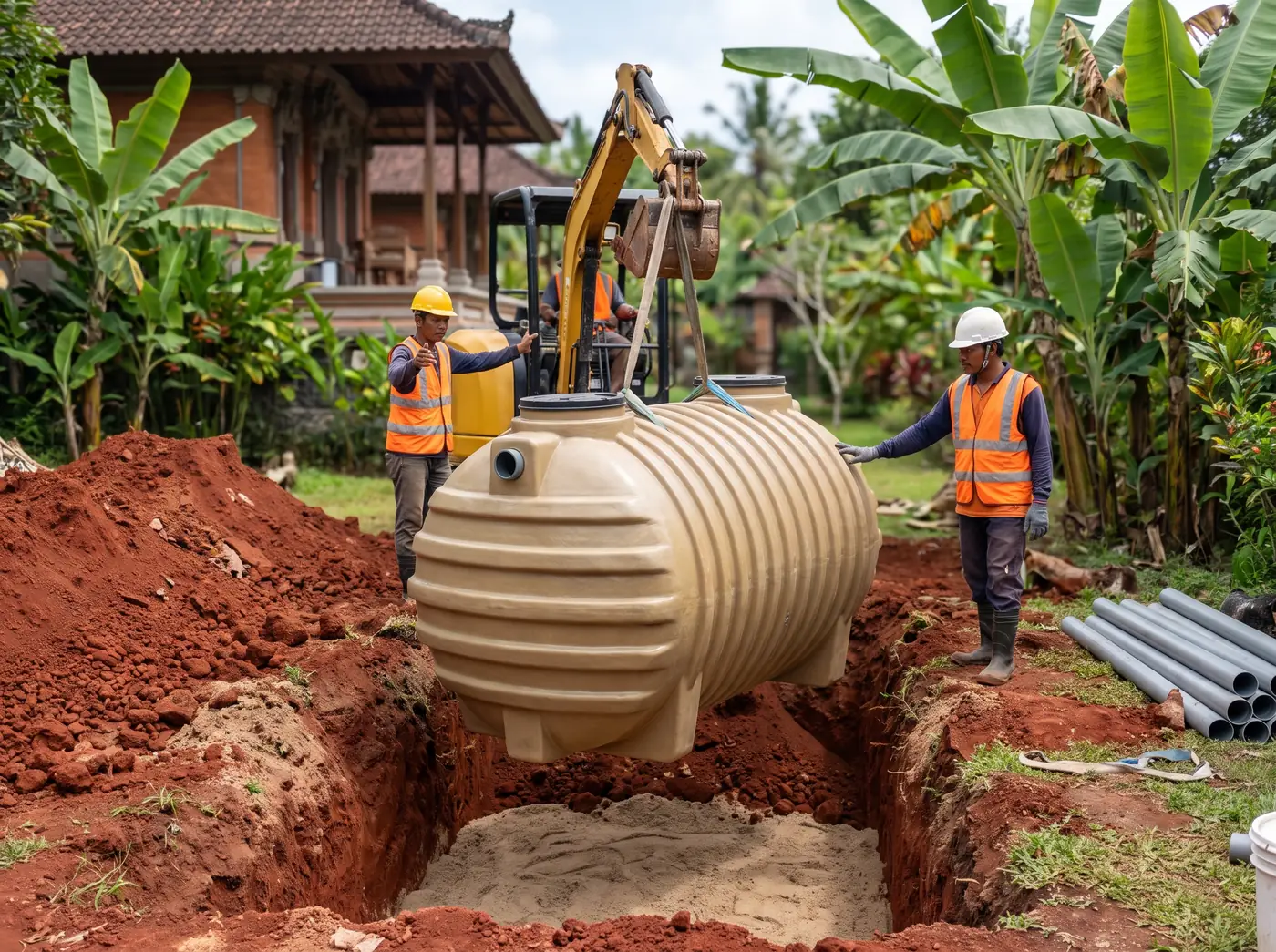
Sizing starts with people, not bedrooms. We work from roughly 150 to 200 litres per person per day, add staff and the kitchen, count the guests a property actually sleeps rather than the number on the listing, then allow retention time for the treatment stage to do its work. A hotel restaurant, a spa or a laundry changes the load far more than one extra room — so we ask for occupancy data and water bills before we draw anything.
What happens after treatment matters as much as the plant. In the clay around Canggu and Kerobokan a soak pit that works in August is a pond by January, so effluent needs a drainage field or reuse-grade water for irrigation. On the limestone of the Bukit the opposite is true: everything disappears instantly, straight towards the water table — which is why we never discharge untreated effluent into bottomless pits there.
STP sizing by guests, units and staff
These are the indicative loads we start from. The final figure comes from your occupancy pattern, but the order of magnitude tells you early whether you need a packaged unit or a plant with its own equalisation and sludge handling.
| Property | People at peak | Daily flow |
|---|---|---|
| Rental villa, 4–5 bedrooms | up to 10 guests + 2–3 staff | ≈ 2–2.5 m³ / day |
| Complex of 8 townhouses | ≈ 30 residents + staff | ≈ 5–6 m³ / day |
| 20-room hotel with restaurant | ≈ 45 guests + 20 staff + kitchen | ≈ 10–12 m³ / day |
Indicative flows at 150–200 L per guest per day. Kitchens get a grease trap ahead of the plant; properties with uneven occupancy get an equalisation tank so weekend peaks do not wash the biology out.
The plant is only as good as what reaches it, so we size it together with the plumbing and drainage rough-in — vented lines, inspection chambers and falls that carry flow without blockages. On villa complexes one shared plant usually beats a tank per unit: one service contract, one effluent route and one log, which is how we plan the shared works in our villa complex construction projects.
What DLH checks — and the documents we hand over
Hotels, guesthouses and larger villa complexes operate under an environmental approval — SPPL, UKL-UPL or AMDAL depending on scale — and the environmental agency (Dinas Lingkungan Hidup, DLH) expects treated effluent to meet the national domestic wastewater standard, Permen LHK 68/2016: for example BOD 30 mg/L, COD 100 mg/L and TSS 30 mg/L. The approval itself is filed by the owner or an environmental consultant. Our part is the technical file and a plant that meets the numbers in daily use, not only on the day of inspection:
- Sizing calculation and process flow diagram
- As-built drawings of the plant and effluent route
- Commissioning record: seeding, flow and blower checks
- Effluent sample arranged for an accredited laboratory
- Operation & maintenance manual for your staff
- Service log, filled in at every visit
Maintenance: service visits and written logs
A treatment plant is a living process. Blowers keep the aerobic stage alive, diffusers clog, sludge builds up, and disinfection needs dosing. On a quarterly contract we check all of it, record effluent clarity and sludge depth, and write the findings into the plant's log — the document a hotel manager hands to an inspector and the first thing we read when something smells wrong. Service runs from IDR 1,850,000 per quarter, desludging quoted separately.
Three failures account for most of the emergency calls. Flotation: an empty plastic tank in a high water table lifts like a boat and cracks its inlet, so ours sit on an anti-flotation slab with straps, backfilled in stages with the tank part-filled. Overloading: a system sized for a family and then run as a six-bedroom rental, which turns a two-year desludging cycle into six months. And proximity: a plant or tank upgradient of a well, or within about ten metres of one, will contaminate it — so we site them downgradient wherever the plot allows, and specify treatment rather than distance where it does not.
Just a household septic tank? For a single family home a sealed bio septic unit is usually enough: a 3 m³ unit, installed and commissioned from IDR 21,500,000, serves a household of five to eight. We install them as part of our own builds; the sizing logic is the same, only smaller. Why water and wastewater come first on a small island is covered in our note on sustainable construction in Bali.
SCOPE OF WORK
What's included
Occupancy & flow calculation
Daily flow worked out from guests, residents, staff and kitchen load, then matched to retention time and peak days.
Percolation & water-table check
A soak test and the wet-season water level decide whether a drainage field is honest or fictional.
Plant supply & installation
Packaged or cast treatment tanks bedded, anchored against flotation and connected, with blowers housed and accessible.
Grease trap & equalisation
Kitchen fat stopped before it reaches the biology; equalisation for properties whose occupancy swings week to week.
Disinfection & effluent reuse
Disinfection stage, then drainage fields, infiltration trenches or subsurface irrigation routed well clear of wells and neighbours.
Commissioning & service
Seeding, flow and blower checks, O&M manual, then a service contract with every visit recorded in writing.
PROCESS
How the job runs
- 01
Load & site assessment
Occupancy data, kitchen and laundry load, plot, water table and distance to wells assessed, with a percolation test where a field is planned.
- 02
Sizing & fixed quote
Plant type, capacity, effluent route and service interval written down and priced itemised — with the calculation you can hand to your consultant.
- 03
Install & connect
Excavation, base slab, tanks set and anchored, blowers and controls installed, inflow and effluent lines connected and tested.
- 04
Commission & log
Plant seeded and flow-tested, staff shown the daily checks, and the commissioning record and service log handed over.
INDICATIVE PRICING
STP prices, before the survey
| Scope | Guide price |
|---|---|
| Treatment plant (STP) with effluent reuse | from IDR 65,000,000 |
| Service contract, inspection & report | from IDR 1,850,000 / quarter |
| Household bio septic unit 3 m³, installed & commissioned | from IDR 21,500,000 |
Flow, ground conditions and access set the figure; the fixed quote follows a free site survey and percolation check.
Request an exact STP quoteFAQ
Wastewater treatment in Bali — what operators ask
How big a treatment plant does a hotel or complex need?
Work from people at peak, not rooms. At 150–200 litres per guest per day plus staff and the kitchen, a 20-room hotel with a restaurant typically lands around 10–12 m³ a day, a complex of eight townhouses around 5–6 m³, and a large rental villa around 2–2.5 m³. We confirm the figure from your occupancy data and water bills before specifying the plant.
Do we need DLH approval for our wastewater?
Hotels, guesthouses and larger complexes operate under an environmental approval — SPPL, UKL-UPL or AMDAL depending on scale — and DLH expects treated effluent to meet the domestic wastewater standard (Permen LHK 68/2016). The approval is filed by the owner or an environmental consultant; we supply the technical part of the file and a plant built to meet the numbers.
How often does an STP need servicing?
A quarterly service visit covers blowers, diffusers, sludge levels, disinfection dosing and effluent clarity, with the findings written into the log. Desludging typically falls every one to three years depending on load; an overloaded plant tells you early through short intervals and cloudy effluent.
Can treated water be reused in the garden?
From a properly running STP, yes — and it is the sensible destination for it on an island that irrigates right through the dry season. We route it to subsurface drip or a planted trench rather than sprinklers, keep it away from anything edible at leaf level, and specify disinfection ahead of reuse.
What does an STP cost in Bali?
A treatment plant with aeration and reuse-grade effluent starts around IDR 65,000,000 depending on flow. Service contracts run from IDR 1,850,000 per quarter, with desludging quoted separately. For a single household, a 3 m³ bio septic unit installed and commissioned starts at IDR 21,500,000. All fixed after a free site check.
RELATED SERVICES
Often booked together
FROM THE BLOG