SEC C / ROOFING & ENVELOPE
Louvered pergolas in Bali
The trouble with a fixed roof over a Bali terrace is that you actually want two roofs: one that lets the afternoon breeze and the low sun through, and one that shuts tight when the sky opens at four o'clock. An adjustable louvered roof is the only structure that does both — provided the blades seal properly and the water it collects has somewhere sensible to go.
- Rain-closed mode with blades that genuinely seal
- Gutters in the beams, downpipes inside the posts
- Marine-spec coating and A4 stainless fixings
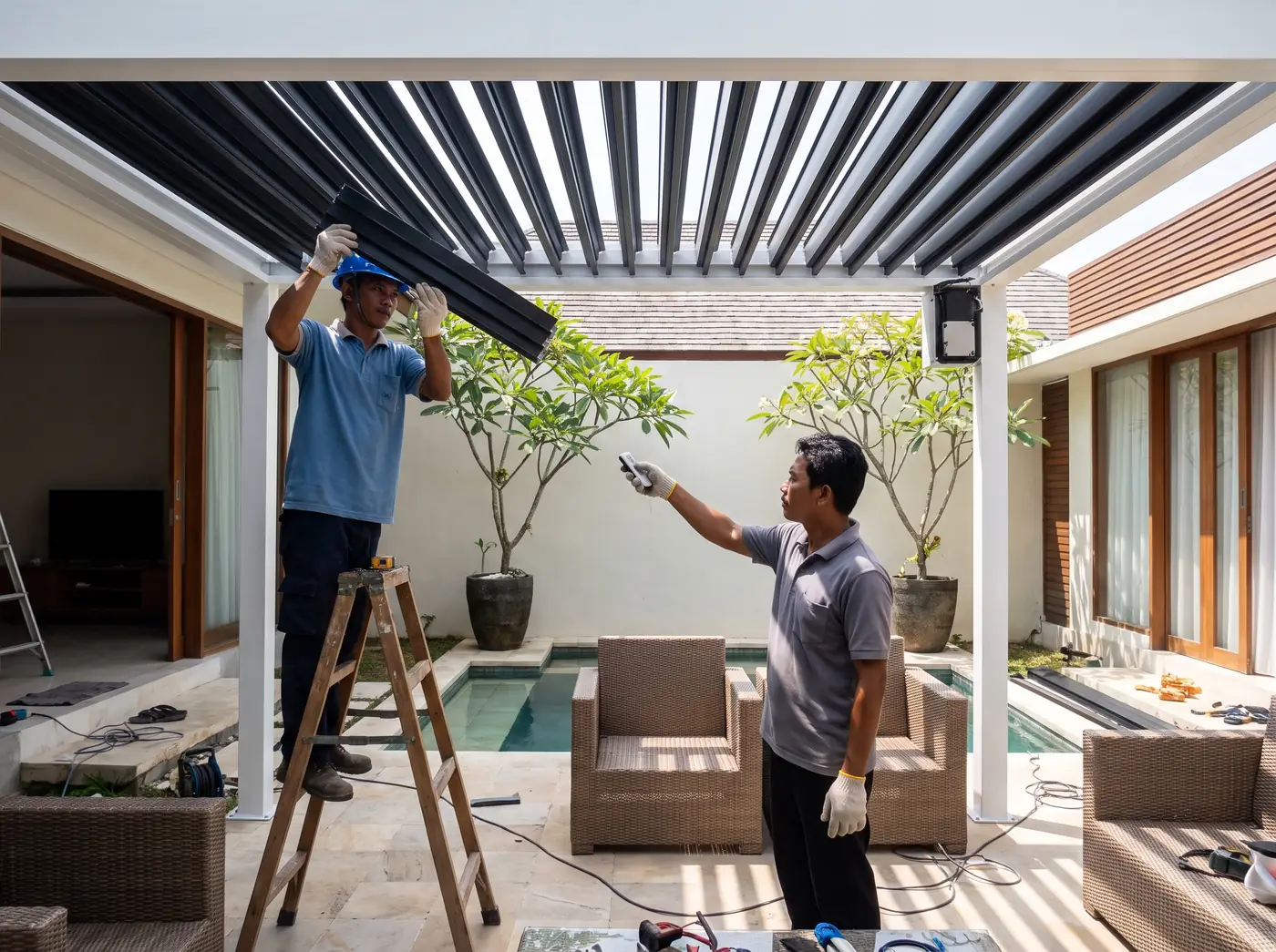
We build louvered systems in extruded aluminium: blades that rotate through roughly 135 degrees, perimeter beams that double as gutters, and downpipes concealed inside the posts. Manual crank versions suit small terraces and have nothing electrical to fail. Motorised systems add an actuator per bay, a remote or wall panel, and optional rain and wind sensors that close the roof while you are still on the beach and reopen it once the squall has passed.
Everything else is corrosion engineering. Blades, beams and posts are powder-coated over a seaside-class pre-treatment, fasteners are A4 stainless, and actuator housings are sealed to an IP rating that survives being rained on sideways. The cheap systems arriving on the island look identical on day one and are seized, streaked and rattling by their third wet season — almost always because somebody saved a few hundred thousand rupiah on screws.
Closed mode is a roof, so we size it like one
A four-by-six-metre louvered roof is twenty-four square metres of catchment. At the 80–100 mm per hour this island produces several times a season, that is roughly forty litres a minute arriving in the perimeter beam, most of it in the opening minutes of a storm. Systems sold with one 50 mm outlet overflow at the blade line and pour straight down a guest's back.
So the closed pergola gets treated as a small roof: outlets sized to the catchment, at least two downpipes on anything above roughly twenty square metres, a fall built into the beams, and a discharge that reaches a drain or a soakaway instead of the terrace tiles. It is unglamorous arithmetic, and it is the single biggest difference between a system that works in a downpour and one that only works in a brochure photograph.
Manual, motorised, or a bit of both
Manual crank systems are mechanically simple, cost around a third less and have no electronics to fail. On a small terrace that a family adjusts twice a day they are frequently the better buy, and we will say so rather than upsell a motor nobody needs.
Motorisation earns its keep on larger roofs, on anything above head height, and on rental properties where guests will never touch a crank handle but will certainly complain about rain on the sofa. Where we do motorise, each bay gets its own actuator so one failure never immobilises the whole roof, cabling runs in conduit instead of being clipped to the frame, and the sensor package is set conservatively — closed on the first rain, held closed until the wind sensor agrees it is safe. Spare actuators and gaskets sit in our store, because a part on a boat from Europe is a wet season lost. Pergolas often sit on upper terraces; where children or pets use the space, we pair the roof with balcony and terrace safety nets along the open edge.
SCOPE OF WORK
What's included
Site & structure check
We confirm what the roof fixes to — slab, wall or free-standing posts — and how the loads reach the ground.
Aluminium frame
Extruded 6063 posts and beams, powder-coated to marine specification and assembled with A4 stainless fixings.
Louvre system
Insulated or single-skin blades with rotation gear, weather seals and end caps that stay where they are put.
Drainage
Beams work as gutters feeding concealed downpipes inside the posts to a discharge point you choose.
Motorisation & controls
IP-rated actuators, remote or wall control, plus rain and wind sensors that close and protect the roof.
Extras & integration
Zip screens, dimmable LED strips, fans and power runs coordinated with our own electrical crews.
PROCESS
How the job runs
- 01
Terrace visit & sizing
We measure the area, check the fixings and sun angles, and agree bay layout and where the water will discharge.
- 02
Specification & fixed quote
Blade type, motorisation, screens and lighting itemised, with manual and motorised options priced side by side.
- 03
Fabrication & installation
Frame cut and coated to order, posts set or wall brackets fixed, blades and gearing assembled on site.
- 04
Commission & test
Full travel test, hose-test of the closed roof and gutters, sensor tuning and a written warranty.
INDICATIVE PRICING
Honest numbers, before the survey
| Scope | Guide price |
|---|---|
| Manual louvered roof system | from IDR 5,500,000 / m² |
| Motorised system with remote control | from IDR 8,500,000 / m² |
| Integrated LED, rain & wind sensor package | from IDR 14,500,000 |
| Zip screens / side blinds | from IDR 2,400,000 / m² |
| Free-standing posts & footings | from IDR 18,500,000 |
Bay size, height and motorisation set the final figure, fixed after a free terrace visit and measurement.
Request an exact quoteFAQ
Louvered pergolas in Bali — what owners ask
Is a louvered roof really watertight when closed?
Watertight enough to eat under in a downpour, yes: the blade seals overlap and the water runs into the beams. What it is not is a sealed roof — rain driving at an angle carries a little past the open ends, and debris sitting on the blades can hold water. Where absolute dryness matters, for electronics or upholstery, we add zip screens on the exposed side.
How do the sensors behave in a Bali storm?
The rain sensor closes the blades within seconds of the first drops, and the wind sensor overrides everything else: above its threshold the roof moves to the position that sheds load and stays there until conditions drop. Sensors share the low-voltage circuit with the actuators, and a manual override is fitted as standard so a power cut never traps the roof.
Will the aluminium survive a beachfront site?
With the right specification, comfortably. We use a seaside-class pre-treatment under the powder coat, A4/316 stainless fasteners and stainless or coated gearing, because the parts that fail first are always screws and pivots rather than the extrusion itself. Rinse the frame with fresh water a few times a year and a coastal installation stays sound well past a decade.
What does a louvered pergola cost in Bali?
Manual systems start around IDR 5,500,000/m² of roof and motorised systems around IDR 8,500,000/m², both covering frame, blades, gutters and installation. A full integrated package with LED lighting and rain and wind sensors adds from IDR 14,500,000. Free-standing structures need posts and footings, which we price separately once the terrace has been measured.
RELATED SERVICES
Often booked together
FROM THE BLOG