SEC G / WELLNESS CONSTRUCTION
Infrared sauna installation for Bali homes
Bali is a strange place to want a sauna until you own one: cool-season evenings in the hills, recovery routines, and the simple fact that a controlled, dry 55 °C is nothing like humid 31 °C outside. We install infrared saunas in private homes — factory cabins placed and wired properly, or full room conversions built from the studwork up — with electrical load, timber choice and ventilation each treated as engineering, not accessories.
- Cabins installed or rooms fully converted
- Dedicated circuit, tested before first heat
- Timber and ventilation specced for humidity
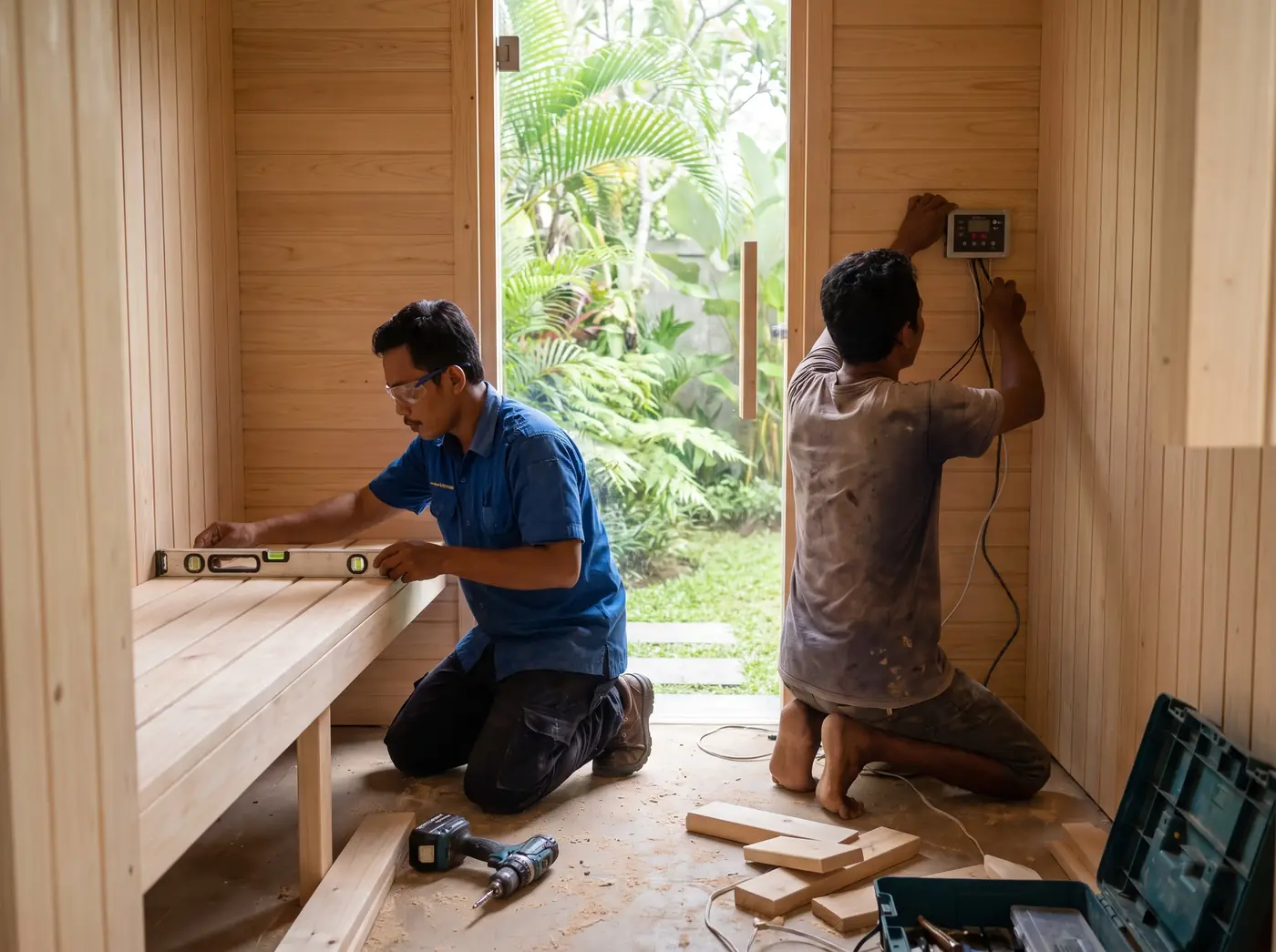
The honest comparison comes before any quote. Infrared heats the body directly at 45–60 °C instead of heating air to 85 °C, so it runs on a fraction of the power, needs no stove, and is usable ten minutes after switch-on — a sensible match for a home, and for PLN supplies that dislike big resistive loads. What it does not give you is steam and löyly; if that ritual is the point, we'll tell you straight and spec a conventional hot room instead.
Two routes to the same result. A factory cabin is the quickest: we handle the base, the dedicated circuit and the ventilation path, and the cabin does the rest. A room conversion goes further — insulated stud walls, a vapour build-up that tolerates Bali humidity, ceramic or carbon emitters positioned around the bench plan, and timber chosen for wet-air stability rather than showroom looks. Either way the wiring sits on its own breaker, tested and certificated before first heat.
Infrared or traditional — what fits a Bali home
A traditional stove room wants 6–9 kW of supply, forty minutes of heat-up and a disciplined drying routine — manageable in a dedicated build, awkward in a family home on a standard PLN connection. Infrared flips every one of those numbers: a two-person cabin draws 1.8–2.6 kW, is ready in ten to fifteen minutes, and produces a dry radiant heat most people find easier to sit in for half an hour. In a climate where the ambient air is already warm and wet, that lighter touch is usually the right call for a house.
Emitter marketing deserves scepticism, so here is the short version. Carbon panels run cooler across a large surface and give even coverage; ceramic elements run hotter and more intense at short range; so-called full-spectrum adds near-infrared claims the evidence base treats gently. What matters more is placement — panels wrapping the bench so your back and calves are covered — plus controls you can service and parts we can still source in five years.
Humidity is the quiet enemy — so we build for it
A sauna in Bali spends one hour a day hot and dry and twenty-three hours soaking in 80 per cent humidity. Timber that shrugs this off is a short list: western red cedar, aspen and thermally modified spruce stay stable and splinter-free; most tropical hardwoods get too hot to sit on, and plywood or MDF anywhere near the heat is a fast route to swelling and glue odours. Fixings are stainless throughout, because plated screws streak black within a season here.
The build-up matters as much as the species. Conversions get insulated framing, a foil vapour layer with taped joints, an air gap behind the boards, and an extract path with fan run-on so the room actually dries after each session instead of incubating mould behind the cladding. The heater circuit is meggered and certificated by our own electricians, and the whole installation carries a written workmanship warranty.
SCOPE OF WORK
What's included
Siting & load check
We confirm floor, clearances and your PLN capacity first — a 2–6 kW sauna must never share a circuit with anything.
Cabin supply & assembly
Factory infrared cabins delivered, assembled square and level, and connected on a dedicated protected circuit.
Room conversion build
Insulated framing, foil vapour layer, interior boarding and benches built to your room's exact dimensions.
Emitters & controls
Ceramic or carbon panels positioned around the seating plan, with wall-mounted digital controls and session timers.
Electrical works
Correctly sized cable, dedicated breaker and RCD protection, installed by our own electrical crew and test-certified.
Ventilation & drying
Passive inlet and powered extract sized so the room reaches temperature quickly and dries out fully between sessions.
PROCESS
How the job runs
- 01
Home visit & load check
We look at the space, measure clearances and test what your PLN connection can actually carry — the visit is free anywhere in Bali.
- 02
Spec & fixed quote
A cabin shortlist or conversion design, the emitter layout, the electrical scope and an itemised fixed price.
- 03
Install & wire
Base, cabin assembly or conversion build, ventilation and the dedicated circuit — all by our own carpenters and electricians.
- 04
Test, certify, hand over
Insulation-resistance test on the circuit, a full heat run to temperature, a user walkthrough and a written warranty.
INDICATIVE PRICING
Honest numbers, before the survey
| Scope | Guide price |
|---|---|
| Two-person IR cabin, supplied & installed | from IDR 95,000,000 |
| Room conversion to infrared sauna | from IDR 145,000,000 |
| Electrical preparation (dedicated circuit) | from IDR 8,500,000 |
Cabin prices include assembly and wiring; the final fixed quote follows a free home survey and load check.
Request an exact quoteFAQ
Infrared saunas in Bali — what homeowners ask
Does a sauna even make sense in a hot climate?
More often than people expect. A session at a chosen, dry 55 °C is a different physiological event from sitting in humid 31 °C air, and owners in the hills — Ubud, Bedugul, Munduk — use theirs most in the wet season, when evenings drop below 23 °C. Recovery-focused owners use them year-round regardless of what the weather is doing outside.
What does an infrared sauna do to my electricity supply?
A two-person cabin draws 1.8–2.6 kW — roughly IDR 4,000–6,000 of electricity per hour of use at 2026 tariffs. The rule we won't bend is a dedicated circuit with RCD protection: many Bali homes run on 3,500–7,700 VA connections, so we measure your real headroom during the free visit and tell you plainly if PLN needs upgrading first.
Cabin or room conversion — which should I choose?
Cabin if you want speed and a contained budget: delivered and running within a day once the circuit is in. Conversion if the sauna must fit an odd space, seat four or more, or match the rest of the house — it costs more and takes one to two weeks, but the result is built into the architecture rather than parked in it.
What does infrared sauna installation cost in Bali?
Guide figures: a two-person cabin supplied, assembled and wired from IDR 95,000,000; full room conversions from IDR 145,000,000 depending on size and timber; electrical preparation alone from IDR 8,500,000 where you've bought a cabin elsewhere. Running costs are modest — most owners spend less on the sauna than on the pool pump. A free home visit fixes the number before any work starts.
RELATED SERVICES
Often booked together
FROM THE BLOG