SEC B / STRUCTURAL WORKS
Steel structures and roof trusses in Bali
Steel earns its place wherever concrete turns clumsy: a fourteen-metre clear span over a restaurant, a mezzanine dropped into an existing shell, a cantilevered canopy that has to look thin. We fabricate in our own workshop and erect with our own crews, which means the welds are made under cover by welders whose work we know, rather than improvised on a scaffold in the middle of a downpour.
- Workshop fabrication by qualified welders
- Hot-dip galvanising or measured paint systems
- Light-gauge truss and hot-rolled portal frames
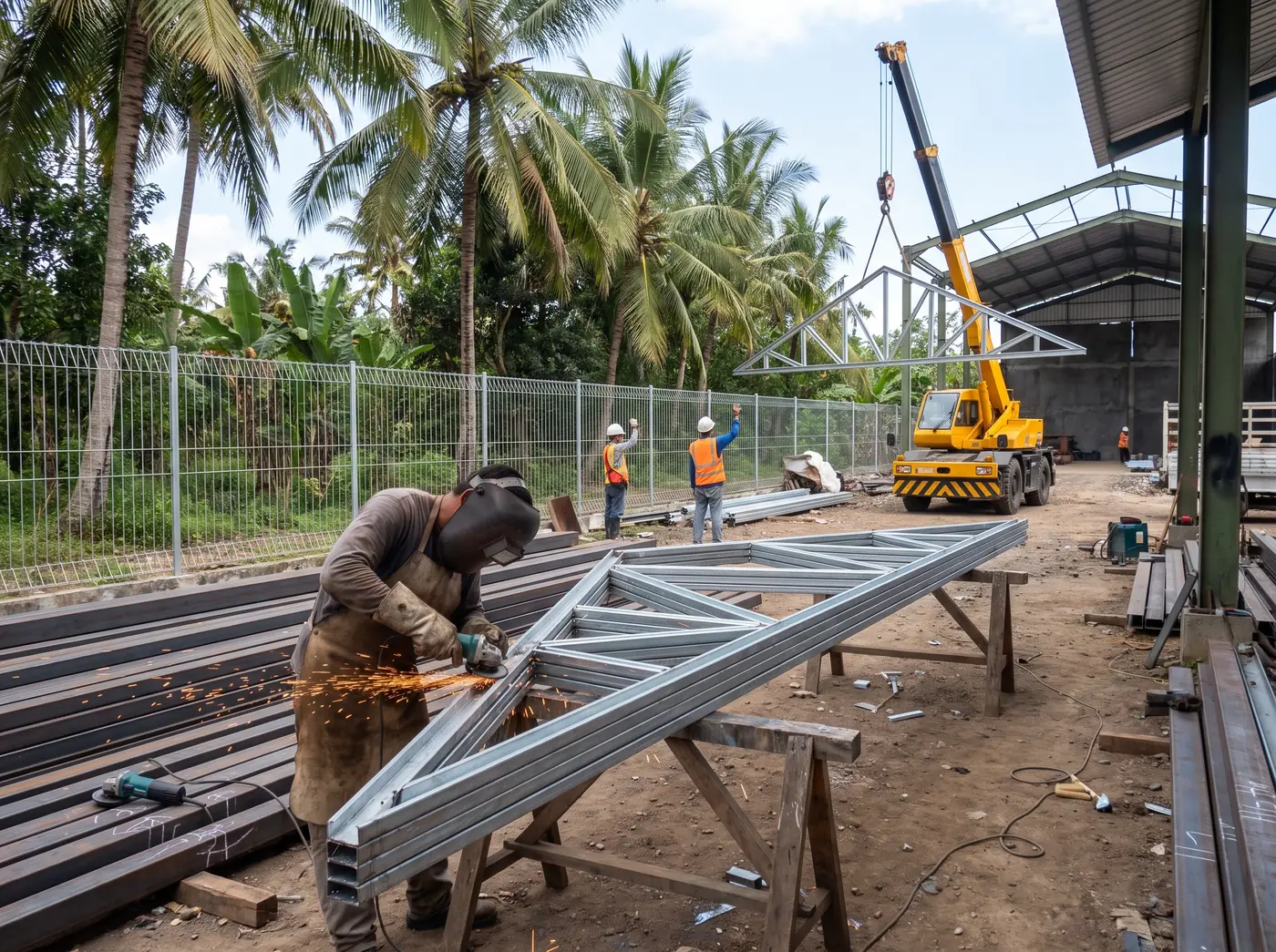
The two systems we build with answer different questions. Light-gauge galvanised truss — the C-profile system now standard across Indonesia — is quick, dimensionally accurate, of no interest to termites and ideal beneath tile or metal on residential spans. Hot-rolled sections take over as loads, spans or exposure grow: portal frames, mezzanine floors, pergola and canopy structures, and anything expected to carry plant or a planted roof.
Corrosion sets the specification long before strength does. Within a couple of kilometres of the surf, unprotected steel starts pitting within months, and a painted section detailed with a water trap fails from inside the trap outwards. So we hot-dip galvanise wherever budget and geometry allow, use a measured primer and topcoat build where they do not, seal hollow sections, drill drainage where water would otherwise sit, and isolate steel from aluminium and stainless at every point of contact.
Light-gauge truss against hot-rolled steel
The galvanised C-profile truss system covers most residential roofs on this island for good reasons: light, precise, factory-coated, delivered in a small truck and erected in days. For spans up to roughly twelve metres carrying tile or metal sheet it is normally the economical answer, and unlike timber it holds no interest for termites. Its limits show when point loads appear — a heavy air-conditioning unit, a solar array, a service-laden ceiling — or when the architecture wants structure worth looking at.
Hot-rolled steel handles those cases. Universal beams and columns, hollow sections and plate connections carry longer spans, cantilever properly and can be detailed to look deliberate. It costs more per kilogram, needs craneage or a written lifting plan, and demands serious corrosion protection. Where a project could reasonably go either way we quote both, with spans, coating specification and erection method written down, so you are comparing buildings rather than rates per kilogram.
Welds and coatings you can verify
Two things separate steel that lasts from steel that stains a building. First, welding: correct consumables, proper joint preparation and welders working to a written procedure. Our fabrication happens in the workshop wherever the geometry allows, because a weld made under cover on clean, dry steel is a different object from one made at height in the wet season. Site welds are limited to defined connections, ground back and coated the same day they are made.
Second, the coating system. Hot-dip galvanising gives decades in Bali's air and is our recommendation for anything coastal or exposed. Where galvanising is impractical — very long members, later modification, an architectural finish — we specify a blast-cleaned primer and topcoat to a stated film thickness and check it with a gauge rather than by eye. Either way the protection specification appears on the quotation, not in the hands of whoever holds the spray gun.
SCOPE OF WORK
What's included
Shop drawings
Connection design, member schedules and setting-out drawings prepared from the engineer's design before steel is cut.
Workshop fabrication
Cutting, drilling and welding under cover to documented procedures, with dimensional checks against the shop drawings.
Corrosion protection
Hot-dip galvanising, or blast-cleaned primer and topcoat systems specified by distance from the coast and exposure.
Delivery & erection
Sections sized for the access route, craned or manually erected, lined and levelled before final bolt-up.
Connections & fixings
Bolted or site-welded connections to the design, with holding-down bolts cast or resin-anchored to surveyed positions.
Roof interface
Purlins, battens and fixings coordinated with the covering, so the roofing trade inherits a frame that actually fits.
PROCESS
How the job runs
- 01
Design review & shop drawings
We take the structural design, resolve the connections and issue shop drawings for approval before any section is cut.
- 02
Fabricate & protect
Members cut, drilled and welded in the workshop, dimensionally checked, then galvanised or coated to the specified system.
- 03
Deliver & erect
Steel delivered in access-sized loads, erected, lined and levelled, with holding-down bolts and connections torqued to specification.
- 04
Inspect & hand over
Weld inspection, coating checks, touch-up of transit damage, and as-built drawings with the bolt and coating record.
INDICATIVE PRICING
Structural steel price in Bali per kg
| Scope | Guide price |
|---|---|
| Structural steel fabricated, coated and installed | from IDR 38,000 / kg |
| Light-gauge galvanised truss system | from IDR 270,000 / m² roof plan |
| Mezzanine floor structure | from IDR 1,950,000 / m² |
Weight, coating system and craneage decide the total; a fixed itemised quote follows a free site survey.
Request an exact quoteFAQ
Steel structures in Bali — what owners ask
Steel or timber for my roof structure?
Light-gauge galvanised truss beats timber here on three counts: termites ignore it, it does not move with humidity, and it arrives factory-accurate. Timber still wins where the structure is exposed and the look carries the room. If exposed steel appeals, hot-rolled sections detailed and coated properly do both jobs — we price the options against the same span.
How long do fabrication and installation take?
For a typical house roof in light-gauge truss, about a week of shop work and two to four days on site. Hot-rolled work runs longer: two to four weeks in the workshop including galvanising, which for larger members means a trip off the island, then erection measured in days. Galvanising queues, not welding, usually set the date.
Will steel rust near the beach?
Unprotected steel will, and quickly — pitting starts within months a few hundred metres from the surf. Hot-dip galvanising, sealed hollow sections, drainage holes where water would otherwise sit and galvanised or stainless fixings change the picture entirely. We specify by distance from the coast and prevailing wind, and isolate dissimilar metals at every contact.
How is structural steel priced?
By weight: from IDR 38,000 per kilogram fabricated, coated and installed, covering the section, its connections, the protection system and erection. Light-gauge truss systems price by roof plan area from IDR 270,000/m², and mezzanine floors from IDR 1,950,000/m². Final figures follow a free site survey and a look at the structural drawings.
RELATED SERVICES
Often booked together
FROM THE BLOG