SEC E / WATERPROOFING & PROTECTION
Structural timber treatment against termites in Bali
Termites do not attack buildings. They attack untreated cellulose that somebody placed within reach of the ground. Bali hands them ideal conditions — warm soil twelve months a year, subterranean colonies several million strong, and a building tradition full of exposed timber and bamboo. We handle the construction-stage half of that problem: treating the material before it goes in, and detailing the structure so a colony never finds a route to it.
- Treated at construction stage, before it is closed in
- Borate impregnation and pressure-treated supply
- Detailing that removes the routes, not just the insects
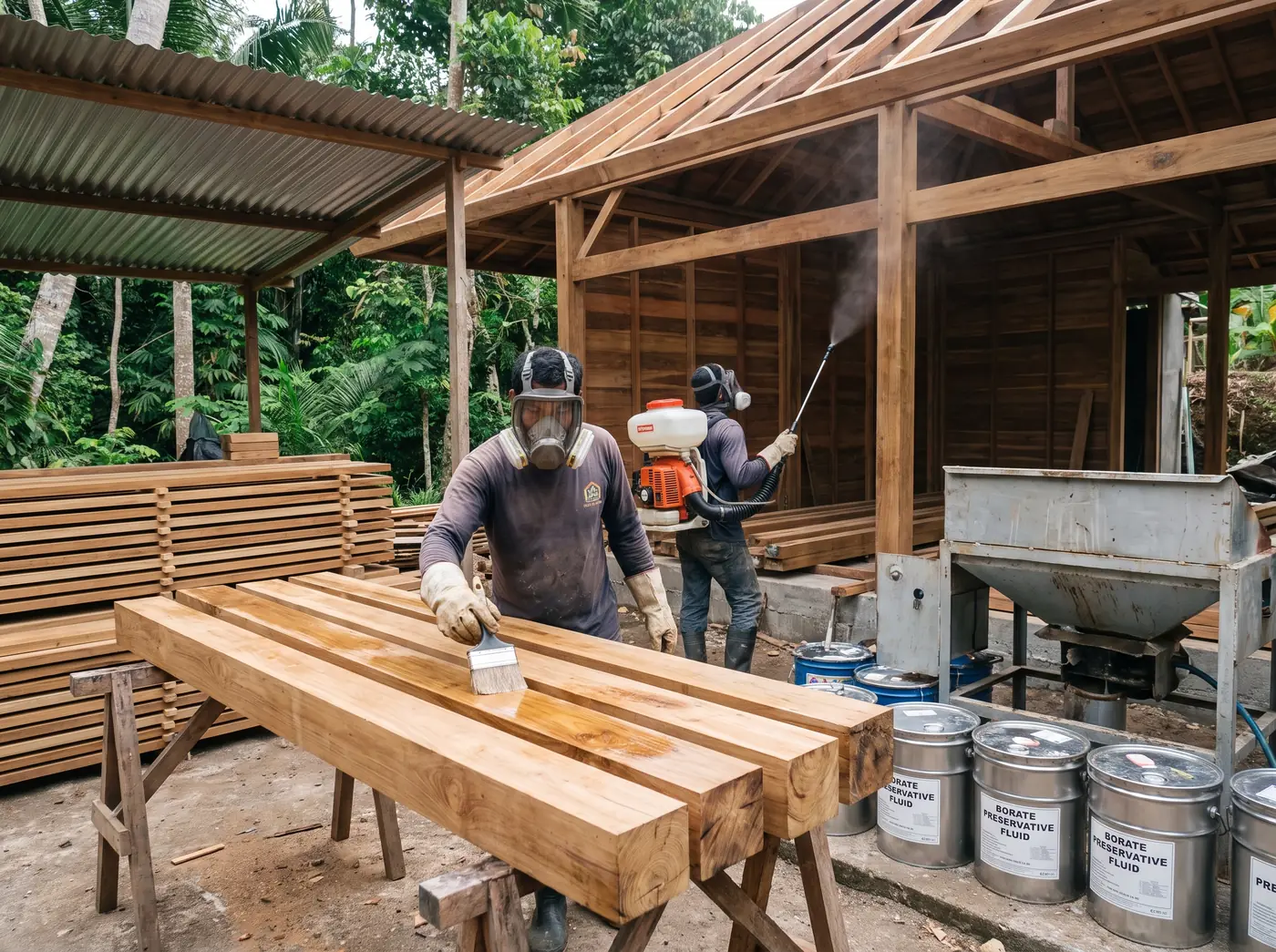
This is protection built into the fabric, not a service contract on a finished house. We supply and impregnate structural timber and bamboo with borate salts, which diffuse through the cell structure and stay lethal to termites and wood-boring beetle for the life of the member, provided it stays out of the rain. Where members will be exposed or in ground contact, we move to pressure-treated stock and oil-borne systems that resist leaching instead.
The detailing matters as much as the chemistry, and at design stage it costs nothing. Timber kept 300 mm clear of soil and 150 mm above finished paving. Stainless shields and physical barriers wherever a post or a service passes through the slab. Ventilated cavities so nothing stays damp. Ground contact designed out entirely, using a steel shoe or a concrete stub. Given the choice between a chemical and a detail, we specify the detail — it never needs renewing.
How termites get into a Bali building
The species that matters here is the subterranean termite, and it lives in the soil rather than in your roof. A mature colony forages tens of metres in every direction and enters a building by three routes: direct wood-to-soil contact, a mud tube built up the outside of a foundation, or a gap around a pipe or conduit through the slab — a route that stays invisible for years because it runs inside the structure.
Which is why treatment on its own is not a strategy. Local conditions stack the odds further: high soil moisture keeps colonies active all year, timber often arrives at 20–25% moisture content and gets built in green, and traditional details put posts straight onto stone bases at ground level. Close the routes and the pressure disappears permanently. Treat the timber as well, and the few scouts that do get through find nothing worth eating.
Where our work ends and pest control begins
We are builders, so our lane is the construction stage: material treatment, protective detailing, barriers installed while the slab is poured, coatings applied before members are closed in. Done at the right moment this is inexpensive — treating an entire roof structure costs less than one panel of the ceiling below it, and it can never be done as cheaply again.
What we do not do is treat an active infestation. A house with termites already in it needs a licensed pest-control operator running baiting or soil-injection systems, and we will say so plainly rather than sell a coat of borate over a live problem. Once the colony has been dealt with, we come back in: replacing what was eaten, treating the new members, and correcting the clearance, flashing or slab penetration that let them in — the part no pest-control contract covers. The reasoning behind each treatment — and what it costs to skip one — is laid out in our guide to protecting structural timber from termites.
SCOPE OF WORK
What's included
Timber & bamboo assessment
Species, moisture content and exposure class checked for every member group before a treatment is chosen.
Borate impregnation
Diffusion, dip or vacuum treatment with disodium octaborate — effective against subterranean termites, powderpost beetle and fungal decay.
Pressure-treated supply
Copper-based pressure-treated stock supplied wherever members sit in ground contact or stay permanently wet.
Site spray treatment
Framing, battens and roof timbers spray-treated in place before ceilings, cladding and insulation close them in.
Barriers & shields
Stainless mesh or steel shields at slab penetrations, post bases and service entries, installed with the structure itself.
Detailing review
A drawing-stage review of clearances, flashings, ventilation and ground contact, with every fix marked up for the builder.
PROCESS
How the job runs
- 01
Drawing or site review
We check species, exposure and details on your drawings or on site and list what needs treating and what needs redesigning — free.
- 02
Treatment plan & quote
Product, method and coverage set out per member group, with an itemised fixed price and the data sheets attached.
- 03
Treat & install
Timber and bamboo treated in the yard or on site; barriers and shields fitted with the structure as it goes up.
- 04
Record & schedule
Batch records, coverage photographs and a written renewal schedule for the members that stay exposed.
INDICATIVE PRICING
Honest numbers, before the survey
| Scope | Guide price |
|---|---|
| Borate impregnation of structural timber | from IDR 850,000 / m³ |
| Site spray treatment, framing & roof structure | from IDR 95,000 / m² |
| Detailing review with marked-up drawings | from IDR 3,500,000 |
Volume, species and access set the figure; scope is fixed after a free drawing review or site visit.
Request an exact quoteFAQ
Timber protection in Bali — what builders ask
Is borate treatment safe around a house?
Borates are among the lower-toxicity wood preservatives in use — the same family of chemistry as the boron in laundry products, applied to timber rather than sprayed through rooms. It is lethal to insects that digest cellulose and low-hazard to people and pets once the timber has dried. The trade-off is leaching: borate-treated wood has to stay dry, so exposed members get a different system.
Do you treat a house that already has termites?
No — that is licensed pest-control work, and doing it properly means baiting or soil treatment by an operator who specialises in it. We come in afterwards: replacing the members that were eaten, treating the new timber, and fixing the clearance, flashing or slab penetration that gave the colony its route in the first place.
Does bamboo need different treatment from timber?
Bamboo is more vulnerable, not less. Its starch content makes it attractive to powderpost beetle as well as termites, and untreated poles can be structurally ruined within two or three years here. Proper treatment means boron soaking or the Boucherie method, which pushes solution through the whole culm, followed by controlled drying — not a brush coat on the outside.
What does timber treatment cost on a build?
Borate impregnation of structural timber runs from IDR 850,000 per cubic metre, site spray treatment of framing and roof structure from IDR 95,000/m² of covered area, and a drawing-stage detailing review from IDR 3,500,000. On a typical house the whole package lands well under one per cent of the build cost, which makes it the cheapest insurance on the project.
RELATED SERVICES
Often booked together
FROM THE BLOG