SEC F / SPECIALIST FINISHES
Natural stone restoration and polishing in Bali
Stone in Bali does not wear out so much as go dull, stain and grow things. Marble loses its polish to sand tracked in from the beach. Terrazzo greys under a decade of the wrong cleaner. Andesite and palimanan hold water, then algae and black spotting. Almost all of it is surface damage a fraction of a millimetre deep. We grind, hone, polish and seal existing stone back to the finish it had when it was laid — nothing lifted, nothing replaced.
- Marble, terrazzo, andesite and palimanan
- Ground flat, honed and polished in place
- Impregnating sealers, never surface films
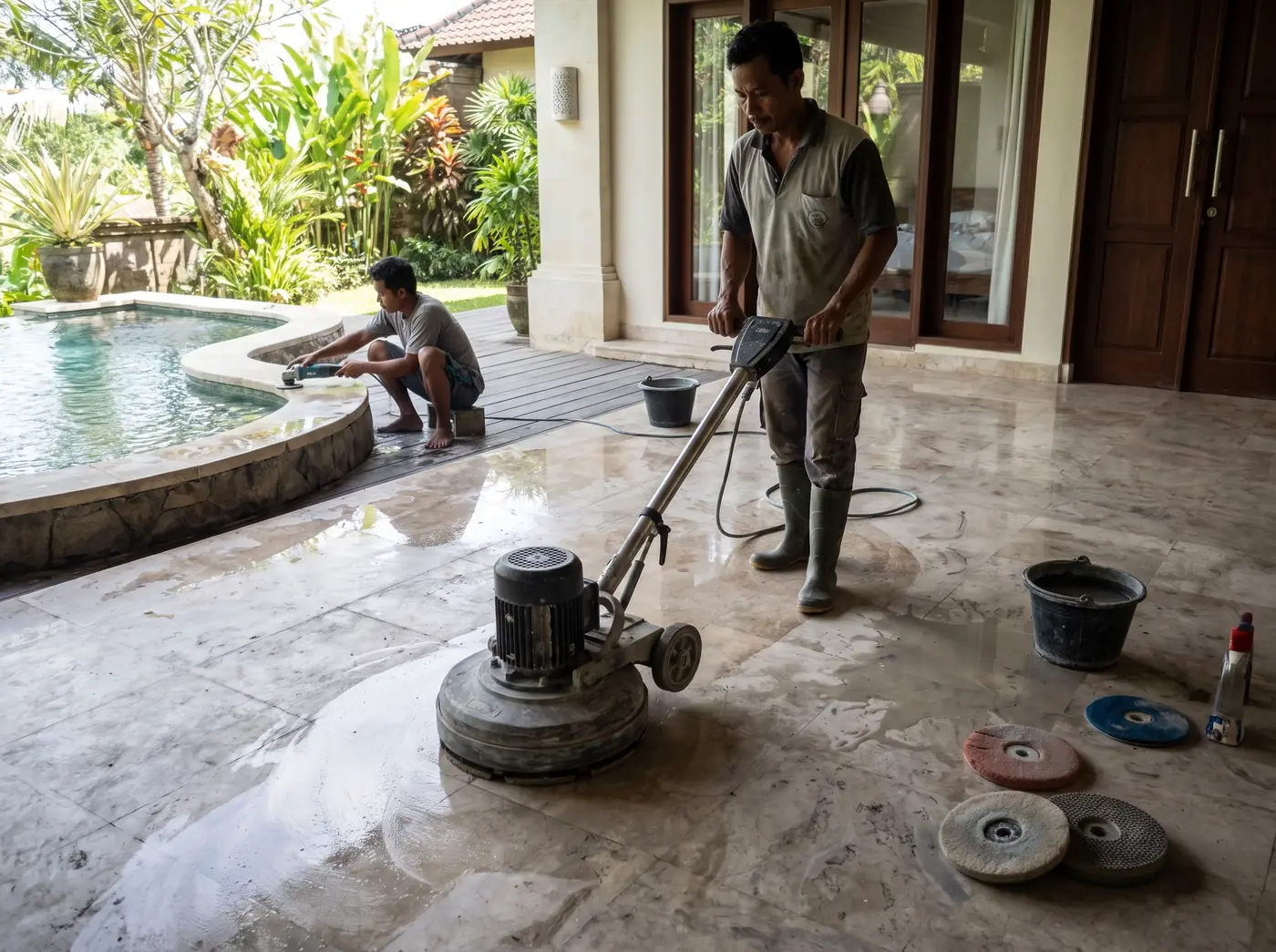
This is restoration work rather than tiling. We arrive with planetary grinders, diamond tooling from 30 grit up to 3,000, wet extraction and the patience the process demands. Grinding removes the damaged layer along with any lippage between tiles; honing sets the sheen level you actually want to live with; polishing or crystallising brings marble and terrazzo back to reflective. Because the whole area is cut to one plane, the result reads as a floor rather than a repaired patch.
Sealing is where restoration is won or lost in this climate. Bali stone lives in permanent humidity, gets splashed with pool water and chlorine, and takes sunscreen, coconut oil and red wine in roughly equal measure. We use impregnating sealers that sit below the surface and leave the stone breathing, because a film sealer on a damp tropical floor traps moisture and clouds within a season. Outdoors on andesite we often recommend no sealer at all and a cleaning schedule instead.
What the tropics do to stone floors
Three things attack stone here. Acid first: pool chemicals, lime juice, hibiscus and cleaning products bought because they smell strong. Marble, terrazzo and travertine are all calcium carbonate, and acid dissolves the polished surface into a dull etch that no amount of buffing will bring back. Then abrasion — sand carried in from the beach on bare feet is quartz, harder than the stone it walks across, and it sands a visible path from the door to the pool.
Third is moisture. Andesite and palimanan are porous and sit outdoors in constant humidity, so they hold water, grow algae and develop black spotting from iron in the stone or in the bedding mortar beneath it. Each of the three needs a different answer: mechanical removal for etch and scratches, controlled cleaning and sometimes a poultice for staining. Which is why we identify the stone and the damage before quoting anything at all.
Restore or replace — the honest arithmetic
Owners often assume tired stone means new stone. It rarely does. Grinding removes a fraction of a millimetre, so a 20 mm marble tile can be restored several times across its life and a terrazzo floor almost indefinitely. Restoration costs a fraction of lifting, disposing, re-screeding and re-laying, and it happens with furniture moved to one side rather than the house closed for a month.
The cases where we recommend replacement instead are specific: tiles that sound drummy and are lifting off the bed, floors with structural cracks running through them, or stone already so thin from previous grinding that another pass would reach the backing. We sound the floor at survey stage and tell you which category yours falls into before you spend anything.
SCOPE OF WORK
What's included
Survey & test patch
Stone type, existing finish, damage and any previous coating identified, with a one-square-metre test patch you approve before we start.
Grinding & flattening
Planetary grinders take out scratches, etch marks and lippage between tiles, cutting the whole area to a single plane.
Honing to sheen level
Progressive grits to matt, satin or high gloss — chosen for slip resistance as much as for appearance, room by room.
Polishing & crystallising
Powder or crystallising polish on marble and terrazzo, bringing reflectivity back out of the stone rather than out of a coating.
Repairs & grout work
Chips, holes and open joints filled with colour-matched resin or cement; failed grout raked out and replaced.
Sealing & aftercare
Impregnating sealer applied at the correct coverage, plus a written cleaning and re-seal schedule for your particular stone.
PROCESS
How the job runs
- 01
Survey & test patch
We identify the stone, sound for loose tiles and cut a sample area so you can approve the finish before committing — free.
- 02
Method & fixed quote
Grit sequence, sheen level, repairs and sealer specified, priced per square metre with the area schedule attached.
- 03
Grind, hone, polish
Machines run wet with extraction, sections completed and protected so the property can stay partly in use throughout.
- 04
Seal & schedule
Sealer applied at the correct coverage, then the floor handed back with a cleaning and re-seal schedule plus product data.
INDICATIVE PRICING
Honest numbers, before the survey
| Scope | Guide price |
|---|---|
| Marble or terrazzo grind, hone & polish | from IDR 225,000 / m² |
| Maintenance visit: clean, buff & re-seal | from IDR 145,000 / m² |
| Pool coping restoration | from IDR 385,000 / m |
Stone type, damage depth and area set the rate — fixed after a free survey and an approved test patch.
Request an exact quoteFAQ
Stone restoration in Bali — what owners ask
Can dull, etched marble really be restored in place?
Yes. Etch marks are physical damage a few microns deep, and grinding with progressively finer diamonds removes the damaged layer and re-polishes the crystal structure underneath. The shine comes out of the stone itself, not out of a coating. Machines run wet with vacuum extraction, so there is far less mess than owners expect and the room is usable the same evening.
How long does a floor take, and do we move out?
A typical 100 m² floor takes two to three days including sealing. We work in sections so you keep half the house in use. Furniture is moved by our crew and put back; wet work is contained with sheeting and extraction. Outdoor andesite and pool decks can usually be done in a day per area with the pool still running.
Do you install new stone as well?
Restoration and polishing of existing stone is our trade — grinding, honing, crystallising, sealing and repair. New stone installation is a different craft with different crews, and we would rather point you to specialists than pretend otherwise. Where we grind a floor and find tiles that are drummy or lifting, we photograph them and let you decide the next step.
What does stone restoration cost in Bali?
Marble grinding and polishing starts at IDR 225,000/m² for a floor in normal condition. A maintenance visit — clean, buff and re-seal — is from IDR 145,000/m². Pool coping restoration is priced by the metre, from IDR 385,000. Heavy etching, deep scratches and old coatings that must come off add grit passes and therefore cost, which the free survey settles.
RELATED SERVICES
Often booked together
FROM THE BLOG