FIELD NOTES · 2026-03-27 · 9 min READ
Roofing materials for the tropics, compared
Every covering sold on the island works somewhere. The trouble starts when a material chosen for a photograph meets 100 mm of rain in an hour, salt air, and UV that chalks cheap coatings in three years. Here is how the five common options behave once they are on a roof in Bali. Roof structure, covering and waterproofing all sit with one crew when a Bali construction company runs the trades itself.
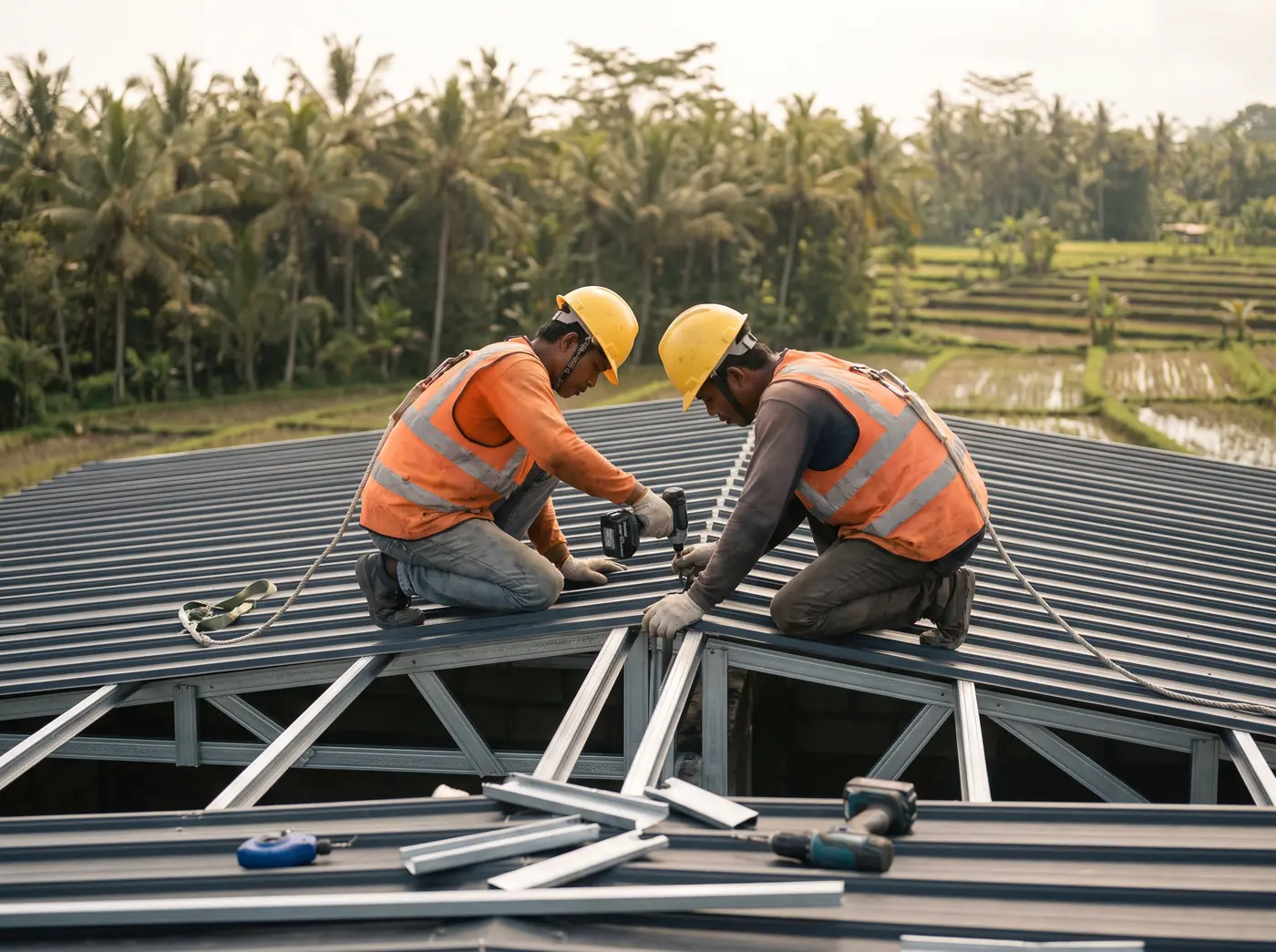
What a Bali roof is actually up against
Before comparing coverings it is worth naming the loads. Annual rainfall runs from roughly 1,700 mm on the dry Bukit to 2,400 mm and more in the hills above Ubud, and it does not arrive politely — a wet-season cell drops 80–100 mm in an hour, which is the number gutters and laps have to survive. Ultraviolet sits at index 11 or higher for most of the year. Relative humidity holds between 75% and 90%, so anything capable of absorbing moisture will do so and stay damp. Within two kilometres of the surf, airborne chloride attacks steel that would last decades inland. And Bali is seismically active, which quietly rewards light roofs over heavy ones.
Five loads, then: intensity of rain, UV, humidity, salt, and mass. No covering wins on all five. The useful question is not which material is best but which trade-offs your site can absorb — and that answer changes between Sanur and Sidemen. What follows is what we see when we open up roofs, not what the brochures promise.
Colour-coated steel sheet
Roll-formed steel with a metallic coating (Zincalume-grade AZ100 to AZ150) plus a baked colour finish is the default on the island for good reason. It weighs about 5 kg/m², so the structure under it gets cheaper; it sheds a cloudburst faster than any tiled surface; and it comes in lengths that eliminate horizontal laps entirely on most rafter runs. A complete metal system with structure runs from IDR 485,000/m² on our roofing jobs.
Its weaknesses are equally predictable. Thin steel has almost no thermal mass, so a room under an uninsulated metal roof tracks the sun within minutes — the fix is 50 mm of bulk insulation or a reflective blanket plus a ventilated ridge, not a thicker sheet. Rain noise is real: 80 mm/hr on bare sheeting is loud enough to interrupt a conversation, and the same insulation layer that fixes heat takes most of that away. Near the coast, the fasteners fail long before the sheet does. We specify Class 4 or stainless screws with bonded washers within two kilometres of the water, and we have replaced entire roofs where the only defective component was a box of cheap screws.
Clay and concrete tile
Tile is the traditional answer and still a good one, particularly inland. A clay tile field carries thermal mass — roughly 45–55 kg/m² including battens — which flattens the afternoon peak and makes ceilings measurably calmer than bare metal. Rain noise is a non-issue. Individual broken tiles are replaced by hand in ten minutes. Complete tile systems start from IDR 650,000/m².
The failure mode is almost never the tile. It is the fixing and the pitch. Tile relies on overlap, so a roof laid at 25° in a place that gets 100 mm/hr will drive water uphill under the laps in a squall; we do not lay clay tile below 30° without a full sarking layer beneath it. The other recurring fault is battens: unprotected mild-steel battens on a coastal site rust through in five to seven years and take the whole field with them, and untreated timber battens feed termites straight into the roof. Mass also matters seismically — 50 kg/m² over a 200 m² roof is ten tonnes sitting on top of your walls, which the frame and the columns have to be designed for rather than inherit.
Asphalt shingle
Shingle is chosen mostly for the look: it drapes over complex geometry, curved dormers and hip-heavy designs that would need dozens of fiddly flashings in metal or tile. It is light (about 12 kg/m² over its deck), quiet, and comparatively cheap to detail. Systems start from IDR 1,000,000/m².
What buyers are rarely told is that the manufacturer's 25-year figure comes from temperate testing. Under index-11 UV with daily thermal cycling, the bitumen in a mid-range shingle hardens and the granules shed faster; 12–18 years is a realistic Bali service life, and the plywood or OSB deck below it becomes the weak point long before that if the roof is not ventilated. If you use shingle here, spend the money on the deck and the underlayment, not on the shingle profile.
Reinforced concrete flat roofs
A concrete deck is not really a roofing material — it is a structure that needs a roofing system on top of it. Done right, it is the longest-lived option on this list and gives you a usable terrace as a bonus. Done at the usual pace, it is the fastest to leak. A screed-to-falls plus membrane build-up starts from IDR 425,000/m² over the deck itself, which prices separately as a suspended slab.
Three numbers decide whether it works: falls of at least 1.5% (15 mm per metre) so nothing ponds, outlets sized for 100 mm/hr with an overflow above them, and upstands of 150–300 mm at every parapet and door threshold. Miss any one and the membrane spends its life underwater. We treat these decks as an engineering detail rather than a finish, and we have written the whole argument out separately in why flat roofs fail in Bali.
Alang-alang thatch
Thatch belongs on this list because clients keep asking and because, for open pavilions, bale and beach bars, nothing else produces the same interior. It insulates genuinely well — a well-laid 15 cm alang-alang roof keeps a pavilion several degrees below an equivalent metal one without any mechanical help — and it weighs 20–30 kg/m² dry, considerably more when saturated.
The number that decides everything is service life: four to seven years, at the far end only if the thatch is thick, steeply pitched at 40° or more, well ventilated and treated. Re-thatching is not a repair, it is a recurring project cost, and it lands in the region of half the original covering price each cycle. Thatch also brings fire load and, in practice, wildlife. For enclosed, air-conditioned rooms we generally steer owners toward a hybrid: a sealed metal or membrane roof underneath, alang-alang laid decoratively over it, so the waterproof layer is not the one that decomposes.
Side by side, and how to choose
| Covering | Realistic life here | Weight | Heat & noise | Coastal | Guide cost |
|---|---|---|---|---|---|
| Colour-coated steel | 20–30 yr (coating grade decides) | ~5 kg/m² | Hot and loud bare; both solved by insulation | Good with AZ150 + Class 4 fixings | from IDR 485,000/m² |
| Clay / concrete tile | 30+ yr tile, 7–15 yr battens & fixings | 45–55 kg/m² | Calm ceilings, real thermal mass | Fine, but batten metal must be specified | from IDR 650,000/m² |
| Asphalt shingle | 12–18 yr under equatorial UV | ~12 kg/m² + deck | Quiet, moderate heat, needs ventilation | Acceptable; deck moisture is the risk | from IDR 1,000,000/m² |
| Concrete flat + membrane | 25+ yr structure, 10–20 yr membrane | 290 kg/m² and up | Excellent mass, silent | Very good; detailing decides everything | from IDR 425,000/m² of build-up |
| Alang-alang thatch | 4–7 yr per re-thatch cycle | 20–30 kg/m² dry | Best passive cooling on the list | Poor in exposed salt wind | recurring, not one-off |
Matching the covering to the site
- Coastal, exposed (Canggu, Seminyak, Bukit cliff edges): steel with upgraded coating and stainless fixings, or tile with galvanised battens. Everything else needs babysitting.
- Inland and higher (Ubud, Tabanan, Sidemen): tile earns its weight here — more rain, less salt, and the thermal mass matters on hot afternoons.
- Rooftop terraces and stacked plots: concrete deck, because the roof is floor area you have already paid for.
- Open pavilions and pool bale: thatch, with the maintenance budget written into the handover documents rather than discovered later.
One more factor rarely discussed at selection stage: whatever you choose is also a catchment. We size gutters and downpipes from the same rainfall intensity used to design rainwater harvesting systems, because a roof that sheds perfectly into an undersized gutter still soaks your walls. Gutter and downpipe packages start from IDR 350,000/m, and they are the cheapest insurance on the entire roof.
The structure underneath is half the decision
Covering weight sets the frame. A 5 kg/m² steel roof can sit on a light-gauge galvanised truss system from IDR 270,000/m² of roof plan; a 55 kg/m² tile field needs deeper sections, tighter spacing and more attention to the wall plate and ring beam below. That difference frequently outweighs the price gap between the coverings themselves, so we quote structure and covering together on steel structures and roof trusses rather than letting an owner pick a tile and discover the frame cost afterwards. The termite-versus-corrosion argument between steel and treated timber framing is a separate discussion, laid out in steel vs timber roof trusses.
Two details apply whatever you choose. Ventilate the roof space — ridge plus eave openings sized at roughly 1/300 of the ceiling area drop attic temperatures and, more importantly, stop condensation from feeding rot and mould in 90% humidity. And insist that flashings, valleys and penetrations are drawn, not improvised on site; they are where nearly every leak we are called to actually starts.
What we'd do
For most new houses within a few kilometres of the coast we specify colour-coated steel at AZ150 with stainless fixings, 50 mm insulation and a ventilated ridge — it is the cheapest system to build, the lightest on the structure, and the easiest to keep watertight for 25 years. Inland, or where the architecture wants a tiled roofline, we price the tile version honestly including the heavier frame so the comparison is real. Our crews build both, along with concrete decks and hybrid thatch, and a roof inspection with a photo report costs nothing if you would rather start from what is already on your building. As a roofing contractor in Bali we publish guide prices for every covering, and our roofing cost guide works them through for a typical villa roof.
NEED IT DONE?
We do this work
Written by the site team at Bali Construction Works, a Bali construction company running its own crews across 46 trades. Questions about your project? Ask on WhatsApp.