FIELD NOTES · 2026-07-31 · 10 min READ
Villa construction cost in Bali: the 2026 price breakdown
- Build-only cost in Bali: IDR 6–15 million per m² depending on finish level; most owner-occupied villas land at IDR 8.5–10 million.
- Pool, design, permits and supervision add 15–25% on top of the build rate; land is separate and is the biggest variable.
- Quotes below IDR 5.5 million per m² are missing structure, waterproofing or electrical scope — compare line items, never totals.
- Timeline: 10–12 months for a 250–300 m² pool villa once the PBG permit is issued.
Ask five contractors for the cost to build a villa in Bali and you will get five numbers spread across a factor of three — all of them technically honest. The spread is scope, not fraud. Here is the breakdown we wish every client had before the first meeting: 2026 prices per square metre, what sits inside them, and the nine-figure line items that never appear in a render.
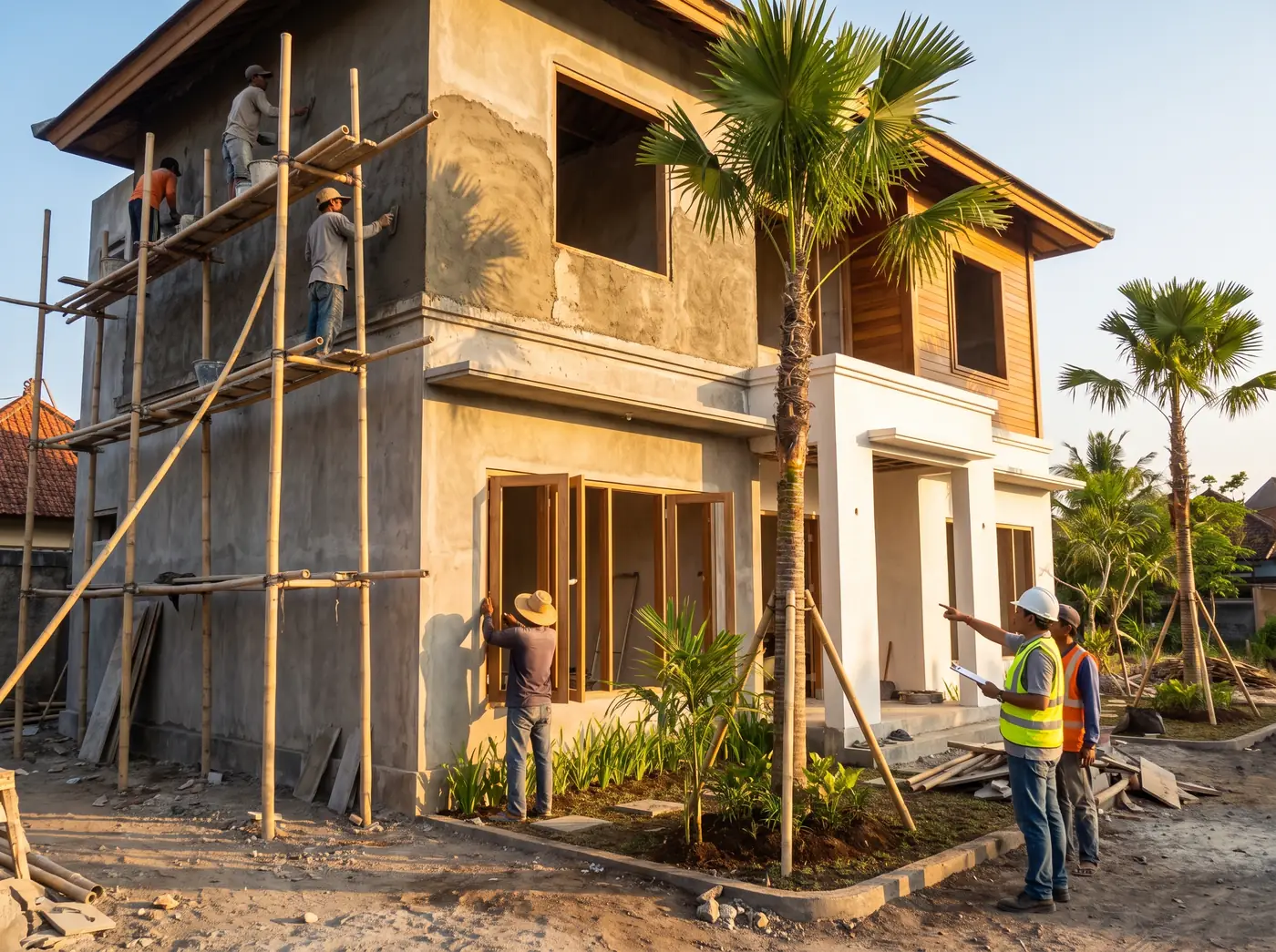
Why quotes for the same villa differ by billions
Last year we priced a 300 m² four-bedroom design that had already been quoted twice: once at IDR 2.4 billion, once at IDR 4.1 billion. Same drawings. The gap came down to glazing spec, sanitaryware brands, who carried the ground risk, and how much management overhead sat inside the rate. Neither quote was dishonest — they were pricing two different buildings that happened to share a floor plan.
So treat every per-m² number, including ours, as a bracket that a bill of quantities must confirm. The cost to build a villa in Bali is set by four things: specification class, the ground under the slab, access to the site, and how much of the real scope the contract actually covers. This article unpacks all four with 2026 figures.
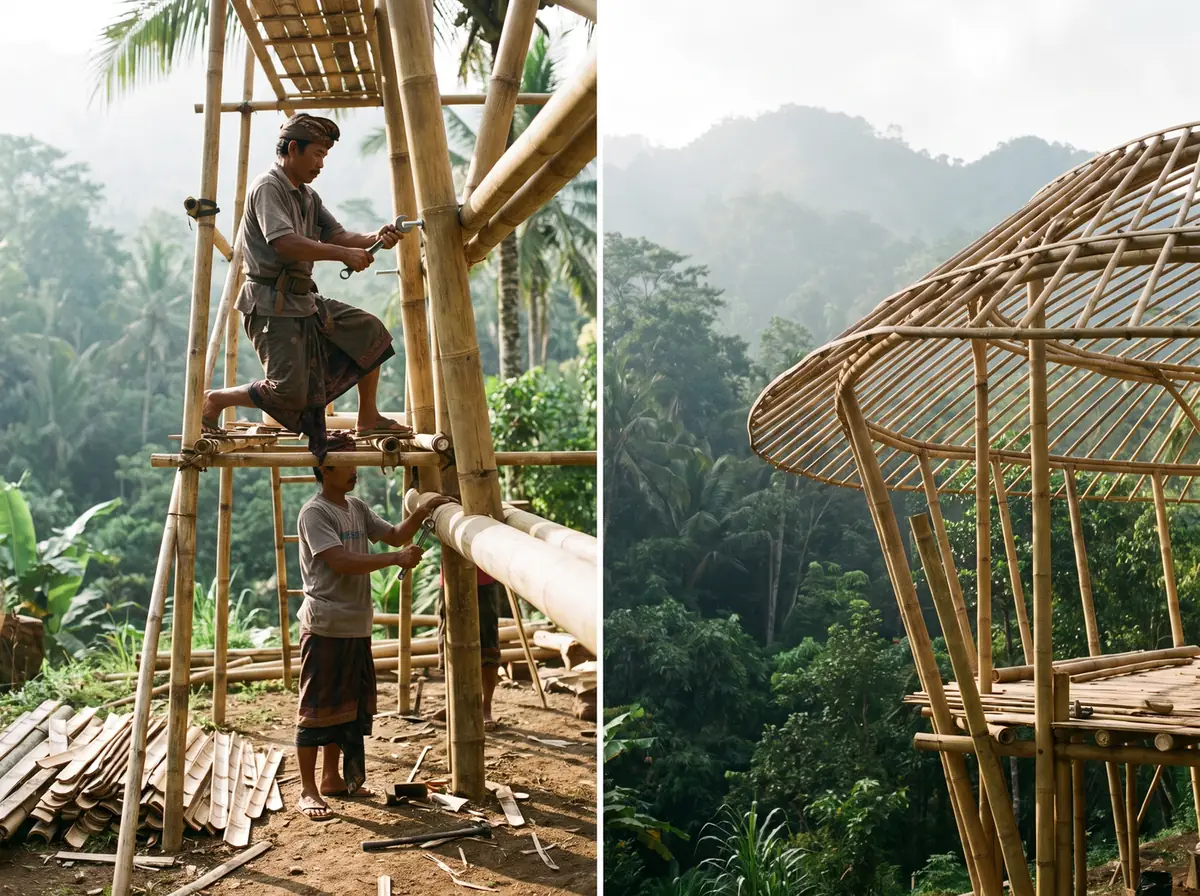
Bali construction cost per m² in 2026
These are working brackets for full-scope construction by a contractor who pours tested concrete, keeps a site engineer on the job and invoices against certified progress. They line up with the published guide prices on our custom home construction page, so nothing here is bait.
| Build class | 2026 guide price | What it buys |
|---|---|---|
| Structural shell only | IDR 3,900,000–4,800,000 / m² | Foundations, reinforced concrete frame, masonry, roof structure — no fit-out, no building services |
| Complete villa, standard specification | IDR 5,500,000–7,500,000 / m² | Local tile and stone, aluminium windows, standard sanitaryware and kitchen, split-unit AC provision |
| Complete villa, premium specification | IDR 7,500,000–12,000,000 / m² | Natural stone and hardwood joinery, floor-to-ceiling glazing, branded MEP equipment, detailed waterproofing |
| Architect-led, top end | IDR 12,000,000–20,000,000+ / m² | Imported finishes, custom steel and glass, home automation, landscape-integrated structures |
You will meet the 12–20 million bracket most often from studios serving the Canggu and Uluwatu market. Some of that premium buys genuine engineering and imported material; some of it buys a foreign project manager's salary. Only the bill of quantities tells you which.
Beware the other direction too. A "complete villa" at IDR 4,000,000 per m² is a shell price wearing a turnkey label: by the time waterproofing, decent doors and a bathroom that drains are back in the contract, the villa building cost lands exactly where the honest quotes started.
What is moving prices in 2026: cement and rebar have been broadly stable, but skilled labour is not. A good tukang now costs IDR 150,000–250,000 a day in the southern districts, roughly a third above 2023 rates, and finishing crews in the Canggu–Berawa corridor book out months ahead. Any quote older than 90 days is history — have it repriced before you sign anything against it.
What the per-m² rate includes — and what it never does
Inside a proper full-build rate:
- Mobilisation, temporary works, scaffolding and site facilities
- Foundations to roof: structure, masonry, roof covering
- Internal completion: floors, walls, ceilings, doors, built-in wet areas
- In-building MEP: wiring and DB, plumbing and drainage to the boundary of the building, AC provisions
- Windows and external doors at the named specification
- Site engineering, supervision and progress reporting
Never inside it, and forgotten in most budgets:
- Land, notary and due diligence costs
- Design, structural engineering and the PBG building permit with its retribusi fee
- Utility connections: PLN power, telecom, meter upgrades
- Your water source and wastewater treatment — a drilled well and a septic unit are separate line items
- Swimming pool, decks, pergolas, boundary walls and gates
- Driveway, landscaping and external lighting
- Furniture, loose appliances and everything an operator calls FF&E
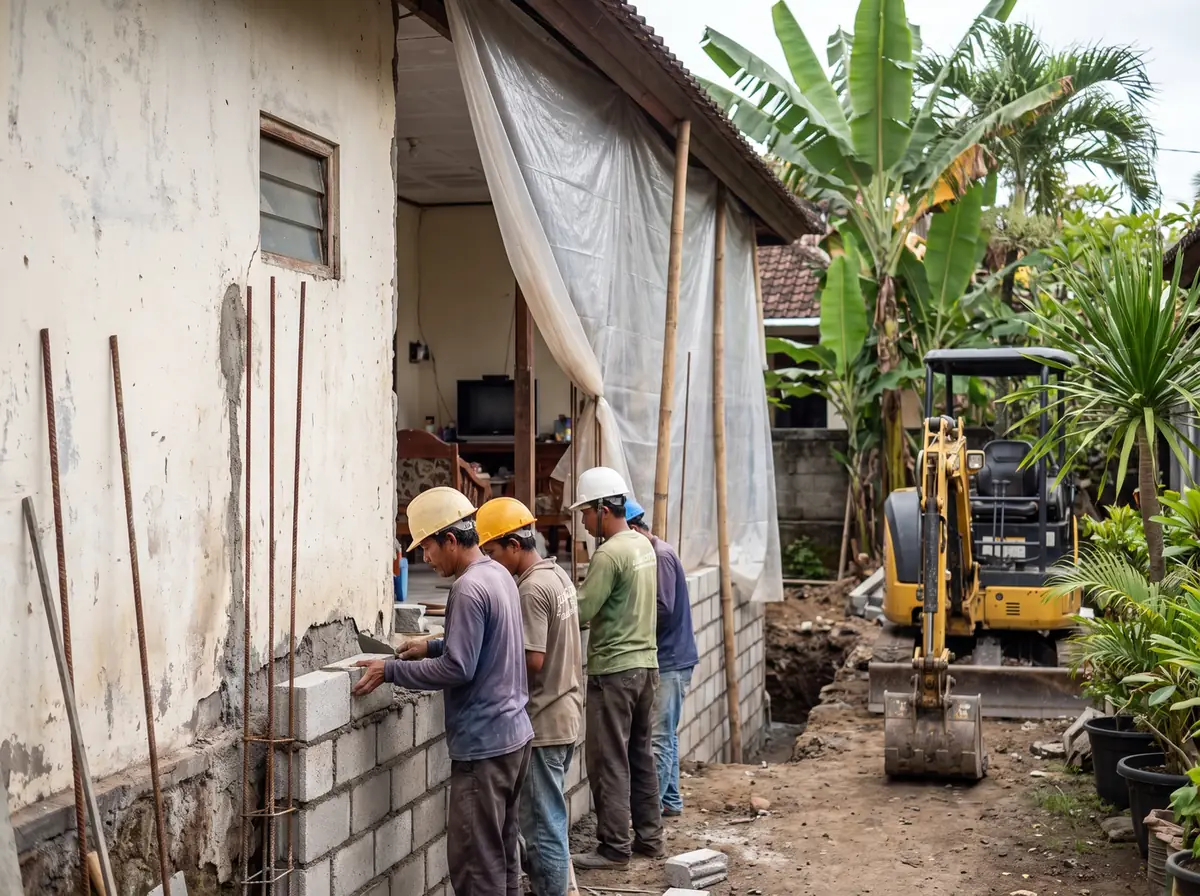
Where the money goes inside the build price
| Cost group | Share of build contract |
|---|---|
| Structure: foundations, frame, masonry, roof structure | 35–40% |
| Architectural completion and fit-out | 30–35% |
| MEP: electrical, plumbing, drainage, AC | 15–20% |
| Preliminaries, site facilities, management | 6–8% |
| Design, engineering and permits (on top of the build contract) | +4–6% |
The structural share moves first. On coastal sand or old paddy clay the foundation line can grow by 15–20% of the structure cost, which is why foundation works are priced from real soil data, not from a neighbour's guess — we walked through the ground-by-ground logic in choosing a foundation for Bali soil. On the Bukit it is water and access that move the other lines instead.
Worked example one: 150 m² two-bedroom villa
Flat 4-are plot in the Canggu–Pererenan corridor, standard specification, no pool. Numbers are 2026 guide brackets, before a site survey fixes them.
| Line | Guide budget |
|---|---|
| Build contract, 150 m² at IDR 5,500,000–7,500,000 / m² | IDR 825,000,000–1,125,000,000 |
| Design, engineering, PBG package and retribusi | IDR 75,000,000–95,000,000 |
| Site works and utilities: soil test, survey, drilled well with pump, bio septic, PLN connection | IDR 105,000,000–140,000,000 |
| Ready-to-occupy total, unfurnished | IDR 1,000,000,000–1,360,000,000 |
Add a modest 8 × 3 m pool and you are budgeting from roughly IDR 200,000,000 more, with its own structure, filtration and waterproofing. Furniture for a two-bedroom rental typically runs another IDR 150–250 million depending on ambition.
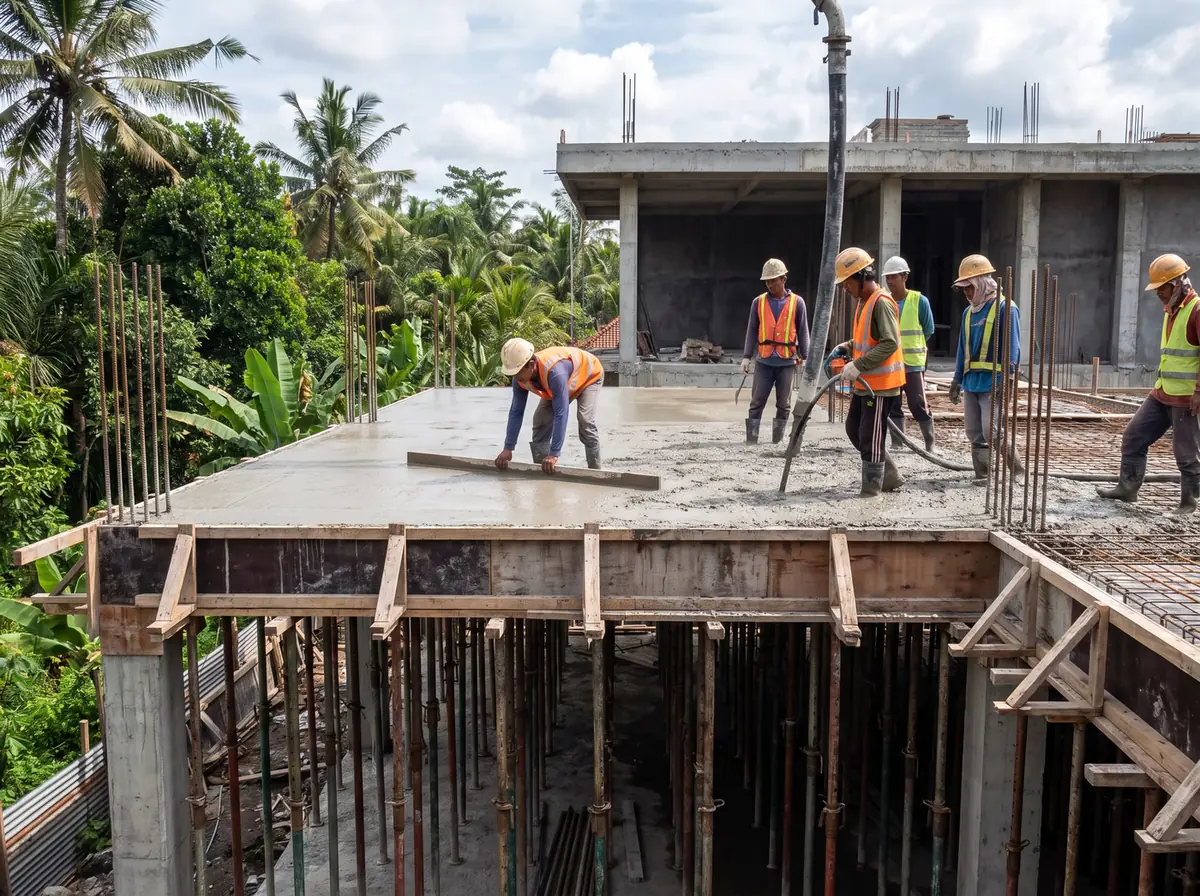
Worked example two: 300 m² four-bedroom with pool
Premium specification on the Bukit near Uluwatu: sloping plot, sea-air exposure, rental-grade finish.
| Line | Guide budget |
|---|---|
| Build contract, 300 m² at IDR 7,500,000–12,000,000 / m² | IDR 2,250,000,000–3,600,000,000 |
| Design, detailed engineering, PBG and retribusi | IDR 150,000,000–200,000,000 |
| Site works: deep well past 100 m, treatment plant, retaining structures, access improvement | IDR 180,000,000–320,000,000 |
| 12 m pool, terraces and external works | IDR 350,000,000–550,000,000 |
| Ready-to-operate total, unfurnished | IDR 2,930,000,000–4,670,000,000 |
The Bukit premium is real: wells commonly pass 100 m through limestone, glazing needs to hold salt wind, and every cubic metre of concrete arrives up a hill. The same villa on flat land in Tabanan would shed well over a hundred million in site costs — which is exactly why we survey before we price.
The hidden costs that break villa budgets
- Soil investigation before design. A sondir programme costs from IDR 7,500,000 through our soil testing service and settles the foundation design. Skipping it is how a 150 m² villa ends up with a redesign invoice mid-build.
- Water supply. Mains water is rare in villa areas. A drilled well to 60 m starts at IDR 18,500,000, and 80–120 m runs from IDR 32,000,000 — full ladder on our deep well drilling page. Budget the pump set separately, from IDR 12,500,000.
- Wastewater. A 3 m³ bio septic unit installed is from IDR 21,500,000 via septic systems; a multi-villa compound with reuse needs a treatment plant from IDR 65,000,000.
- Slopes and river edges. Ubud gorge plots and Canggu river frontage need engineered retention: gabion walls run from IDR 1,350,000 per m³ installed through gabion retaining walls, and the drainage behind them is not optional.
- Access logistics. A plot up a 2-metre lane in Seminyak or Umalas means small trucks, double handling and slower concrete pours — typically 3–5% on the build contract.
- Power. A new PLN connection at villa capacity, with the site distribution to match, is commonly IDR 15,000,000–30,000,000 and takes weeks — order it early, not at handover.
Construction timeline, stage by stage
For the 150 m² example, with a complete design and permit file:
| Stage | Duration |
|---|---|
| Design development and engineering | 6–10 weeks |
| PBG approval (runs partly in parallel) | 4–12 weeks |
| Site preparation and foundations | 6–8 weeks |
| Structure to roof | 12–16 weeks |
| Roof covering, windows, envelope closed | 6–8 weeks |
| MEP and interior completion | 12–16 weeks |
| Commissioning, snagging, SLF inspection | 2–4 weeks |
Call it 9–12 months from approved design to keys for 150 m², and 14–18 months for the 300 m² premium build. The rainy season does not stop a well-run site, but it punishes one that poured its ground floor without drainage planned.
Compress the programme only where compression is cheap: order glazing, switchgear and imported sanitaryware at structure stage, because supplier lead times — not labour — are what stall Bali sites at month eight. Paying overtime to wait for windows is the most expensive way to build a villa slowly.
How to compare contractor quotes
Never compare per-m² numbers; compare bills of quantities. A BoQ lists measured quantities against unit rates, so two quotes can be laid side by side line for line. If a contractor cannot produce one, they are not estimating — they are guessing with your money. Our own quotes itemise structure, completion trades and MEP separately, referencing the drawing set from design and build.
- Check the exclusions page first — that is where cheap quotes hide their gap
- Confirm concrete grades and reinforcement are named, not "as required"
- Confirm brands for windows, waterproofing, pumps and switchgear
- Look for provisional sums: every "PS" is a price that will move later
- Ask who pays for ground surprises — a contract silent on rock or soft spots is a dispute in waiting
- Fixed-price beats cost-plus for a first build, even at a small premium
On payments: 10–20% mobilisation, then monthly certificates against measured work in place, with 5% retention held through the defects period. If the schedule asks for half the contract before the roof exists, walk away.
For builds longer than a year, also agree in writing how material escalation is handled: a capped index clause beats an open-ended one, and both beat a mid-build renegotiation with your money already in the ground.
What we'd do
Fix the specification before you shop the price: a one-page finishes schedule kills most of the quote spread on its own. Spend the first IDR 12–15 million on the ground — survey and soil test — because that is what the expensive lines are built on. Then compare three BoQs at identical scope, check the exclusions, and pick the contractor whose site you have actually walked. We build across the island from Canggu to Uluwatu and will price your drawings line by line, or design and build the whole thing under one contract.
FAQ
Quick answers
How much does it cost to build a villa in Bali in 2026?
As a complete building: from IDR 5,500,000 per m² at a standard specification and from IDR 7,500,000 per m² premium, with architect-led projects reaching IDR 12,000,000–20,000,000+. A turnkey 150 m² two-bedroom villa lands around IDR 1.0–1.36 billion including design, permits, well, septic and power — before pool and furniture.
Can you really build for IDR 4,000,000 per m²?
As a structural shell, yes — our shell rate starts at IDR 3,900,000 per m². As a finished villa, no. Quotes at that level recover the gap later through exclusions, provisional sums and substituted materials, usually starting with waterproofing and windows — the two items you least want cut.
What is not included in the per-m² construction price?
Land and notary costs, design and engineering, the PBG permit and retribusi, PLN connection, a drilled well, the septic system, pool, landscaping, driveway, boundary walls and furniture. On a real villa these add IDR 180–400 million even before the pool.
How long does it take to build a 150 m² villa in Bali?
Nine to twelve months from approved design: roughly 6–8 weeks of groundwork and foundations, 12–16 weeks of structure, then envelope, MEP and finishes. Add 2–4 months up front for design and the PBG if you are starting from a bare plot.
How are payments to the contractor structured?
Typically 10–20% on mobilisation, monthly progress certificates against measured work in place, and 5% retention released after the defects period. Payments should always trail work, never lead it by more than one stage.
Is it cheaper to build in Ubud than in Canggu?
Labour and materials cost broadly the same island-wide. What changes is the site: Ubud plots often need retention and longer utility runs, Canggu and Seminyak lanes add handling cost, and the Bukit adds deep wells and wind-rated glazing. The postcode changes the site budget more than the build rate.
NEED IT DONE?
We do this work
This guide is published by the engineers of a full-cycle construction company in Bali — the same team that quotes and builds the work described above.