FIELD NOTES · 2026-07-31 · 9 min READ
Building permit in Bali (PBG): cost and timeline in 2026
The permit conversation in Bali usually starts too late — after the land is paid for, sometimes after the contractor has mobilised. Since 2021 the IMB no longer exists: you need a PBG before work starts and an SLF before the building is used. Here is how the process actually runs in 2026 — documents, weeks, retribusi maths, and what enforcement now looks like on the ground.
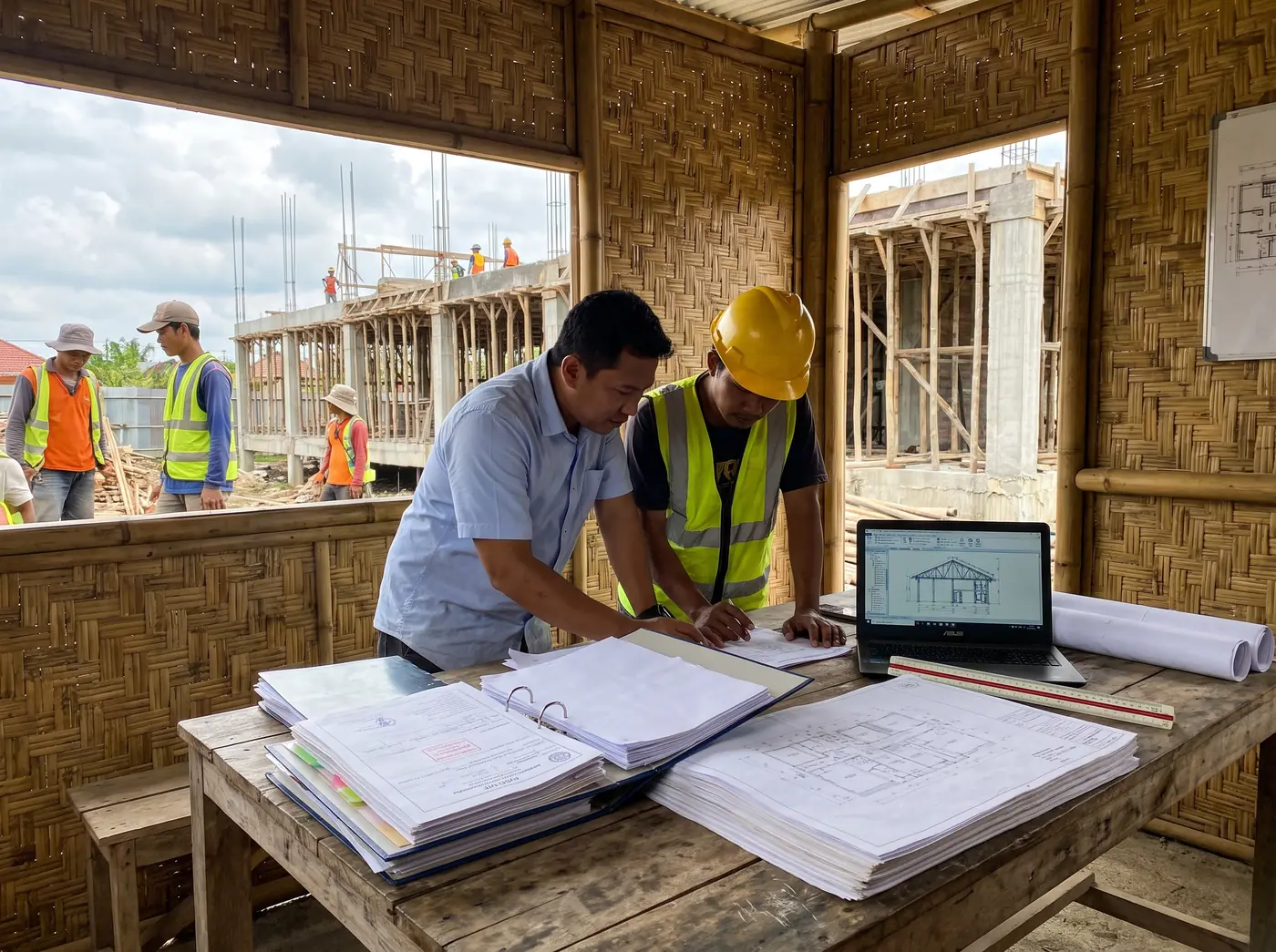
PBG and SLF: what replaced the IMB
Since the national building rules changed under Government Regulation 16/2021, the old IMB no longer exists. Its replacement, the PBG — Persetujuan Bangunan Gedung — is an approval of your technical design issued before construction starts. Its companion, the SLF — Sertifikat Laik Fungsi — certifies after completion that the finished building matches the approved design and is fit to use. An existing IMB stays valid for the building it covers until you extend it, alter the structure or change its function.
The practical shift matters: an IMB was largely an administrative stamp, while a PBG in Bali is checked by a technical review team against real drawings and calculations. Files assembled the old way — a sketch and a fee — now bounce.
Who needs a PBG
- Every new building: villa, guesthouse, restaurant, shop, staff house over the size thresholds
- Extensions and additional floors on an existing building
- Structural renovation — moving columns, walls or the roof structure
- Change of function, including a private home starting commercial rental
- Significant ancillary structures: pools, retaining structures, large pergolas attached to the building
Like-for-like interior work does not trigger a new PBG. A pool in the garden of a permitted villa is usually handled as a revision to the existing approval — cheaper than a fresh file, but not free.
The documents reviewers actually check
- Land certificate — SHM or HGB, or a notarised lease with the owner's written consent to build
- KRK — the zoning statement (Keterangan Rencana Kabupaten/Kota) that says what your plot may carry: function, building coverage, floor limit, setbacks
- Identity and tax — KTP or KITAS/passport, NPWP, current PBB land-tax receipt
- Site plan on a measured base — boundaries and levels from a topographic survey, not from a phone screenshot
- Architectural set — plans, sections, elevations at permit level of detail
- Structural drawings and calculations — referencing an actual soil investigation; we covered why in why a soil test comes before any design
- MEP drawings — electrical single-line, water supply, drainage and sanitation concept
- Environmental statement — SPPL for a normal villa, UKL-UPL for larger or commercial projects
Reviewers check consistency more than beauty. A structural set that shows different column positions from the architectural set, or drainage that ignores the site levels, is where months quietly disappear.
The process step by step, with real timings
- Zoning check and KRK — 1–2 weeks. Done first, ideally before land money moves. This is where green-zone surprises surface.
- Technical file — 3–6 weeks. Survey, soil data, architectural, structural and MEP sets brought to permit standard and made consistent.
- Submission on the SIMBG portal — about 1 week. The national online system; documents are uploaded and administratively verified by the local office.
- Technical review — 2–6 weeks. The review team examines the file, issues comment sheets, and your engineers respond with revisions. One revision cycle is normal; three means the file was weak.
- Retribusi assessment and payment — 1–2 weeks. The office issues the fee calculation (SKRD); you pay the regional treasury and keep the receipt.
- PBG issued. Construction may start, with the approved drawings kept on site.
A complete, consistent residential file commonly clears in one to three months end to end. Files that arrive half-built drag past six — the queue is not the problem, the drawings are. The realistic planning assumption for a villa is: secure the land, then allow a quarter for design plus permit before mobilisation, which is exactly how we sequence it inside design and build projects.
One practical note on the portal: the SIMBG account belongs to the applicant — the certificate holder, or the leaseholder with the owner's consent — not to the drafting agency. Keep the login credentials yours. If a service provider registers the file under their own account, your permit history follows them rather than the building, and retrieving it years later for a sale or an SLF renewal becomes an errand you did not need to create.
PBG cost in Bali: how the retribusi is calculated
The government fee — retribusi — is calculated from your floor area multiplied by a standard unit price and a stack of coefficients: building function, complexity, height, permanence and ownership. Each regency sets its own rates, so Badung, Gianyar and Tabanan price the same villa differently. Working brackets we see on real files in 2026:
| Project | Typical retribusi |
|---|---|
| 150 m² private residence | IDR 8,000,000–18,000,000 |
| 250 m² villa, residential function | IDR 15,000,000–35,000,000 |
| 300 m² villa with commercial rental function | IDR 30,000,000–70,000,000 |
Two notes. Commercial function coefficients are meaningfully higher than residential — declaring honestly at the start is still cheaper than a function change later. And the retribusi is a government fee paid against an official assessment: anyone quoting it as a round cash number without an SKRD is not quoting the retribusi.
What permit services charge in 2026
The technical file is where the real money and the real risk sit. Our construction permit support is priced openly: permit drawing package from IDR 18,500,000, structural calculation package from IDR 12,500,000, and full process coordination — submission, review responses, retribusi handling — from IDR 15,000,000. For a typical 200–300 m² villa the complete professional scope lands around IDR 45–60 million, plus the retribusi at cost.
The market's cheap alternative is the 10–15 million "all-in" fixer. What that usually buys: someone else's recycled drawings, no structural calculations, a file that fails review, and a fee that was never itemised. If the person quoting cannot name your KRK parameters, they have not read your plot.
Building without a PBG: the actual risks
Enforcement in south Bali stopped being theoretical several years ago. The sanction ladder runs: written warnings, then a stop-work order and sealing of the site, administrative fines that can reach 10% of the building value, and — the step Badung has now demonstrated repeatedly in Canggu and on the Bukit — demolition at the owner's cost. Satpol PP does not need a court order to seal a site.
The quieter costs bite harder. Without a PBG there is no SLF; without an SLF a rental operation cannot be licensed properly, a sale to any diligent buyer stalls, banks will not touch the asset, and an insurer has a clean reason to refuse a claim. Legalising an existing unpermitted building is possible through an assessment route, but it costs more than doing it once, properly, before the first pour.
Zoning: the check that comes before the land money
A PBG can only approve what the zoning already allows. Bali's spatial plan protects productive rice field as green zone — much of it now also flagged nationally as protected paddy (LSD) — and no fee, agent or patience converts a green-zone plot into a legal villa site. Setbacks from roads, rivers and cliff edges, the island's building height cap of 15 metres, and building-coverage limits all arrive attached to the KRK.
The KRK itself is quick and cheap — an administrative document measured in days and in hundreds of thousands of rupiah, not millions — which is exactly why skipping it before a land deal is indefensible.
So run the sequence in the only order that protects you: KRK and zoning check, then a measured survey, then design, then the PBG file. If you are still costing the project itself, our villa construction cost breakdown shows where the permit sits inside the full budget — around 4–6% of the build contract including the technical file.
SLF in Bali: the second certificate
The SLF closes the loop: after completion, the building is inspected against the approved PBG drawings — structure, fire safety basics, sanitation, electrical — and certified fit for use. It is valid for 20 years for a private residence and 5 years for commercial buildings, then renewed on re-inspection. Operating a rental villa without one is running a business on an uncertified building, and the licensing system increasingly asks for it. Keep the approved drawing set and the SLF together; the next buyer will ask for both.
The inspection itself is not exotic: structural conformity with the approved drawings, safe electrical terminations, functioning sanitation and drainage, basic fire measures. A building built honestly to its PBG passes without drama — which is the quiet argument for getting the drawings right the first time.
What we'd do
Before buying: pull the KRK and check the zone, the setbacks and the coverage limit against the villa you actually want. After buying: commission the survey and soil test, have one team produce a consistent drawing file, and budget IDR 55–110 million for permit scope plus retribusi on a typical villa rather than discovering it mid-build. We prepare and walk PBG files through review as part of our permit support, and we do not mobilise a site before the approval exists — that rule has saved more client money than any discount ever has.
FAQ
Quick answers
What is the difference between PBG and IMB?
The IMB was abolished in 2021. The PBG replaced it as a pre-construction approval of your technical design, reviewed by a technical team, with the SLF certifying the finished building. An existing IMB remains valid until you extend, structurally alter or change the function of the building.
How much does a PBG cost for a 150 m² villa in Bali?
Budget two layers: the government retribusi, typically IDR 8–18 million for a 150 m² residence depending on regency and function, and the technical file — drawings, structural calculations and process coordination — around IDR 45–60 million at professional scope. Commercial rental function pushes the retribusi higher.
How long does PBG approval take?
A complete, consistent residential file commonly clears in one to three months including the technical review and one revision cycle. Add 3–6 weeks up front for the survey, soil test and drawing production. Weak files run six months or more — the drawings, not the queue, are usually the delay.
Can I start building while the PBG is still in process?
No. Construction legally starts after the approval is issued, and enforcement teams in Badung and Gianyar do seal active sites. Mobilising early risks a stop-work order, fines and undoing work that conflicts with review comments — a far larger loss than the weeks saved.
I bought a villa with an old IMB — is it still legal?
Yes, for the building as permitted. The IMB keeps its validity until you extend, structurally renovate or change the function — including switching to commercial rental, which formally requires updating to a PBG with the commercial coefficients. For any purchase, ask for the permit file and the SLF before money moves.
Do I need a PBG for a pool or an extension?
Extensions and additional floors: yes, always. A pool on a plot with a permitted villa is normally processed as a revision to the existing approval rather than a fresh file. Purely cosmetic interior work does not trigger a permit, but anything touching structure does.
NEED IT DONE?
We do this work
Prices and methods in this article are the ones we use on our own sites as a construction contractor in Bali. They are updated when the market moves.