SEC D / MEP & UTILITIES
Deep well drilling in Bali
A well is the one part of a property you can never inspect afterwards. Everything that decides whether it delivers clean water for twenty years — where it was sited, how deep the screen sits, whether the top of the borehole was sealed — happens underground in a single week and is invisible from then on. We drill from 60 to 150 metres, and we document every metre of it.
- Sited from geology and neighbouring well logs
- Yield tested with drawdown and recovery data
- Water sent to a laboratory before handover
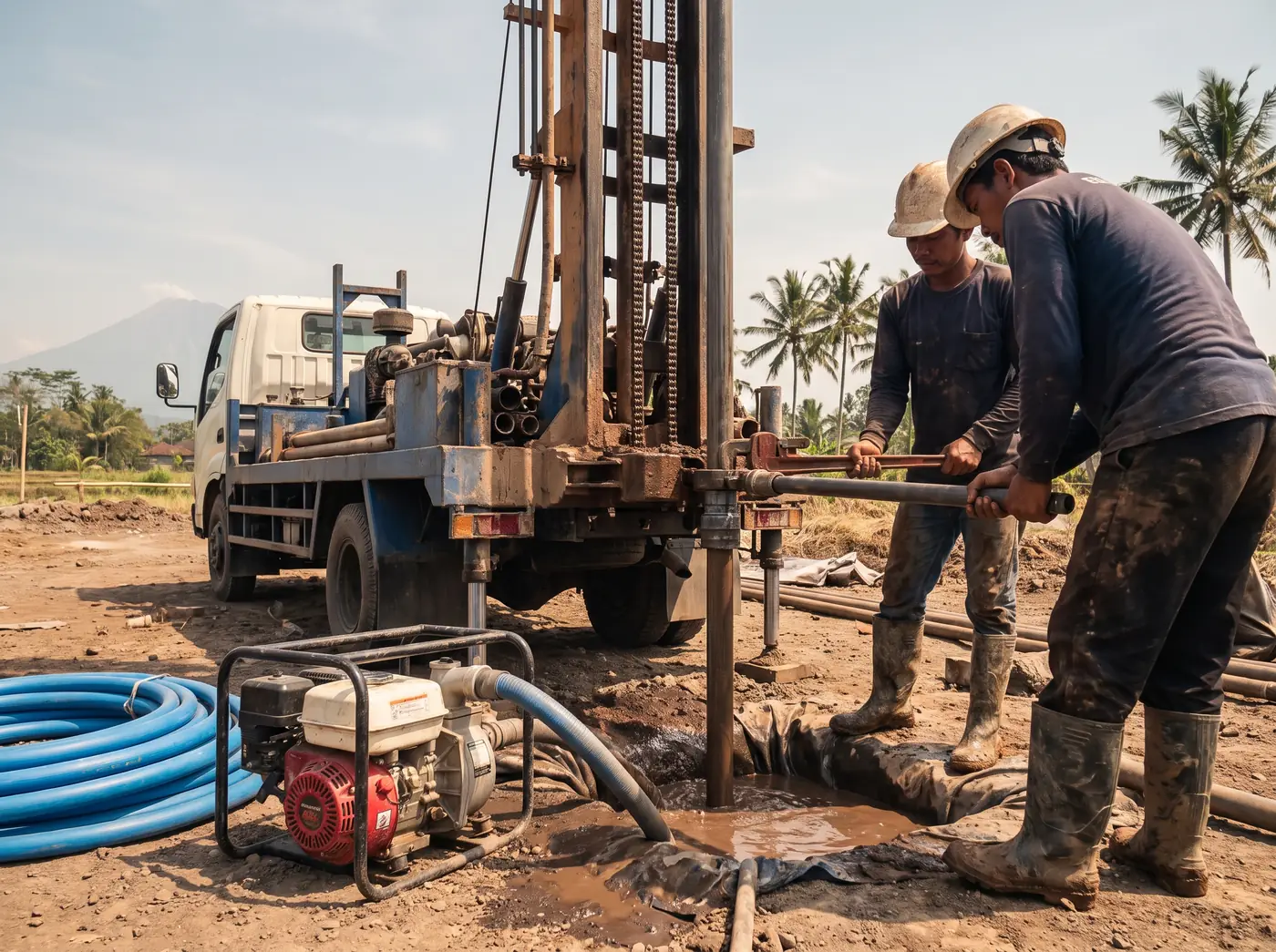
Siting comes from geology, not from a man with a bent rod. We look at known aquifer depths for your area, logs from nearby wells, the surface geology and the distance to septic systems and the coast, then drill where the water is likely to be and the contamination is not. Across much of the south the productive layers sit between 40 and 90 metres; on the limestone of the Bukit, 120 metres and beyond is ordinary.
Construction matters as much as depth. Casing to full depth, slotted screen positioned against the water-bearing layer rather than guessed at, graded gravel pack around it, and a grouted seal in the upper section so surface water and septic seepage cannot run down the outside of the casing. Then development, a step and constant-rate yield test with drawdown recorded in litres per second, and a laboratory analysis before anybody drinks anything.
Depth, yield and the limits of guessing
Depth here is a geography question. Shallow wells of 15 to 30 metres still work in parts of Tabanan and inland Gianyar, but across the built-up south that shallow water is both scarce and suspect — it is the layer the septic tanks share. Protected aquifers in Canggu, Seminyak and Kerobokan typically begin somewhere between 40 and 90 metres, while karstic limestone on the Bukit drains fast and holds its water deep, so 120 to 150 metres is a normal outcome rather than a bad one.
Yield is the number that decides your pump, and it has to be measured. We run a step test to find where drawdown accelerates, then a constant-rate test at the intended duty to see whether the level stabilises. A hole giving two litres per second for ten minutes and half that after four hours is not a two-litre well, and specifying a pump from the first figure is how wells get burned out in their first dry season.
Taking water responsibly
South Bali's groundwater is under genuine pressure. Abstraction has outpaced recharge across the tourist belt for years, water tables have dropped, and saline intrusion now shows up in coastal wells that were fresh a decade ago. Over-pumping your own well is self-defeating: pull harder than the aquifer delivers and you draw in salt or silt, and the water you end up with is worse than the water you had.
So we design to the tested yield rather than to a pump catalogue, recommend storage so the well refills between draws instead of running continuously, and pair wells with rainwater harvesting and recharge pits wherever the roof area allows — every cubic metre caught in January is a cubic metre not taken from the ground in September. Abstraction beyond modest domestic use needs a SIPA permit, and we prepare the drilling log, yield data and coordinates that application requires.
SCOPE OF WORK
What's included
Siting & desk study
Area aquifer data, nearby well logs and distances to septic systems and the coast reviewed before the rig moves.
Drilling & strata log
Rotary drilling with the ground logged metre by metre, so you end up owning a record of what is under your land.
Casing, screen & gravel pack
Casing to depth, screen set against the aquifer and graded pack to keep fines out of your water.
Sanitary sealing
The upper annulus grouted so surface water, fertiliser and septic seepage cannot short-circuit down the outside.
Development & yield test
Airlift development, then step and constant-rate testing with drawdown and recovery measured rather than estimated.
Pump, tower & water test
Submersible sized to the tested yield, tank or tower installed, and a laboratory analysis of the water delivered.
PROCESS
How the job runs
- 01
Siting & feasibility
We review local aquifer data, nearby wells and plot constraints, then agree a target depth and a price band.
- 02
Mobilise & drill
Rig, water and crew mobilised; drilling with the strata logged, typically three to seven days to target depth.
- 03
Case, develop & test
Casing, screen and gravel pack installed, the well developed, then yield tested with drawdown and recovery recorded.
- 04
Pump, plumb & sample
Submersible sized to the tested yield, connected to tank or tower, and a water sample sent to the laboratory.
INDICATIVE PRICING
Honest numbers, before the survey
| Scope | Guide price |
|---|---|
| Drilled well to 60 m, cased & tested | from IDR 18,500,000 |
| Drilled well 80–120 m, cased & tested | from IDR 32,000,000 |
| Submersible pump with tank or tower | from IDR 12,500,000 |
Geology, depth and rig access move the number; quoted fixed after a free site visit and desk study.
Request an exact quoteFAQ
Deep wells in Bali — what owners ask
How deep will our well need to be?
Your area decides it. Much of Canggu, Seminyak and Kerobokan finds usable water between 40 and 90 metres; the Bukit and Uluwatu commonly need 120 to 150; inland Tabanan can be shallower. We quote a depth band from local data and log the strata as we go, so you see what was actually found rather than an invoice with a number on it.
What happens if you do not find water?
It is uncommon at these depths, but the terms should be clear before the rig arrives. Our packages are priced to a target depth with a stated rate per additional metre, and if a hole is genuinely dry we discuss re-siting on the same plot rather than simply drilling deeper. Dry holes get grouted and abandoned properly, never left open.
Do we need a permit for a well?
Household-scale domestic use is generally tolerated, but groundwater rules in Bali have tightened, and commercial abstraction — hotels, restaurants, rental compounds — needs a SIPA abstraction permit. We supply the technical evidence any application needs: drilling log, construction detail, coordinates and yield test data. We will also say when a project looks unlikely to be approved.
What does drilling a well cost in Bali?
A complete well to 60 metres — cased, screened, developed and tested — starts at IDR 18,500,000. Depths of 80 to 120 metres start around IDR 32,000,000, and a pump with tank or tower package from IDR 12,500,000. Rig access and geology set the final figure, fixed after a free site visit and desk study.
RELATED SERVICES
Often booked together
FROM THE BLOG