FIELD NOTES · 2026-02-24 · 9 min READ
Choosing a foundation for Bali soil conditions
Four foundation families cover almost every build on this island, and the ground decides which one you get — not the budget and not the drawings. Here is how coastal sand, former rice paddy, Bukit limestone and river-valley alluvium each behave, and what the right answer costs.
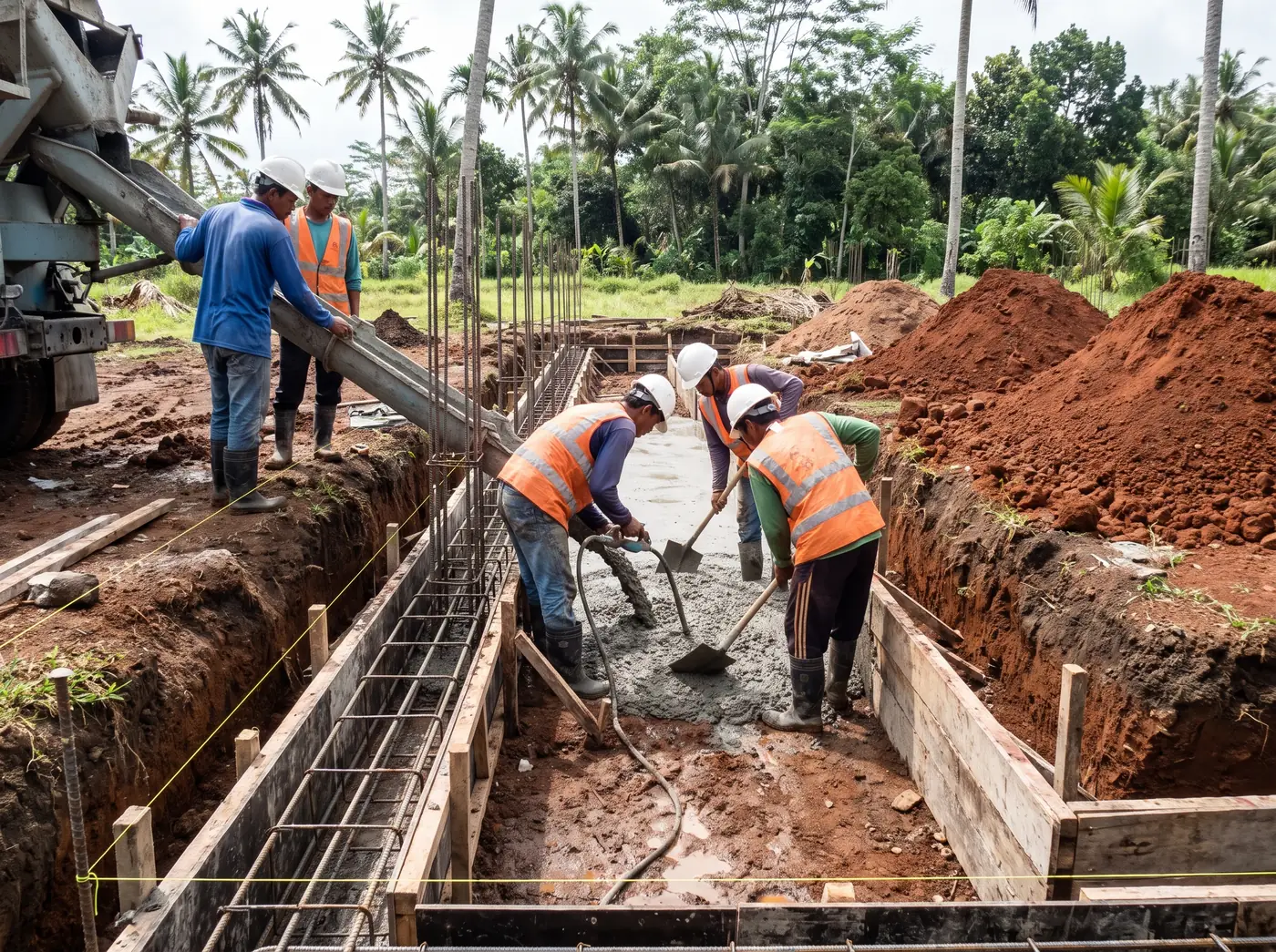
Three soils in one twenty-minute drive
Leave the Berawa beach road heading inland and the ground under you changes three times before Kerobokan. First grey shelly sand with the water table about a metre and a half down. Then two to six metres of soft paddy clay that a shovel slides into without effort. Then dense weathered volcanic material that blunts a pick. A foundation that suits any one of those is wrong on the other two — and the mistake never announces itself at handover. It arrives as a stair-step crack above a door frame in the third wet season, by which time the fix costs more than the whole original footing.
This is the working version of that decision: what strip, pad, raft and piled foundations actually do, which Bali ground each belongs on, and what the choice costs in rupiah. Guide prices assume normal access; a real number comes after real data.
What sits under Bali, area by area
The island is young volcanic rock and ash through the centre and north, uplifted reef limestone across the Bukit peninsula, and an apron of alluvium, ash and sand around the coast. Rain does the rest. The south takes roughly 1,700–2,000 mm a year, Ubud and the central slopes 2,200–2,400 mm, and it arrives in bursts of 80–100 mm an hour that saturate the top two metres within days and push the water table up by a metre or more between August and February. Ground that tests well in the dry season is not the ground your footing will sit in come January.
- Coastal sand belt — Sanur, Nusa Dua, Seminyak and the beachfront strips of Berawa and Pererenan. Loose to medium sand, shelly fill, water table commonly 1.5–3 m, tidal movement within a few hundred metres of the shore.
- Former rice paddy — much of Canggu, Umalas, Kerobokan, the back blocks of Pererenan and the fringes of Ubud. Two to six metres of soft grey clay and organic silt over firmer volcanic ground.
- Bukit limestone — Uluwatu, Bingin, Balangan, Pecatu. Hard coral limestone beneath thin red clay: excellent bearing, with occasional cavities and clay-filled solution channels that swallow a footing.
- River-valley alluvium — the Ayung, Petanu and Oos corridors, plus the small gullies that cut through half the subdivisions on the south coast. Layered sand, silt and old channel fill, water table high and mobile.
- Weathered ash slopes — Tabanan, Sidemen, Munduk. Deep latosol that stands almost vertically in a dry cut and turns to heavy paste once it is saturated.
The four foundation families
Strip and pad footings
Shallow footings spread wall and column loads over a wider area, typically 0.6–1.2 m below finished ground. The local strip is a batu kali trench footing — river stone bedded in mortar — carrying a reinforced concrete ground beam; on engineered work it becomes a reinforced concrete strip sized to the bearing capacity the soil report gave. Pads take individual columns and must be tied together with ground beams so no single column can settle alone. Complete strip work runs from about IDR 5,500,000 per cubic metre of concrete in place, with excavation from IDR 145,000 per cubic metre.
Conditions to use them: competent ground within 1.5 m, allowable bearing around 150 kPa or better, and nothing soft waiting below. That last clause is the whole reason for soil testing — a footing bearing happily on a one-metre crust still rides down with the clay underneath it.
Raft slabs
A raft turns the entire footprint into one stiff foundation: a 200–350 mm slab with thickened ribs under loaded lines, cast on lean concrete over compacted fill. It works where the ground is uniformly mediocre rather than locally awful, because the building settles as one object instead of in pieces. Rafts also suit high water tables, where a deep trench becomes a swimming pool halfway through the pour. Budget from IDR 1,450,000 per m² of raft, and remember that on a compact footprint a raft often beats deep strips once you count excavation, dewatering and the time lost to both.
Piled foundations
Piles ignore the bad layer and take load down to something that can carry it. Hand-augered strauss piles of Ø25–40 cm reach 6–12 m and start around IDR 475,000 per metre; machine-bored piles of Ø40–60 cm go to 20–30 m from about IDR 725,000 per metre, plus mobilisation from IDR 8,500,000. Either way the piles are capped and tied with a ground-beam grid, so the structure above never depends on a single element. Which method fits a given plot is mostly an access and depth question, covered in our comparison of bore piles and strauss piles, and executed by our piling crews.
Hybrids
Real sites rarely read from a textbook. Stepped strip footings follow a sloping plot without excavating the high side to death. A piled raft carries a heavy pool or water tank on piles while the house sits on the slab. On a cut-and-fill plot the cut side may take strips while the fill side needs piles through the imported material — mixing systems is fine as long as an engineer has checked the differential movement between them.
Decision table: ground to foundation
| Ground | Typical areas | Usually the right foundation | What bites |
|---|---|---|---|
| Coastal sand, high water table | Sanur, Nusa Dua, beachfront Berawa | Raft slab, or short piles under heavier lines | Trench collapse, dewatering, salt attack on rebar cover |
| Soft paddy clay 2–6 m over firm ground | Canggu, Umalas, Kerobokan, Ubud fringe | Piles to the firm layer with capping beams | Consolidation settlement, shrink-swell in the dry season |
| Limestone under thin clay | Uluwatu, Bingin, Pecatu | Strip or pad footings on rock, dowelled where needed | Cavities and solution channels, rock excavation cost |
| Layered river alluvium | Ayung and Petanu corridors, gully plots | Bored piles, depth set by test data | Scour, moving water table, buried soft channels |
| Deep weathered ash on slope | Tabanan, Sidemen, north-coast hills | Stepped footings plus retaining and drainage design | Slope creep, saturated collapse, surface water |
The four scenarios in practice
Coastal sand
Sand is not weak — medium-dense sand carries a house comfortably. The problem is that it does not hold a trench wall, it drains fast enough to be re-saturated by the next storm, and within two kilometres of the sea the air itself attacks steel. We normally go to a raft here, with 50 mm minimum cover on the bottom mat and a K300 mix specified for durability rather than strength alone. Where a pool or a two-storey wing loads one line hard, short piles under that line keep the settlement even.
Former rice paddy
This is the classic Canggu trap. The top metre feels solid after a few dry weeks, so someone digs strips, pours them and builds. Underneath, three metres of soft clay is still consolidating under the new weight, and the building leans towards its heaviest corner over the following two years. When cone testing shows a soft layer over firm ground at four to eight metres, piles are the honest answer, and they are usually cheaper than the remedial underpinning that follows the shortcut.
Bukit limestone cliff
Rock takes big loads, which tempts people to skip investigation entirely. Do not. Coral limestone is riddled with voids and clay-filled channels, and a footing that lands over one behaves like a footing on nothing. Probe holes on the actual footing lines are cheap. Cliff plots add a second question — setback from the edge and the stability of the face itself — which belongs with gabion and slope stabilisation design before the house layout is frozen, not after.
River-valley plots
Valley sites look beautiful and hide the messiest ground on the island: old channels of loose sand and silt in no useful order, with the water table swinging a metre or two through the year. Nothing here is guessable. Bored piles taken to a tested depth, plus generous surface drainage so run-off never reaches the foundation zone, is the pattern that survives a decade of wet seasons.
What actually goes wrong
- Differential settlement. Buildings tolerate settling; they do not tolerate settling unevenly. Most cracks we are asked to diagnose are one corner moving 15–25 mm more than the rest.
- Untied pads. Isolated pads without ground beams turn every column into an independent experiment, and in a seismic zone they also lose the diaphragm that keeps the base acting as one frame.
- Shrink and swell. High-plasticity paddy clay moves seasonally. Shallow footings sitting in that zone rise and fall with the calendar; taking the bearing level below it solves the problem outright.
- Fill nobody tested. Plots levelled with uncompacted spoil are common. Fill placed in 200 mm layers and compacted is a foundation material; fill dumped and bulldozed flat is not.
- Water arriving from outside. A perfect footing under a garden that channels a thousand litres a minute against the wall is still going to have a bad February.
What the choice costs
Take a 120 m² single-storey house. On competent ground, strip footings and ground beams come to roughly 14 m³ of concrete work — call it IDR 77 million plus excavation, and the ground floor slab is a separate line. The same footprint as a raft is about IDR 174 million, and on soft paddy clay a piled solution of twenty Ø30 cm strauss piles at 8 m runs about IDR 76 million of piling, plus mobilisation, caps and beams.
Those gaps look dramatic until you price the alternative. Underpinning a settled house means working in one-metre bays under a live structure, and it routinely costs three to five times the foundation that should have been built. The investigation that prevents it — two sondir points from IDR 7,500,000 — is under one per cent of a typical build. We have never seen an owner regret that spend; we have seen plenty regret the week they saved by skipping it, as the article on why a soil test comes first sets out in detail.
What we'd do
Test first, choose second, and keep the two decisions in that order: sondir points on the actual footing lines, a foundation type selected from the numbers, and a ground-beam grid tying whatever you build into one structure. If the report says piles and the budget says strips, change the building — reduce the footprint, lighten the upper floor — rather than the foundation. Our own crews do the foundation work we recommend, which is precisely why we would rather argue about the ground now than about cracks in three years.
FAQ
Quick answers
Can I copy the foundation my neighbour used?
Only if you have data showing the ground is the same, and on this island it often is not. Old river channels, backfilled irrigation cuts and limestone cavities all change within a few dozen metres. A neighbour's success tells you what worked on their ground under their building weight — two sondir points on your plot tell you about yours.
Does the water table really change the foundation type?
Frequently, yes. A table sitting 1.5 m down turns a deep strip trench into a pumping exercise and makes a raft the cheaper, drier option. It also matters for buoyancy under basements and tanks, and for durability, since permanently damp concrete needs more cover to the steel. We log the water level at every test point for exactly this reason.
Are piles always more expensive than a raft?
Per square metre they usually are, but that is the wrong comparison. Piles are priced against what a raft on soft clay would need to be safe: more thickness, more steel, sometimes ground improvement underneath. On firm ground a raft or strips win easily. Over four metres of soft paddy clay, piles are normally both the safer and the cheaper foundation.
NEED IT DONE?
We do this work
Written by the site team at Bali Construction Works, a Bali construction company running its own crews across 46 trades. Questions about your project? Ask on WhatsApp.