FIELD NOTES · 2026-05-04 · 9 min READ
Rainwater harvesting in Bali: the numbers
Roughly two metres of rain lands on Bali every year, and most of it leaves the average property inside ten minutes through a downpipe pointed at the drain. This is the arithmetic of catching some of it instead: how much a roof yields month by month, how big the tank has to be, and when the payback is real.
One formula, three honest corrections
Harvestable water is roof plan area multiplied by rainfall depth, and one millimetre falling on one square metre is one litre. That much is simple. The corrections are where most estimates go wrong.
- Plan area, not sloping area. Rain falls vertically. A pitched roof catches what its footprint catches.
- Runoff coefficient. Metal sheeting delivers about 0.9 of what lands on it; tile, with its texture and absorption, closer to 0.8. Wetting the roof at the start of each shower is a real loss.
- System losses. First-flush diversion, filter bypass during heavy bursts and overflow during full-tank periods take another 10% or so before the water is stored.
For a 200 m² metal roof that lands at roughly 0.85 × 0.9, or about 153 litres of stored water per millimetre of rain. Round it to 150 and the rest of the sums can be done in your head.
A worked year on a 200 m² roof
The rainfall column below is a south-Bali pattern totalling 1,800 mm — Canggu, Umalas, Kerobokan sit around there. Ubud and the central ridge run 2,200–2,400 mm, the north coast nearer 1,400, so scale the whole table by the ratio if your site is elsewhere. Demand is a three-bedroom household using rainwater for toilets, laundry and garden irrigation, with irrigation rising as the dry season bites.
| Month | Rainfall | Yield stored | Typical draw | Balance |
|---|---|---|---|---|
| January | 340 mm | 52.0 m³ | 4 m³ | +48.0 |
| February | 300 mm | 45.9 m³ | 4 m³ | +41.9 |
| March | 230 mm | 35.2 m³ | 4 m³ | +31.2 |
| April | 110 mm | 16.8 m³ | 8 m³ | +8.8 |
| May | 90 mm | 13.8 m³ | 12 m³ | +1.8 |
| June | 60 mm | 9.2 m³ | 16 m³ | −6.8 |
| July | 40 mm | 6.1 m³ | 18 m³ | −11.9 |
| August | 25 mm | 3.8 m³ | 20 m³ | −16.2 |
| September | 45 mm | 6.9 m³ | 16 m³ | −9.1 |
| October | 90 mm | 13.8 m³ | 10 m³ | +3.8 |
| November | 190 mm | 29.1 m³ | 5 m³ | +24.1 |
| December | 280 mm | 42.8 m³ | 4 m³ | +38.8 |
| Year | 1,800 mm | 275 m³ | 121 m³ | +154 |
Two things jump out of that table. The roof produces more than twice the water the household wants — and it produces it entirely in the wrong months. Every serious decision in rainwater harvesting comes from that mismatch, not from the annual total.
The first 100 litres are not yours
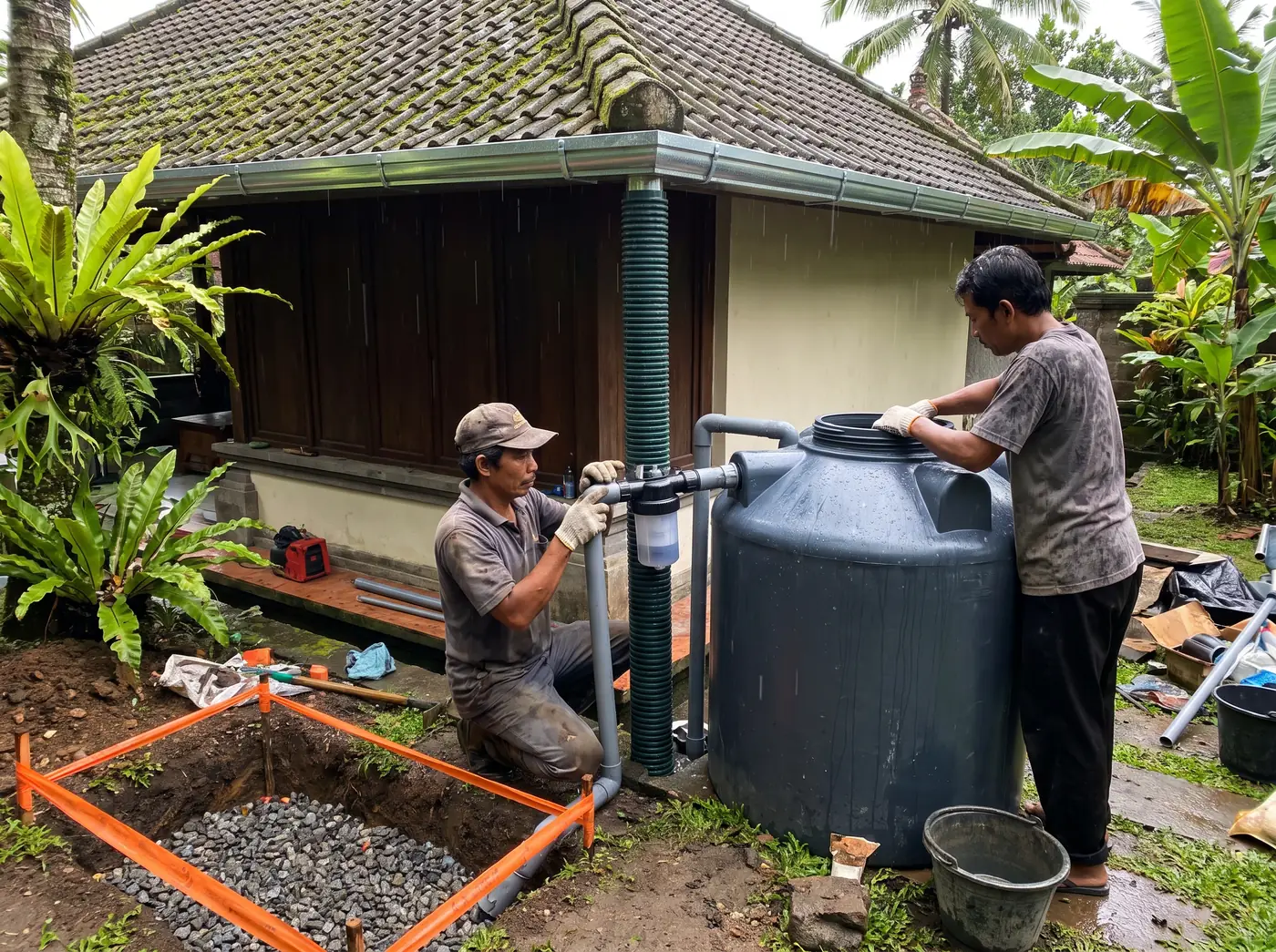
A roof accumulates dust, salt, bird droppings, frangipani flowers and gecko remains between storms. The opening minutes of rain carry all of it into the system, which is why every installation we build has a first-flush diverter — a standpipe that fills with the dirty initial flow, seals with a float ball, and lets the clean water pass on.
Size it at about 0.5 mm of rainfall, which on a 200 m² roof is 100 litres. After a long dry spell in August, when a month of deposits is sitting up there, we divert closer to 1 mm. The diverter drains slowly through a small orifice and resets itself between showers. It costs very little and it is the single component that decides whether your tank water smells sweet or organic three months in.
Sizing the tank against the dry season, not the brochure
Storage is the expensive part, and bigger is not automatically better. Run the balance column cumulatively: with the tank full at the end of May, June and July draw it down, and by mid-August it is empty regardless of what it cost. The dry-season deficit in the worked example totals about 44 m³. A tank that carried the household all the way through would need to hold that much — a serious concrete structure, buried, with an excavation to match.
What we actually build sits between 10 and 20 m³ for a house that size, and the honest performance looks like this:
- 10 m³: covers roughly 85–90 m³ of the 121 m³ annual demand — about 72%. Carries June and half of July before the well or mains takes over.
- 20 m³: around 95–100 m³, roughly 80%. The extra 10 m³ buys about three weeks in August, and costs disproportionately more.
- 45 m³: full autonomy on paper, and a capital cost that no water bill in Bali will ever repay.
The working rule we use: size storage at four to six weeks of average demand, or about 5% of annual yield, whichever is larger. Then spend the money you saved on filtration and on the plumbing that actually connects the tank to the fixtures. A 10 m³ garden and toilet-flush system starts from IDR 24,500,000 installed, which is the configuration most houses should start from — expandable later if the household grows into it.
Where the tank goes matters almost as much as how big it is. Buried reinforced concrete is the durable answer on a finished property: it takes no garden space, keeps the water cool and dark, and can be cast while the foundations are open for a fraction of what it costs to retrofit. Modular HDPE tanks are quicker and cheaper but need shade, since sunlight through a translucent wall grows algae in a fortnight, and they need ballast or an anchor slab where the wet-season water table is high — an empty tank in saturated ground behaves exactly like an empty septic unit and lifts. Whichever you choose, put the tank below the gutter outlets and above nothing, so gravity does the collecting and a small pressure set does the delivering.
What you can legitimately use it for
Water quality follows use, and the tiers are distinct. Paying for potable treatment to irrigate frangipani is a common and expensive mistake.
| Tier | Uses | Treatment required |
|---|---|---|
| 1 | Garden irrigation, pool top-up, hardscape and vehicle washing | Leaf screen, first-flush diverter, sealed dark tank |
| 2 | Toilet flushing, laundry, outdoor showers, cleaning | Tier 1 plus 20 µm and 5 µm sediment cartridges, pressure set |
| 3 | Kitchen and drinking water | Tier 2 plus 1 µm and carbon stages, UV at 30 mJ/cm² or better, annual coliform testing |
Tier 2 is the sweet spot for most properties: toilets and laundry are between a third and half of household consumption, they run all year, and they need no disinfection. Tier 3 is achievable — a potable-grade filtration add-on runs from IDR 9,500,000 — but it commits you to changing cartridges and lamps on schedule and to testing the water like a small utility. Do it because you want the independence, not because it saves money.
Does it pay for itself?
That depends entirely on what your water currently costs, and the range in Bali is enormous.
- Tankered water: dry-season deliveries commonly run IDR 350,000–600,000 for 5,000 litres, which is IDR 70,000–120,000 per cubic metre. Displacing 87 m³ a year saves something like IDR 7–9 million. A 10 m³ system pays back in roughly three years, and faster every August.
- A well: the saving is electricity, not water, so the money case is weak. The case that matters is that every cubic metre from the roof is a cubic metre not pulled from an aquifer that is already under pressure — the reason we pair harvesting with almost every deep well we drill.
- Mains supply: domestic tariffs are single-digit thousands of rupiah per cubic metre. On price alone the payback runs to decades. Commercial tariffs, and properties where supply simply stops for days, change that calculation completely.
We say this to clients plainly, because greenwashed payback claims have made owners suspicious of the whole category, and rightly so. Harvesting earns its keep on trucked-water properties, on properties with weak or brackish bores, and anywhere the alternative is drilling another hole. On a well-served mains connection it is an environmental decision, and worth making for that reason alone — the groundwater arithmetic on this island is not improving on its own.
Where these systems go wrong
Almost never in the tank. Almost always in the four metres between the roof and it.
- Undersized conveyance. Bali rain arrives at 80–100 mm/hr. On a 200 m² roof that is 5 litres per second arriving at the gutter, and a 40 mm inline filter passing half a litre per second sends 90% of the storm over the top. Gutters, downpipes, screens and diverters all have to be sized for the burst, not the annual average — which is why we calculate gutters and downpipes from catchment area and rain intensity rather than from what fits the fascia.
- The wrong roof. Coated metal and clay tile are both fine catchments. Alang-alang cannot be harvested from usefully, old asbestos-cement sheet should never feed a storage tank, and freshly painted or bitumen-coated surfaces need a season of flushing first. Roof choice affects far more than rain capture, which is why it is worth reading how the common coverings compare here before deciding.
- Mosquitoes. Any standing water in a dengue zone is a public health matter, not an inconvenience. Every inlet, overflow and vent gets 1 mm stainless mesh, and tanks are opaque and sealed. We check this on every service visit.
- Overflow pointed at the drain. When the tank is full in January, 40 m³ a month leaves it. Sending that to a recharge pit puts it back into the ground under your own property instead of into the street. A pit costs from IDR 6,500,000 and does more for the local water table than the tank does.
- No plan for the changeover. An automatic switch to well or mains when the tank drops below a set level is what keeps a household from noticing the system exists in August. Manual valves get forgotten and pumps run dry.
What we'd do
Measure the roof plan area, multiply by your local annual rainfall and 0.15 to see the yield in cubic metres, then compare it with what the property actually uses. Build for Tier 2 with a 10–15 m³ tank, size every pipe and filter for a 5 litre-per-second burst, and put the overflow into a recharge pit rather than the storm drain. We design and install rainwater harvesting systems as part of the plumbing on new builds and as a retrofit on finished houses, and we will run these numbers on your roof before anyone quotes a tank.
NEED IT DONE?
We do this work
This guide is published by the engineers of a full-cycle construction company in Bali — the same team that quotes and builds the work described above.