FIELD NOTES · 2026-04-15 · 9 min READ
Deep wells in Bali: depths, permits, real costs
Two properties 400 metres apart, both in Pererenan. One well hit good water at 74 metres and has never faltered. The other went to 96 metres, produced 0.15 litres per second, and the owner still buys tankered water. The difference was not luck — it was what each crew knew before the rig arrived.
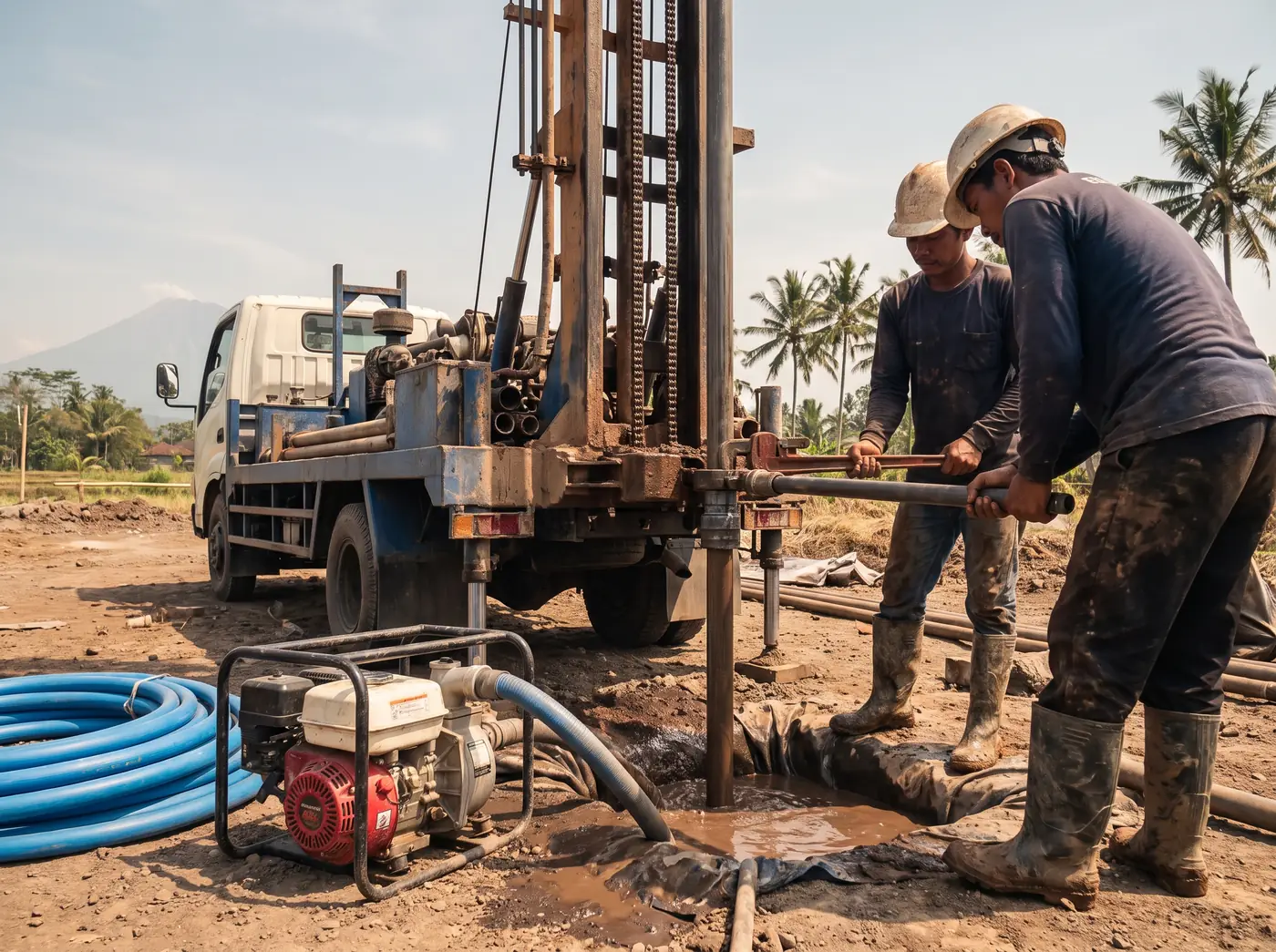
What is actually under your land
A drilling quote that arrives before anyone has asked where the property sits is a price for a hole, not for water. Bali's groundwater lives in layered volcanic deposits — ash, tuff, weathered lava — and the depth at which those layers hold something worth pumping shifts over a few kilometres. In Canggu we routinely find a productive strata between 60 and 90 metres. Eight kilometres south on the Bukit, the same rig can grind through 120 metres of karst limestone and find fissures that swallow drilling fluid without ever giving water back.
The table below reflects what our rigs meet in the field, not a hydrogeological survey. Read it as a starting expectation, then confirm it against neighbouring wells — on this island the most useful data source is usually the property two doors down, and the driller who last worked that street.
| Area | Typical productive depth | What the rig usually meets |
|---|---|---|
| Canggu, Berawa, Pererenan | 60–90 m | Dependable volcanic aquifer under a clay cap; the shallow water at 12–20 m is generally not fit to drink |
| Seminyak, Kerobokan, Umalas | 70–100 m | Dense neighbouring abstraction; static levels sit lower every September than they did in April |
| Sanur and the east coast strip | 40–80 m | Good flows, but chloride climbs as you approach the shoreline — test before you buy a pump |
| Ubud, Tegallalang, Payangan | 40–90 m | Strong yields; elevation simply puts the water table a long way below the building pad |
| Bukit peninsula (Uluwatu, Pecatu, Bingin) | 100–150 m and beyond | Karst limestone, unpredictable fissures, genuine risk of a dry hole — budget for that possibility |
| Tabanan and the inland rice belt | 30–60 m | Shallow aquifers that are easy to reach and easy to contaminate from paddy runoff |
| North coast (Lovina, Seririt) | 25–60 m | Shallower volcanic layers, kinder drilling, lower cost per metre |
Shallow bore or deep well
A shallow bore of 20–40 metres is a different animal from a deep well, and plenty of Bali properties are quietly running the wrong one. Shallow bores tap the unconfined water table — the same body of water that receives every soak pit, drain field and fertilised paddy within a few hundred metres. It is cheap to reach, a jet pump handles it, and in the wet season it delivers happily. Then August arrives, the table drops two or three metres, the pump starts sucking air by mid-afternoon, and the household discovers what seasonal abstraction really means.
A deep well goes past an aquitard — a clay or dense tuff layer that separates the shallow water from a confined aquifer beneath it. That layer is the whole point. It buys pressure stability through the dry months and it keeps surface contamination out of the water you shower in. Coliform bacteria and nitrate in shallow south Bali wells are not rare findings; they are the expected result of putting untreated effluent into permeable ground upstream of a bore, which is exactly why how your wastewater is treated belongs in the same conversation as where your water comes from.
- Shallow bore, 20–40 m: low cost, jet pump, seasonal reliability, water quality tied to whatever your neighbours discharge.
- Deep well, 60–150 m: higher capital cost, submersible pump, stable through the dry season, protected by the confining layer above it.
- Hybrid reality: many older properties have a shallow bore for the garden and a deep well for the house. That split is sensible if the shallow one is never plumbed into a drinking line.
The anatomy of a well that lasts twenty years
Drilling is the visible half of the job. What decides whether the well is still performing in 2046 is what goes into the hole afterwards, and most of it is buried before the client sees it.
Casing and screens
We case with pressure-rated PVC — usually 4 inch for a house, 6 inch where the yield or pump size demands it — and we do not case the whole depth blind. Screens, the slotted sections that actually let water in, go opposite the water-bearing strata identified from the drill cuttings and the driller's log. Slot size is matched to the formation grain: too coarse and the well pumps sand into your pump for the rest of its life, too fine and it blinds off within two seasons.
Gravel pack and sanitary seal
Graded gravel is placed in the annulus around the screens so that fine material stays outside and water passes through. Above it, the top 6–12 metres of annulus gets a grout seal — bentonite or cement. That seal is the only thing preventing rainwater running down the outside of your casing and carrying surface contamination straight to the aquifer. It is also the first item cut when a quote is being squeezed, which tells you something about very cheap wells.
Development
A new well is full of drilling mud and fines. Airlifting or surging until the water runs clear can take several hours; skipping it means the well never reaches the yield it was capable of, and the client blames the aquifer. We log turbidity as we go and stop when it stops improving, not when the clock says so.
Yield testing: the number your pump is chosen from
Before anyone sells you a pump, the well needs a pumping test. We measure the static water level, then draw at a fixed rate and watch how far the level falls and how fast it recovers when we stop. A short step test finds the sustainable rate; a constant-rate run of six to twenty-four hours proves the well can hold it. The output is two numbers: sustainable yield in litres per second, and the pumping water level that the pump must lift from.
Put that against real demand. A four-bedroom house with a pool, a garden and regular guests uses roughly 2.5–4 m³ a day. A well producing a modest 0.5 l/s delivers 1.8 m³ per hour — which means the aquifer is not the constraint, storage and pump duty are. This is why we pair almost every well with a ground tank and a booster set rather than letting a submersible cycle on demand; that pump and tank work sits inside our plumbing and drainage packages and is priced with the well, not discovered afterwards.
SIPA, in one paragraph
Groundwater abstraction in Indonesia is licensed. A drilling permit covers the act of making the hole, and SIPA — Surat Izin Pengusahaan Air Tanah — covers taking water from it, with the well located inside a recognised groundwater basin, a meter fitted, and volumes reported. Households drawing small domestic quantities are treated differently from businesses; a villa operating commercially, a restaurant or a hotel is squarely in permit territory, and enforcement in Badung and Gianyar has grown noticeably less theoretical over the last few years. We handle the technical submissions — well log, construction drawing, yield test data, meter details — as part of a deep well drilling package, because the paperwork needs the driller's data anyway and retrofitting it later is painful.
What a well actually costs
Cost is driven by depth, geology and access. A rig on an open Tabanan plot is a different mobilisation from a rig that has to be broken down and carried through a 2.2-metre gang in Seminyak. These are the guide figures we quote from, before a site visit fixes them.
| Scope | Guide price | What it covers |
|---|---|---|
| Drilled well to 60 m | from IDR 18,500,000 | Drilling, PVC casing and screens, gravel pack, sanitary seal, development, basic yield check |
| Deep well 80–120 m | from IDR 32,000,000 | Heavier rig, more casing, longer development, formal pumping test and well log |
| Pump, tower and controls | from IDR 12,500,000 | Submersible sized to the pumping level, cable, control box, dry-run protection, tower or ground tank connection |
Two honest caveats. First, on the Bukit a dry hole is a real outcome, and any driller who guarantees water there without local evidence is selling optimism — we price exploratory depth explicitly so nobody is arguing about it at 110 metres. Second, the cheapest quote on the island is nearly always the one with no gravel pack, no sanitary seal and no pumping test, and you will meet all three omissions again within five years.
After the water arrives
Test what you are pumping
Clear water is not clean water. We send a sample to an accredited laboratory before the well is connected to anything a person drinks from: pH, TDS, total hardness, iron and manganese, chloride, nitrate, and a bacteriological panel for total coliform and E. coli. Iron and manganese are the routine findings in Bali's volcanic aquifers — harmless to health at the levels we usually see, ruinous to white sanitaryware and laundry, and easily handled with an oxidising filter. Chloride above roughly 250 mg/l near the coast is the number that changes plans: it means seawater intrusion, and no filter fixes that economically. Repeat the bacteriological test annually, and always after flood water has crossed the wellhead.
Take less than the pump could give you
Bali abstracts more groundwater in the south than the wet season puts back, and the tourism sector takes the larger share of it. Wells that draw down neighbouring bores, and coastal intrusion that follows sustained over-pumping, are not abstract problems here — they are the reason some Canggu properties now drill twice. We build wells, and we still tell clients to take less from them: irrigate the garden and flush the toilets from a rainwater system instead, and let the well serve the uses that genuinely need treated groundwater. On a 200 m² roof the arithmetic is better than most owners expect, which we worked through in detail in the rainwater numbers. A recharge pit that returns roof runoff to the ground rather than to the storm drain costs less than a week of tankered deliveries.
What we'd do
Ask three neighbours what depth their wells are and how they behave in September. Get a written scope that names casing diameter, screen positions, gravel pack, sanitary seal depth and a pumping test — if any of those is missing from the quote, it is missing from the well. Budget for the lab panel before you budget for the tap. Our own rigs and crews drill across the island and we will tell you plainly when a site is better served by storage and rainwater than by another 120-metre hole; that answer costs us a job and saves you thirty million rupiah.
FAQ
Quick answers
How deep does a well in Bali need to be?
It depends entirely on where you are. Canggu and Pererenan usually find dependable water at 60–90 m, the east coast at 40–80 m, and the Bukit peninsula frequently needs 100–150 m or more through limestone. Anything shallower than about 40 m is generally drawing from the same unconfined table that receives local wastewater, which is fine for the garden and unwise for the kitchen.
Do I need a SIPA permit for a private well?
Domestic households drawing small volumes are treated differently from commercial users. If the property is rented out, runs as a hotel or serves a business, you are in permit territory: a drilling permit, then SIPA for abstraction, with a meter and reported volumes. We prepare the technical file — well log, construction drawing, yield test — as part of the job, because that data only exists while the rig is on site.
How long does drilling take, and how messy is it?
A 60 m well is usually two to three days on site; 100–120 m runs four to six. Rotary drilling uses circulating fluid, so expect a settling pit and a muddy working zone of roughly 4 × 5 m, plus access for the rig. We sheet and bund the area on finished properties, and clear the spoil and restore the ground before demobilising.
NEED IT DONE?
We do this work
Need this done rather than read about it? Our Bali construction company quotes every scope in writing after a free site survey — see the 46 services.