FIELD NOTES · 2026-04-24 · 9 min READ
Bio septic vs conventional: wastewater done right
Nobody asks to see the septic tank before they buy a house. Two years later, when the garden smells after every downpour and the guest bathroom drains slowly, it becomes the only thing anyone wants to talk about. Wastewater is the cheapest part of a build to get right and one of the most expensive to fix.
What happens after the flush
A conventional septic tank is a settling chamber with ambitions. Sewage enters the first compartment, solids sink, grease floats, and the liquid in the middle passes under a baffle into a second chamber before leaving for a soak pit. Anaerobic bacteria slowly digest the sludge at the bottom. That is the whole mechanism, and it works — as far as it goes.
How far it goes is the part owners are rarely told. A correctly built two-chamber tank holding two to three days of flow removes somewhere between a third and a half of the organic load. The liquid leaving it still carries roughly 100–200 mg/l of BOD and a full population of pathogens. It is not treated water; it is settled sewage, and everything downstream depends on the ground absorbing and filtering it. When the ground cannot do that, the tank has no plan B.
Three failure patterns account for most of the tanks we replace: undersized chambers, so solids carry over into the soak pit and blind it; unlined blockwork built without a proper base, so the tank leaks directly into the water table; and a soak pit dug into clay, which fills in the first week of the wet season and never empties again.
What the extra chambers of a bio septic buy you
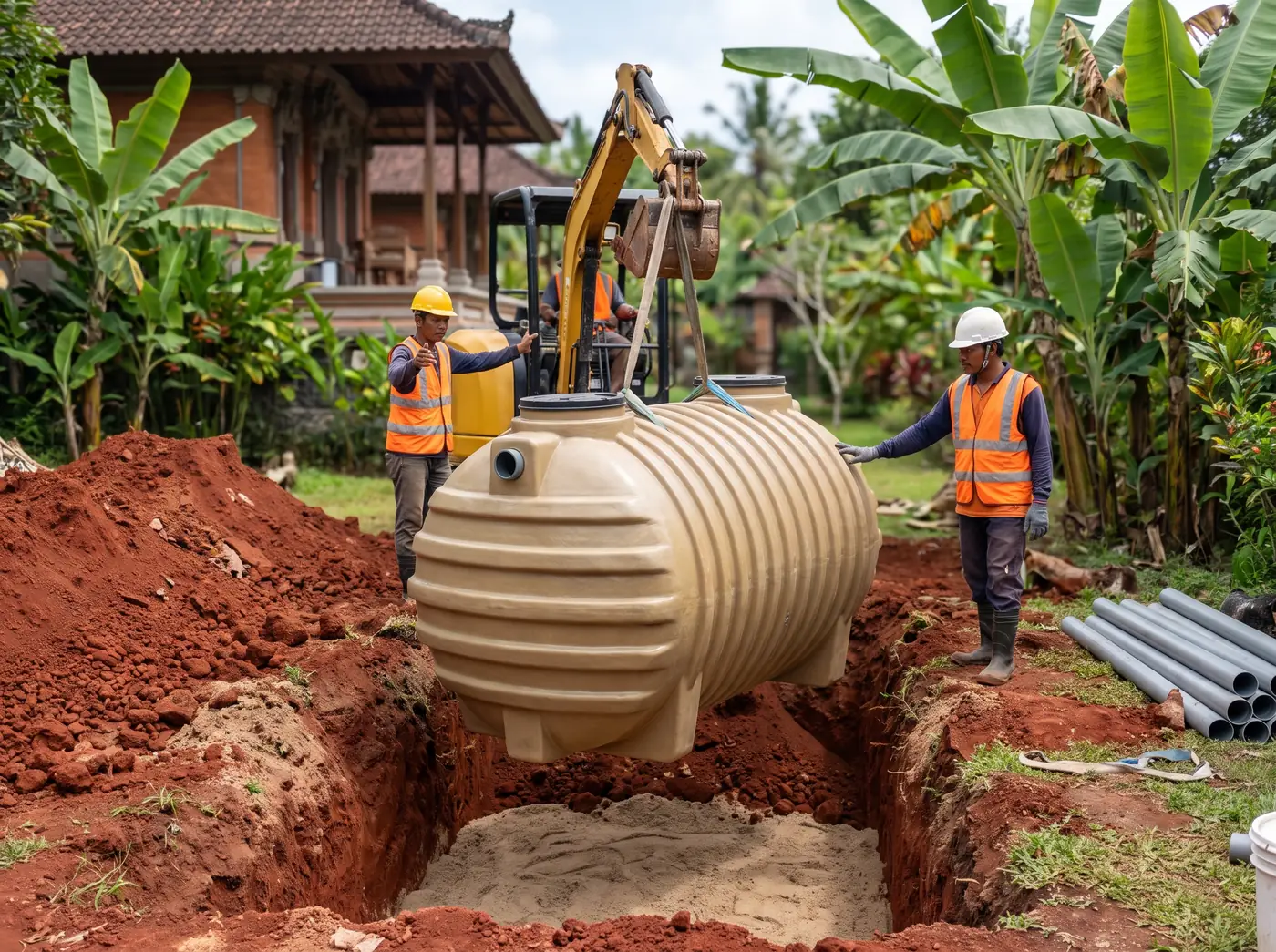
A bio septic — the fibreglass or HDPE units you see arriving on flatbed trucks across the island — is a compact treatment plant rather than a holding tank. Flow moves through four or five stages: settling, an anaerobic chamber packed with plastic media where bacteria colonise the surface area, an aerated chamber fed by a small blower, a clarifier that returns settled sludge, and a contact chamber where a chlorine tablet handles the last of the bacteria.
The aeration stage is what changes the numbers. Oxygen lets a different bacterial population work an order of magnitude faster, and a properly loaded unit puts out effluent around 20–30 mg/l BOD — inside the national domestic effluent standard, clear enough to feed subsurface irrigation instead of a soak pit. The costs of that performance are honest ones: a blower drawing 40–80 watts continuously, a tablet to replace every few weeks, and a system that genuinely notices when you switch the power off for a fortnight.
| Conventional tank + soak pit | Bio septic unit | |
|---|---|---|
| Treatment | Settling and anaerobic digestion only | Settling, anaerobic media, aeration, clarifier, disinfection |
| Typical effluent | 100–200 mg/l BOD, pathogens present | 20–30 mg/l BOD, disinfected |
| Depends on soil | Completely — the soak pit does the rest of the work | Lightly — effluent can go to drip irrigation or a small pit |
| Power | None | Blower running continuously |
| Footprint | Tank plus a soak pit or field, often 15–25 m² | One buried unit, typically 4–8 m² |
| Desludging | Every 2–3 years | Every 1–2 years, plus blower servicing |
| Suits | Free-draining volcanic soil, generous plot, low occupancy | Clay, limestone, tight plots, rented properties, anywhere near a well |
Sizing by bedrooms, not by habit
The default on many Bali sites is a 2 m³ tank because that is what the last five houses got. Sizing starts from occupancy and water use instead. Owner-occupied households here run about 120–150 litres per person per day. Rented properties with pools, laundry, daily housekeeping and a rotating cast of guests run 250–350 litres. That difference doubles the tank before anyone has counted a bedroom.
| Bedrooms | Design occupancy | Daily flow (owner / rental) | Bio septic size |
|---|---|---|---|
| 1–2 | 4 people | 0.6 / 1.2 m³ | 2 m³ |
| 3 | 6 people | 0.9 / 1.8 m³ | 3 m³ |
| 4 | 8 people | 1.2 / 2.4 m³ | 4–5 m³ |
| 5–6 | 12 people | 1.8 / 3.6 m³ | 6–8 m³ or twin units |
| 7+ or multi-unit compound | 16 people and up | 2.4 / 5.0 m³ and up | Packaged treatment plant |
Two additions that get forgotten. A commercial kitchen — or any villa kitchen cooking for guests — needs a grease trap ahead of the tank, cleaned weekly, or the media chambers turn into a solid block within a year. And staff quarters, if they exist, count as full-time occupancy even when the main house sits empty for months.
The clay problem
Everything downstream of a conventional tank rests on one assumption: that the ground takes the water. Across Bali's inland rice belt and the Ubud valley the ground is heavy clay, and it does not. On the Bukit peninsula the opposite is true — fissured limestone takes the effluent instantly and filters almost none of it before it reaches groundwater. Neither soil suits a soak pit, for opposite reasons.
The test is simple and worth the half-day. Dig a 300 mm hole, 600 mm deep, at the proposed pit location. Presoak it overnight, refill, and time how long the level takes to fall 25 mm.
- Under 10 minutes per 25 mm: free-draining volcanic loam. A soak pit will work; check separation from wells.
- 10–45 minutes: workable, but size the field generously and expect wet-season slowdown.
- Over 60 minutes: effectively impermeable. A soak pit here is a hole that fills up in January and stays full until August.
- Instant disappearance with no water retained: karst. Fast is not good — there is no filtration path at all.
Where percolation fails, the answer is to treat harder rather than dig deeper: a bio septic discharging to shallow subsurface drip lines under the garden, a raised sand-filled mound, or an evapotranspiration bed planted with heavy feeders. The one thing that never works is a bigger pit in the same clay. If a soil investigation is already programmed for the foundations, ask the crew to log the drainage layers while they are there — the data costs almost nothing at that point.
One more piece of physics: an empty fibreglass tank in a high water table floats. We have been called to two units that surfaced through a lawn like a submarine after a week of rain. Tanks get an anchor slab and straps, and they get filled with water as the backfill goes in, not after.
The island drinks its own groundwater
This is the part that makes wastewater a shared problem rather than a private one. Most of Bali's water comes from beneath Bali. Shallow wells across the southern strip regularly test positive for coliform bacteria and high nitrate, and there is no mystery about the source: thousands of soak pits discharging settled sewage into permeable ground, upstream of thousands of bores. When we discuss where a well should be drilled, half the conversation is really about where everyone's septic systems are.
Practical rules we hold to, and would hold to on our own house:
- Minimum 10 metres between any soak pit and any well, and put the pit hydraulically downhill of the bore, never above it.
- Keep at least 1.5 metres of unsaturated soil under the base of a soak pit at the wet-season water table, not the dry-season one.
- If the plot cannot deliver both, treat to a standard that lets the effluent irrigate rather than infiltrate.
- Sample the well annually for total coliform and E. coli. It is the only way to know whether the neighbourhood is winning or losing.
Maintenance, which is not optional
A septic system is the only part of a house that runs a biological process continuously and gets inspected never. The schedule is short:
- Monthly: check the chlorine tablet, listen to the blower, look for standing water above the field.
- Every 6 months: blower service, air filter clean, diffuser check, sludge depth measured in the settling chamber.
- Every 1–2 years: desludge a bio unit; every 2–3 years for a conventional tank. Never empty a tank completely in the wet season — see the floating submarine above.
- Annually: an effluent sample if the property is rented or licensed. It is also the cheapest early warning that the unit is overloaded.
Our service contracts start from IDR 1,850,000 per quarter and exist mostly because absentee owners cannot smell the problem developing. Bleach is the usual accidental killer: a housekeeper pouring disinfectant down every drain daily will sterilise the media chambers, and the unit takes weeks to recover.
When a tank stops being enough
Above roughly 5 m³ a day — a small hotel, a compound of rental units, a restaurant, a co-living building — packaged tanks stop being the right tool and a proper treatment plant takes over. Extended aeration or moving-bed media, sized by daily flow rather than by tank volume, with sludge return, blowers on a duty-standby pair, and disinfection before discharge. The output can legitimately irrigate landscape, which turns a cost centre into the wet half of a water strategy. We install these alongside the drainage rough-in during construction, because retrofitting gravity falls into a finished building is where the real money goes.
Guide pricing, before a site survey fixes it: a 3 m³ bio septic installed from IDR 21,500,000, a villa-scale treatment plant from IDR 65,000,000, and quarterly servicing from IDR 1,850,000. The difference between the first two is usually occupancy and soil, not ambition.
What we'd do
Do the percolation test before you choose a system, not after the pit fails. On clay, on the Bukit, or anywhere within 15 metres of a bore, we would fit a bio septic and irrigate the effluent rather than push it into ground that cannot handle it. Size from realistic occupancy, add a grease trap if a kitchen feeds guests, and put the servicing on a calendar the day it is commissioned. Our crews install wastewater treatment plants and septic systems across the island and also maintain them, which is why we would rather size a tank generously on day one than come back to dig it up.
NEED IT DONE?
We do this work
Prices and methods in this article are the ones we use on our own sites as a construction contractor in Bali. They are updated when the market moves.