FIELD NOTES · 2026-06-11 · 9 min READ
Bamboo vs timber: an honest comparison
We are asked to price bamboo against hardwood perhaps twice a month, and the honest answer is rarely the one either camp wants. Bamboo is not automatically cheaper, and timber is not automatically more durable. What separates them is treatment, connections and how much maintenance the owner will realistically do.
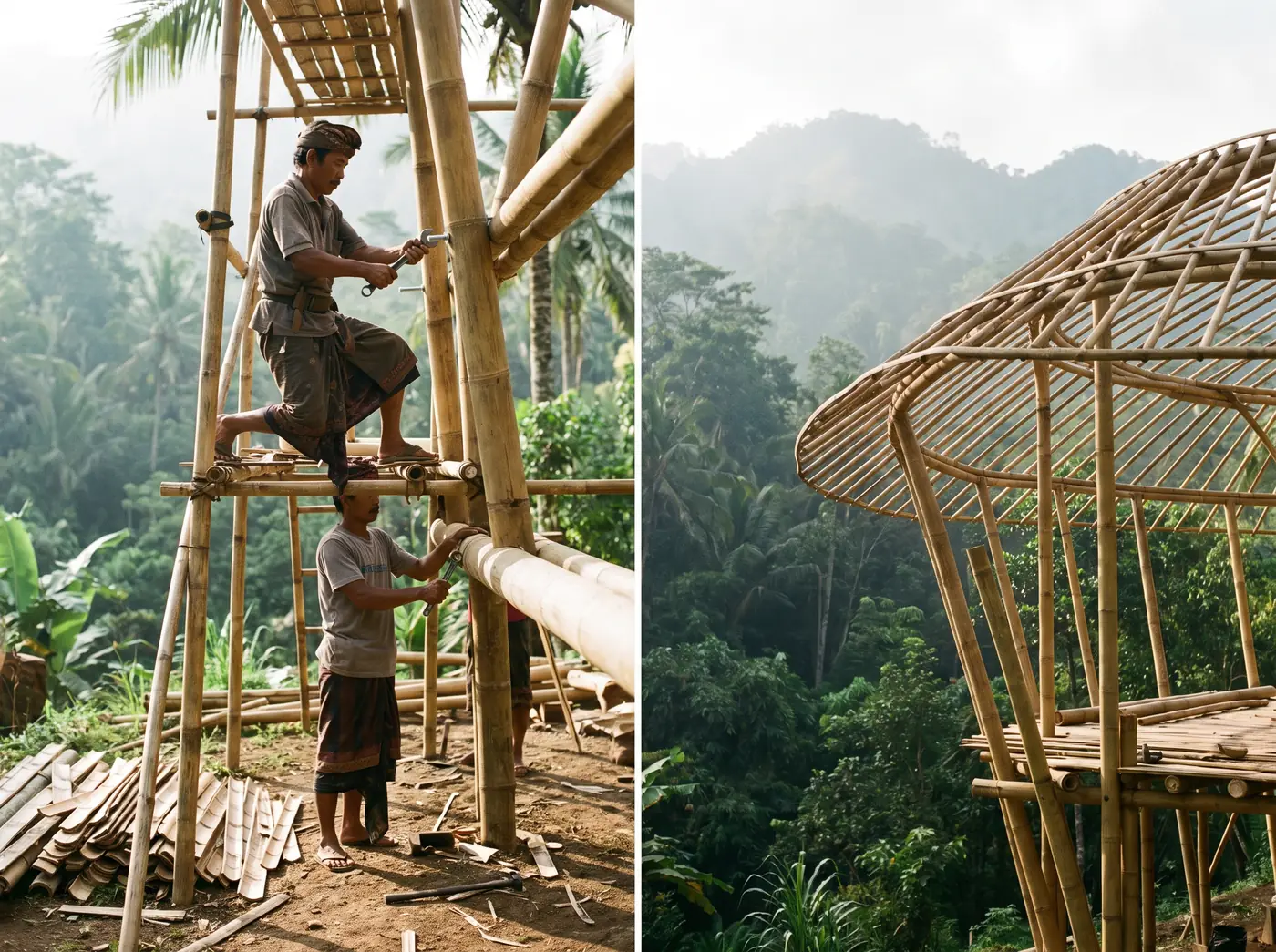
Start with a real building
There is a bamboo pavilion near Ubud that we were asked to survey last dry season. Nine years old, about 90 m², petung columns, a thatch roof with a wide overhang. Eight of the ten columns were in excellent condition — dense, ringing when struck, dimensionally sound. The other two had turned to powder inside their first metre. The difference between them was not the species, the treatment or the year they were cut. It was that the two failed columns sat where a downpipe discharged, and one of them had been trimmed on site so the cut face at the base was never sealed.
That is the whole comparison in miniature. Both materials are organic, both are eaten by the same insects, both rot when they stay wet. Neither is inherently good or bad here. What decides the outcome is whether the design keeps water off them and whether the treatment went all the way through.
What each material actually is
Structural bamboo
Bamboo is a hollow tube of longitudinally aligned fibres with periodic diaphragms at the nodes. That geometry gives an extraordinary strength-to-weight ratio in tension and in bending: a well-selected petung (Dendrocalamus asper) pole weighs a fraction of a hardwood section of comparable capacity, which is why bamboo spans and cantilevers look impossible and are not.
Three properties shape how it is used. First, it is strongest along the grain and weak across it — a bolt through a pole wants a fitted timber or grout plug behind it, or the tube splits. Second, it varies: diameter, wall thickness and node spacing change along every pole and between poles, so nothing is standardised and every member is effectively hand-selected. Third, it must be harvested mature — four to five years old, cut in the dry season — and treated within days. Green, immature or untreated bamboo is powderpost beetle food within a year, and no amount of good design saves it. On the island, the species worth knowing are petung for structure, tali (Gigantochloa apus) for lashings and secondary members, and black bamboo for visible decorative work.
Tropical hardwood
Sawn hardwood gives you the opposite trade. You lose the strength-to-weight advantage and pay for the extra mass in foundations, but you gain predictability. A 100 × 200 bengkirai beam is the same section everywhere along its length, its capacity comes from published tables, and a carpenter can join it with conventional connections that engineers, building inspectors and insurers all recognise.
Indonesian durability classes are the useful shorthand. Ulin (ironwood) is Class I and survives ground contact for decades. Merbau sits at I–II and is stable and hard. Bengkirai is Class II and is the practical workhorse for decking, pergolas and roof structures. Plantation teak has a wide pale sapwood band that is not durable at all, whatever the name implies. Timber also takes fixings anywhere along its length, which sounds trivial until you are hanging a door, a gutter or an air-conditioning bracket on a bamboo frame.
Side by side
| Structural bamboo (petung) | Tropical hardwood | |
|---|---|---|
| Strength-to-weight | Outstanding in tension and bending | Good, but heavier for the same capacity |
| Dimensional consistency | None — every pole is selected and matched | Sawn to consistent sections |
| Treatment needed | Mandatory. Borax-boric soak, 5–10 days | Strongly advised; mandatory for Class III and below |
| Connections | Bolts with grout-filled nodes, fish-mouth joints, steel plates | Conventional bolts, screws, straps, carpentry joints |
| Lifespan, protected and maintained | 15–25 years, individual poles replaceable | 20–50 years by species |
| Lifespan, exposed to sun and rain | 3–7 years | 8–20 years with oiling |
| Fire behaviour | Thin wall, burns through quickly | Chars slowly, larger sections retain capacity |
| Indicative cost | Pavilion from IDR 3,200,000 / m²; treated poles from IDR 285,000 each | Bengkirai deck from IDR 1,950,000 / m²; roof structures priced by section |
| Seismic behaviour | Light and flexible — very good | Good, given properly strapped connections |
Two lines in that table cause most of the surprises. Bamboo built properly is not cheap: the engineering, the treatment, the selection and the labour to fit hand-matched poles push a finished pavilion above what a simple timber-and-metal structure of the same footprint would cost. And the lifespan figures are not fixed properties of the material — they are what happens at each end of the maintenance spectrum.
Treatment: both need it, in different ways
Bamboo is treated by borax-boric diffusion, most commonly vertical soak diffusion, in which freshly cut poles are stood in a tank of solution and the sap is displaced over five to ten days. Done correctly the salts travel through the entire wall thickness, and treated poles are then dried under cover for weeks before they are cut. Done badly — a short dip, or a spray after drying — the treatment is a surface film and the beetles simply start inside. You can usually tell from a cut end: proper diffusion leaves the whole section uniformly treated, not a bright rim.
Hardwood is treated by borate impregnation for internal work and by pressure treatment for anything outdoors or in ground contact. The shared rule is the same one that killed the two columns near Ubud: every cut and drilled hole opens untreated interior material, and every one of them needs sealing at the saw bench. Our structural timber treatment runs borate impregnation at IDR 850,000 per cubic metre as a standard line on any build with timber or bamboo in it; the detail, and what treatment cannot do on its own, is set out in protecting structural timber from termites.
Both materials also share a moisture threshold rather than a rainfall limit. Kept below roughly 20 per cent moisture content, both are stable and unattractive to insects. Above it, both are food. That is why the roof overhang, the drip detail and the plinth height matter more than the species argument does.
Connections decide the building
In timber, connections are a solved problem: bolts, coach screws, galvanised straps, steel gussets and traditional joinery all behave predictably, and the fixings are the thing to specify carefully — stainless or hot-dip galvanised near the coast, because a corroding bolt splits the member around it.
In bamboo, connections are the engineering. A bolt through a hollow tube crushes and splits it unless the internode is drilled and filled with cement grout or a hardwood plug to give the bolt something to bear on. Fish-mouth cuts let one pole seat properly against another instead of point-loading it. Steel plates and threaded rod handle the joints that carry real force. Lashings look traditional and are genuinely useful for secondary members, but they are not what holds a modern bamboo roof up. This is why we treat bamboo projects as engineered structures with a design package — from IDR 25,000,000 — rather than as a craft exercise, and why our bamboo structures and pavilions work always starts with connection drawings.
Where each one belongs
After a couple of hundred structures, our allocation is fairly settled:
- Bamboo earns its place in pavilions, yoga shalas, restaurant and reception structures, long sculptural roofs, bridges and anywhere the form itself is the point. It suits owners who want the building to be visibly of this place and who accept a maintenance rhythm.
- Hardwood earns its place in decks, pergolas, door and window joinery, roof structures under a tile or metal covering, and anywhere the members need to be hidden, painted, fixed to or forgotten about.
- Neither is right in ground contact without pressure treatment, in permanently wet plant rooms, in unventilated cavities, or as the structure of a building nobody will inspect for a decade. For those cases we specify galvanised steel or concrete instead, and the trade-offs are laid out in steel versus timber roof trusses.
Hybrids work well and are underused. A bamboo roof on masonry or concrete columns removes the two weakest points in a bamboo building — the base of the column and the connection to the ground — while keeping the character overhead. Similarly, timber decking on a galvanised steel substructure gets you the look you want without burying your most vulnerable material in the dampest position.
The maintenance calendar
Neither material is fit-and-forget. Both are perfectly manageable if the owner knows the schedule before signing:
- Every 6 months. Inspect with a torch: pole and post bases, every junction, anywhere water splashes. Look for fine powder (beetles), mud tubes (termites) and dark staining (persistent damp).
- Every 12 months. Re-oil exposed hardwood; re-coat exposed bamboo. Clear gutters and check that every downpipe still discharges away from a structural member.
- Every 2–3 years. Recoat sheltered bamboo, re-tension or replace lashings, and check bolts, which loosen as poles shrink.
- Every 5 years. Expect to replace one or two individual bamboo poles in an exposed structure. This is normal and cheap when the connections were designed to be undone; it is a rebuild when they were not.
- After any roof or drainage change. Re-walk the building. Most premature failures we see start with an alteration that put water somewhere new.
What we'd do
Choose by exposure first and aesthetics second. If the member will live under a generous roof, stay dry and be looked at, bamboo is a genuinely good structural material and a beautiful one. If it will be rained on, buried, loaded with hardware or ignored for ten years, use treated hardwood — or steel. Whichever way it goes, demand documented treatment, insist that every cut is sealed, and put the maintenance calendar in the handover file rather than in a conversation.
We build in both and have no stake in which you pick. If you send us a sketch and a site location, we will price the same structure in bamboo and in timber so the comparison is a number rather than an opinion.
NEED IT DONE?
We do this work
This guide is published by the engineers of a full-cycle construction company in Bali — the same team that quotes and builds the work described above.