FIELD NOTES · 2026-06-04 · 8 min READ
Protecting structural timber from termites
A roof beam that has been eaten from the inside looks exactly like a sound one until the day it does not. Termite damage in Bali is not an accident of bad luck — it is the outcome of three decisions made during construction: what treatment the timber received, how the junctions were detailed, and whether anyone ever looks.
Two termites, two entirely different problems
Almost every timber loss we are called to assess on the island comes from one of two groups. Subterranean termites, mostly Coptotermes, live in a soil nest that can hold a million insects and travel to your building through sealed mud tubes, because they must keep contact with moisture. They are the ones that destroy structure: sole plates, posts, roof battens, door frames — anything they can reach from the ground or from a damp bridge. Drywood termites, mostly Cryptotermes, need no soil contact at all. They fly in, enter through a crack or an unsealed end grain, and live entirely inside the timber, pushing out small piles of gritty faecal pellets that owners usually mistake for sawdust. Drywood colonies are far smaller and slower, and they concentrate in joinery, furniture and exposed rafters. The distinction matters because subterranean termites are beaten at ground level with barriers and detailing, while drywood termites are beaten inside the timber, with preservative that is present throughout the section rather than on its surface.
Treatment is a construction-stage decision
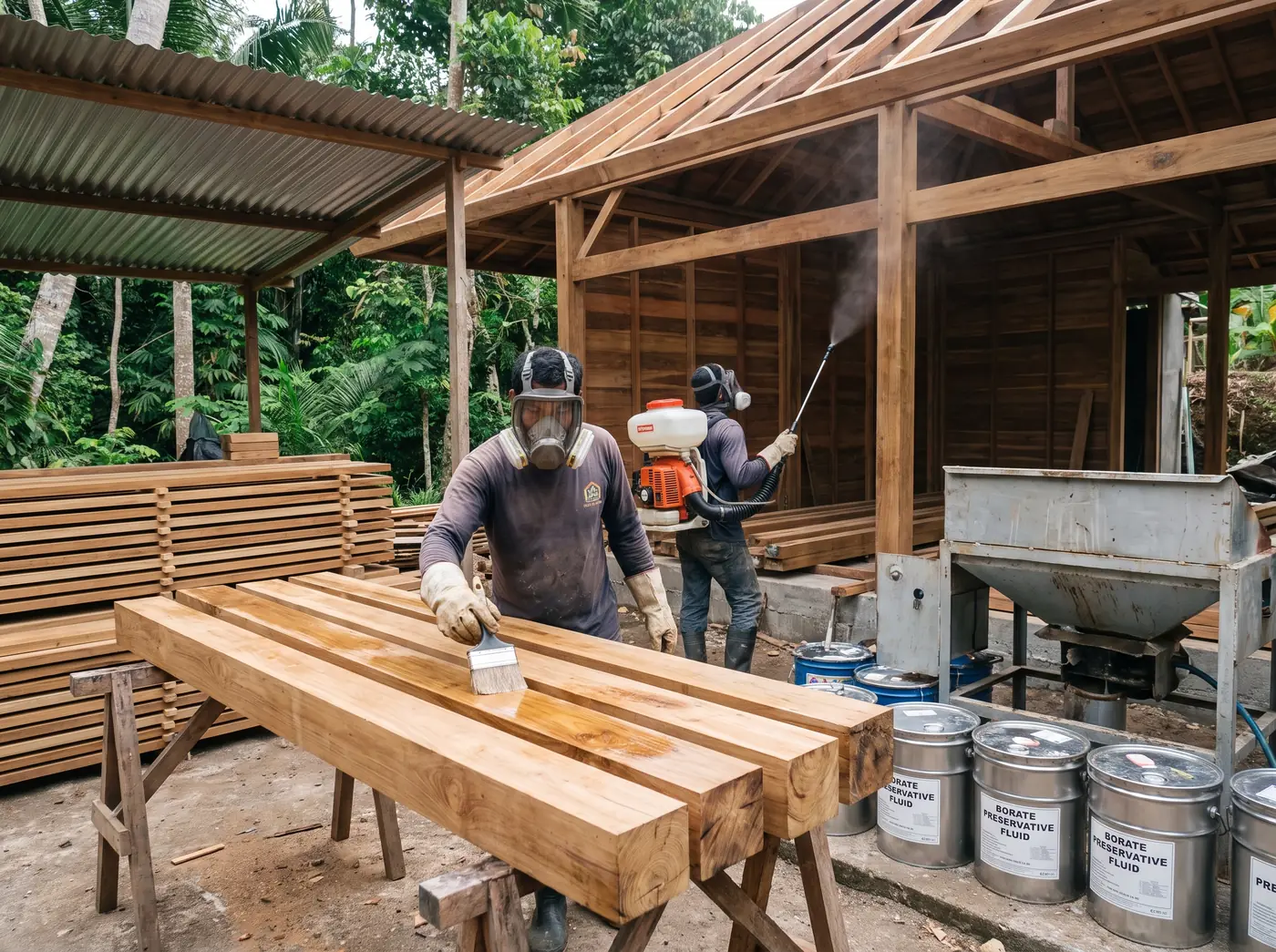
Timber arrives on Bali sites in three states: untreated, surface-treated, and properly impregnated. The difference is not visible, which is precisely why untreated stock keeps being delivered against treated orders. Untreated fast-grown hardwood in a roof space here has a working life we would put at five to eight years before the first hollow-sounding member turns up.
| Method | How deep it goes | Best used for | Service life | From |
|---|---|---|---|---|
| Borate diffusion (soak or vertical soak) | Full section on green or moist timber | Structural timber and bamboo kept dry in service | Life of the member if not leached | IDR 850,000 / m³ |
| Pressure treatment (CCA / ACQ / copper azole) | Full sapwood penetration, fixed in the wood | Ground contact, posts, decking substructure, external work | 15–25 years | Supplied pre-treated by mill |
| Site spray or brush application | 1–3 mm of surface only | Cut ends, drilled holes, top-up on already treated stock | 3–5 years, less if washed | IDR 95,000 / m² |
| Soil barrier at construction stage | Not in the timber at all | Blocking subterranean access under slabs and around footings | 5–10 years by product | Quoted per site |
Borate impregnation
Borates — disodium octaborate is the common one — work by diffusion, which is their strength and their weakness. Because they move through water inside the cell structure, they will travel right through a full section of green timber given seven to ten days in a soak tank, and they leave the whole member toxic to termites and fungi rather than just its skin. They are also low in mammalian toxicity, which is why we prefer them for anything indoors or overhead.
The weakness is the same mechanism running backwards: borate is water-soluble, so it leaches out of timber exposed to repeated wetting. Borate-treated members belong under a roof or behind a coating. If a member is going to sit in the rain, it wants a fixed-in-wood preservative instead.
Pressure treatment
Vacuum-pressure impregnation forces preservative into the sapwood in a cylinder, and copper-based systems then bind chemically to the wood so they do not wash out. It is the only sane specification for anything in ground contact or permanently outdoors: fence posts, deck bearers, pergola legs, formwork that will stay in place. Buy it pre-treated and ask for the retention figure in kg/m³ on the delivery documentation, because visual inspection tells you nothing beyond the green tint.
Checking what actually turned up
Treated timber costs more than untreated, which creates a standing incentive somewhere down the supply chain. We check deliveries against four things before anything is unloaded, and we recommend the same routine to owners running their own builds:
- A treatment certificate naming the preservative, the process and the retention in kg/m³ — not a line on an invoice saying "treated".
- A cut test on a random piece from the middle of the pack. A borate-soaked section is uniformly wetted through; a sprayed one shows a bright rim a millimetre or two deep and dry heartwood behind it.
- Moisture content with a meter. Timber delivered above 25 per cent has been kiln-skipped, and it will shrink, split and open the joints you are relying on.
- Sapwood proportion. On plantation teak and merbau the pale sapwood band is the vulnerable part, and a pack that is half sapwood is a different product from the one you priced.
One rule survives both methods and is broken on almost every site we visit: every cut, notch and drilled hole exposes untreated interior wood. Trimming a treated post to length and standing it in a socket without brushing the end grain undoes the treatment at the exact point where water and termites arrive. We keep a tin of end-grain preservative at the saw bench and treat cuts as they are made.
Detailing that starves a colony
Chemistry buys time. Detailing decides whether the colony ever gets a route in. Subterranean termites need moisture and a continuous path from soil to timber, so the whole game is breaking that path and keeping the timber dry.
- No timber in soil contact, anywhere. Posts stand on concrete plinths lifted at least 150 mm above finished ground level, on a stainless or galvanised shoe, with a visible gap you can sweep under.
- Physical barriers under the slab. Stainless mesh or graded stone barriers at pipe penetrations and around the perimeter do not degrade the way a chemical soil treatment does.
- A visible inspection zone. Keep a 100 mm strip of exposed foundation between finished ground and the first timber or render. Mud tubes have to cross it in the open, where a torch finds them in seconds. Render carried down to the soil hides the single most useful warning sign there is.
- Keep the timber under 20 per cent moisture content. That means real eaves overhangs, drip grooves, flashings at every wall junction, and ventilation in the roof space and under decks. Damp timber is not just vulnerable to rot; it is actively attractive.
- Nothing stacked against the building. Firewood, offcuts, formwork, garden mulch and bamboo screening against a wall are all bridges. So are timber planters bolted to the structure.
- Watch the landscaping. Irrigation spraying onto a wall base, a garden bed raised above the damp-proof course, or a mature tree stump left in the ground within a few metres of the house all reopen the path months after handover.
These are the checks we work through in a detailing review, which we price from IDR 3,500,000 and normally run at the drawing stage, when changing a plinth height still costs nothing.
What finishes do not do
Owners regularly tell us their timber is protected because it has been oiled or varnished. Decking oil, polyurethane and paint are moisture management, not insecticide. They slow the wetting and drying that splits timber, and by keeping moisture content down they make a member marginally less attractive — but a subterranean termite tunnelling up inside a post is not inconvenienced by a film on the outside, and a drywood female entering through a hairline check in the end grain has already gone past it.
Two further points get missed. A coating applied over timber that is already damp seals the water in, which is worse than leaving it bare. And a hard film finish on external timber will crack at the joints within a couple of wet seasons and then admit water at exactly those cracks, which is why we prefer penetrating oils on external hardwood and re-oil rather than re-coat. That maintenance rhythm is part of how we quote timber decking and deck restoration, where restoring a grey, checked deck starts at IDR 425,000 per square metre — usually cheaper than the replacement it prevents.
Inspection rhythm: twice a year, fifteen minutes
Treatment and detailing are the insurance. Inspection is the alarm. Twice a year — once at the end of the wet season, once mid-dry — walk the building with a torch and a screwdriver and check:
- The exposed foundation strip, all the way round, for mud tubes the width of a pencil.
- Every post base and every point where timber meets masonry or concrete.
- The roof space: tap purlins, rafters and battens with the screwdriver handle. Sound timber rings; eaten timber thuds and gives.
- Skirtings, door frames and window reveals in bathrooms and any room with a history of damp.
- Windowsills and floors under exposed rafters for small piles of hard pellets — the drywood signature.
- Anything soft enough to push a screwdriver into with thumb pressure. Note it, photograph it, date the photo.
Damage found in the first year is a member replacement. Damage found in year six is a structural repair with propping, and it is where the real money goes. If your roof structure is at the specification stage, the comparison in steel versus timber roof trusses is worth reading before you commit — and if bamboo is on the table, the bamboo versus timber comparison covers how the same treatment logic applies to poles.
What we'd do
Specify the treatment on the drawings, not in conversation: borate impregnation for internal structure, pre-treated pressure-impregnated stock for anything outdoors or in ground contact, end-grain sealing at the saw bench as a written site rule. Detail 150 mm of clear air between soil and any timber, leave a visible inspection strip on the foundation, and get the eaves and flashings right so the wood stays under 20 per cent moisture. Then diarise two inspections a year and actually do them.
Our crews treat structural timber and bamboo as a standard line in every build that contains either, and we will do the treatment and detailing review on someone else's project just as readily as our own — usually it is a short list of cheap changes rather than a rebuild.
FAQ
Quick answers
Is treated timber safe to use indoors and overhead?
Borate-treated timber is, and that is why we use it for internal structure, roof members and anything above a bedroom. Borates have low mammalian toxicity and stay fixed inside the wood in dry service. Copper-based pressure-treated stock is intended for external and ground-contact work; we keep it outside the building envelope where the specification allows a choice.
Can timber already installed in my house still be treated?
Partly. Existing timber can be surface-sprayed and, where sections are large, injected through drilled holes plugged afterwards — that is a genuine improvement, but it is not the same as full-section impregnation done before installation. If we find active subterranean access, the durable fix is usually detailing: breaking the soil-to-timber path and drying out the junction that let them in.
Do you also do termite treatment for the whole house?
No. We work on the construction side only — treating structural timber and bamboo, specifying barriers and fixing the details that let termites in. Baiting systems, fumigation and ongoing pest-control contracts are a different trade with its own licensing, and we will point you to a specialist rather than pretend otherwise.
NEED IT DONE?
We do this work
Written by the site team at Bali Construction Works, a Bali construction company running its own crews across 46 trades. Questions about your project? Ask on WhatsApp.