SEC B / STRUCTURAL WORKS
Diamond core drilling and concrete cutting in Bali
Cutting an opening through finished concrete is either a controlled operation or it is damage. A hammer drill through a beam takes out reinforcement nobody can see and weakens the element permanently; a breaker through a slab shakes cracks into the ceiling below. Diamond tools cut rather than hammer — clean edges, almost no vibration, water-controlled dust, and an opening exactly where the drawing put it.
- Cores Ø32–350 mm through slabs, walls and beams
- Reinforcement scanned and marked before any cut
- Low vibration and contained slurry — buildings stay in use
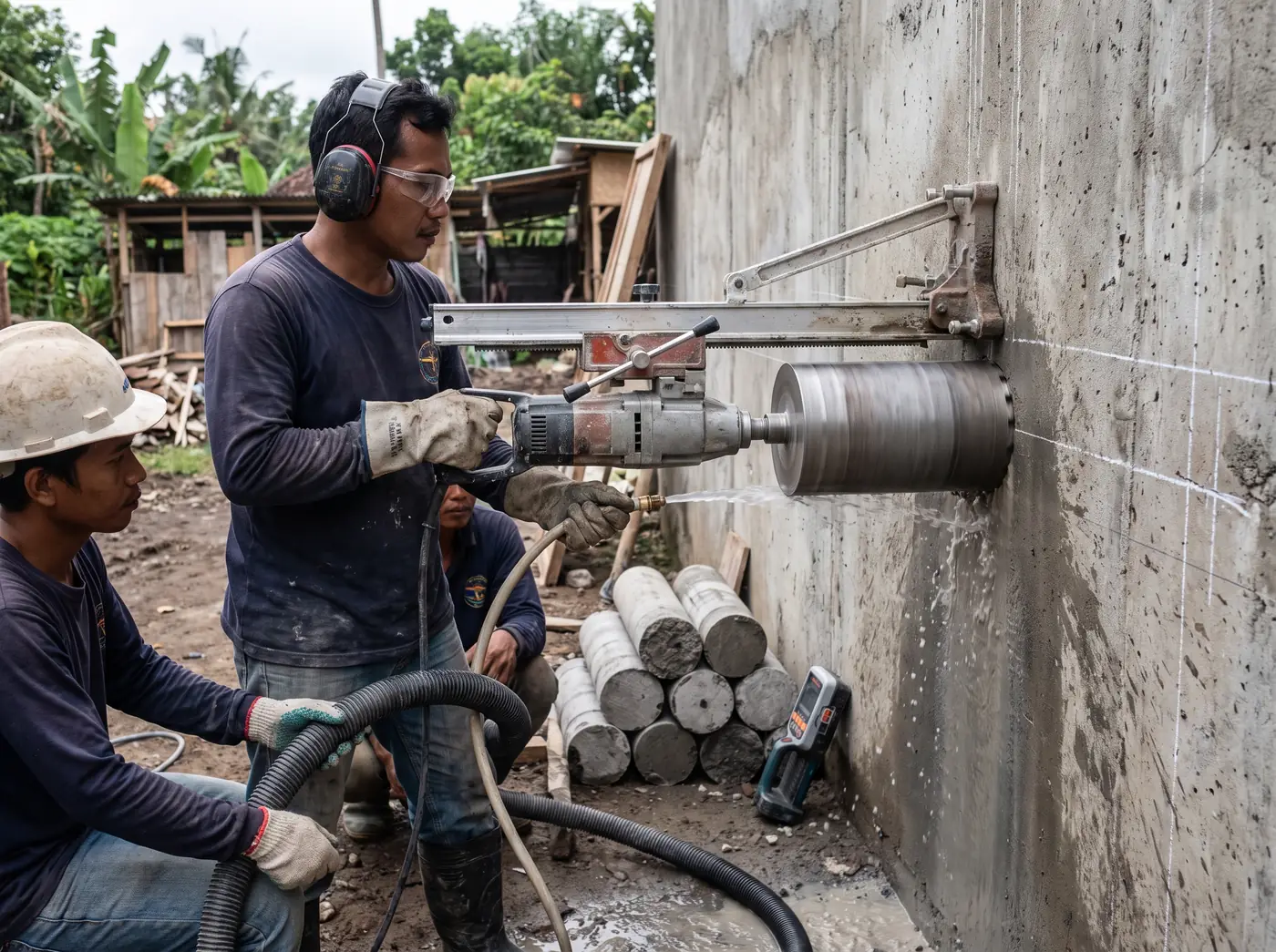
The everyday work is coring: holes from Ø32 to 350 mm for drainage, ducting, conduit, extraction and pipe penetrations through slabs, walls and beams. A core comes out as a solid plug instead of debris, so the surrounding concrete is untouched and the opening needs nothing beyond a sleeve and a seal. On an occupied floor above a restaurant still trading, that difference decides whether the kitchen opens that evening.
Larger openings call for saws. Track-mounted wall sawing cuts doors and windows through reinforced walls to precise dimensions; floor sawing removes slab sections for stairs, lifts and service risers; wire sawing handles thick or obstructed elements no blade can reach in one pass. Every cut is planned around what sits inside the concrete, which is why scanning comes before the machine rather than after the surprise.
What sits inside the concrete decides the method
Every element we cut has a history: a bar layout, a conduit run, occasionally post-tension strands that must never be touched. Cutting a slab without knowing that history is how a project acquires a structural repair nobody budgeted for. So the first visit is a scan — an electromagnetic scanner mapping bars and cover, cross-checked against the structural drawings where they exist, with the findings chalked onto the surface so you can see the constraints before the position is agreed.
Often the scan shifts an opening a hundred millimetres and the problem evaporates. Sometimes it cannot: a duct has to pass through a beam, or a stair opening has to interrupt a slab band. Then the cut becomes an engineering item — the opening designed, trimming steel or a steel frame detailed, and the cutting and propping sequence written down. We would rather hold that conversation before the blade arrives than explain a sagging soffit afterwards.
Cutting inside a building that stays open
Most of our cutting happens where nothing can close: houses with guests in them, restaurants trading at night, retail units, hotel floors directly above occupied rooms. Diamond cutting suits that work because it is quiet next to a breaker, transmits almost no vibration into adjoining structure, and produces slurry rather than airborne dust when the water is managed properly. We bund the work area, vacuum slurry as it forms, and protect finished floors and the drains it must never reach.
The rest is scheduling and preparation. Noisy passes get booked outside service hours, access routes are sheeted and protected, and cut sections are lifted and removed on the same visit instead of being left as an obstacle for somebody else. On fit-outs we run the full sequence in one mobilisation — scan, cut, core the services, clear the spoil — so the following trades find an opening ready to build into rather than a mess to sort out.
SCOPE OF WORK
What's included
Scan & mark-up
Reinforcement, conduits and post-tension cables located and marked, with the layout adjusted before a blade touches concrete.
Structural check
Where an opening affects the element, the cut is confirmed with an engineer and any strengthening detailed first.
Core drilling
Ø32–350 mm cores through slabs, walls and beams, drilled square with water collected at the bit.
Wall & floor sawing
Track-mounted and floor saws for accurate openings, with cut sections lifted out rather than broken out.
Wire sawing
Diamond wire for deep sections, foundations and elements a blade cannot pass through in one cut.
Clean handover
Slurry contained and removed, edges cleaned, sleeves fitted where specified, and the area handed back usable.
PROCESS
How the job runs
- 01
Survey & scan
We inspect the element, scan for reinforcement and services, and mark the proposed cut for your approval.
- 02
Method & approvals
Cutting sequence, propping and any strengthening confirmed with the engineer, plus building-management approvals where they apply.
- 03
Cut or core
Protection set up, water and slurry controlled, cuts made to the marked lines and sections removed intact.
- 04
Clean & finish
Slurry vacuumed and disposed of, edges tidied, sleeves and seals fitted where specified, and the area handed back usable.
INDICATIVE PRICING
Honest numbers, before the survey
| Scope | Guide price |
|---|---|
| Core Ø100 mm through a 200 mm slab | from IDR 450,000 / hole |
| Wall sawing | from IDR 1,100,000 / m² of cut face |
| Reinforcement scan and mark-up | from IDR 1,500,000 / visit |
Diameter, element thickness and access set the rate, and batching work into one mobilisation lowers it; quoted after a free site survey.
Request an exact quoteFAQ
Concrete cutting in Bali — what owners ask
Can you cut an opening in a structural wall?
Often yes, but only once it has been designed. We scan the wall, share what we find, and where the opening affects load paths an engineer details the trimming steel or frame and the propping sequence. Cutting first and asking afterwards is how walls end up needing repairs that cost several times what the opening did.
Will the work make dust and mess?
Diamond cutting with water produces slurry, not airborne dust, and we collect it at source with vacuums and bunding. Floors, drains and finished surfaces are protected before anything starts. Dry coring with extraction is available where water cannot be used at all — near live electrics, or directly over a finished ceiling, for example.
Do you work in occupied houses and restaurants?
Regularly. The equipment is quiet enough to work around guests, vibration is low enough that adjoining rooms are unaffected, and the noisier passes get scheduled outside trading or sleeping hours. Access protection, slurry control and same-visit spoil removal are included, because half-finished work in an operating property is not acceptable.
What does core drilling cost?
A Ø100 mm core through a 200 mm slab is from IDR 450,000 per hole, with larger diameters and thicker elements priced accordingly. Wall sawing runs from IDR 1,100,000 per square metre of cut face, and a scan-and-layout visit from IDR 1,500,000. Mobilisation is charged once per visit, so batching holes into a single trip saves real money.
RELATED SERVICES
Often booked together
FROM THE BLOG