FIELD NOTES · 2026-02-10 · 9 min READ
Building materials that survive Bali's climate
Most material failures we are called to repair in Bali were decided on the day someone picked a product from a catalogue written for a temperate country. The climate here is not harsher in a vague way — it is harsher in four measurable ways, and each one rules out a specific list of materials.
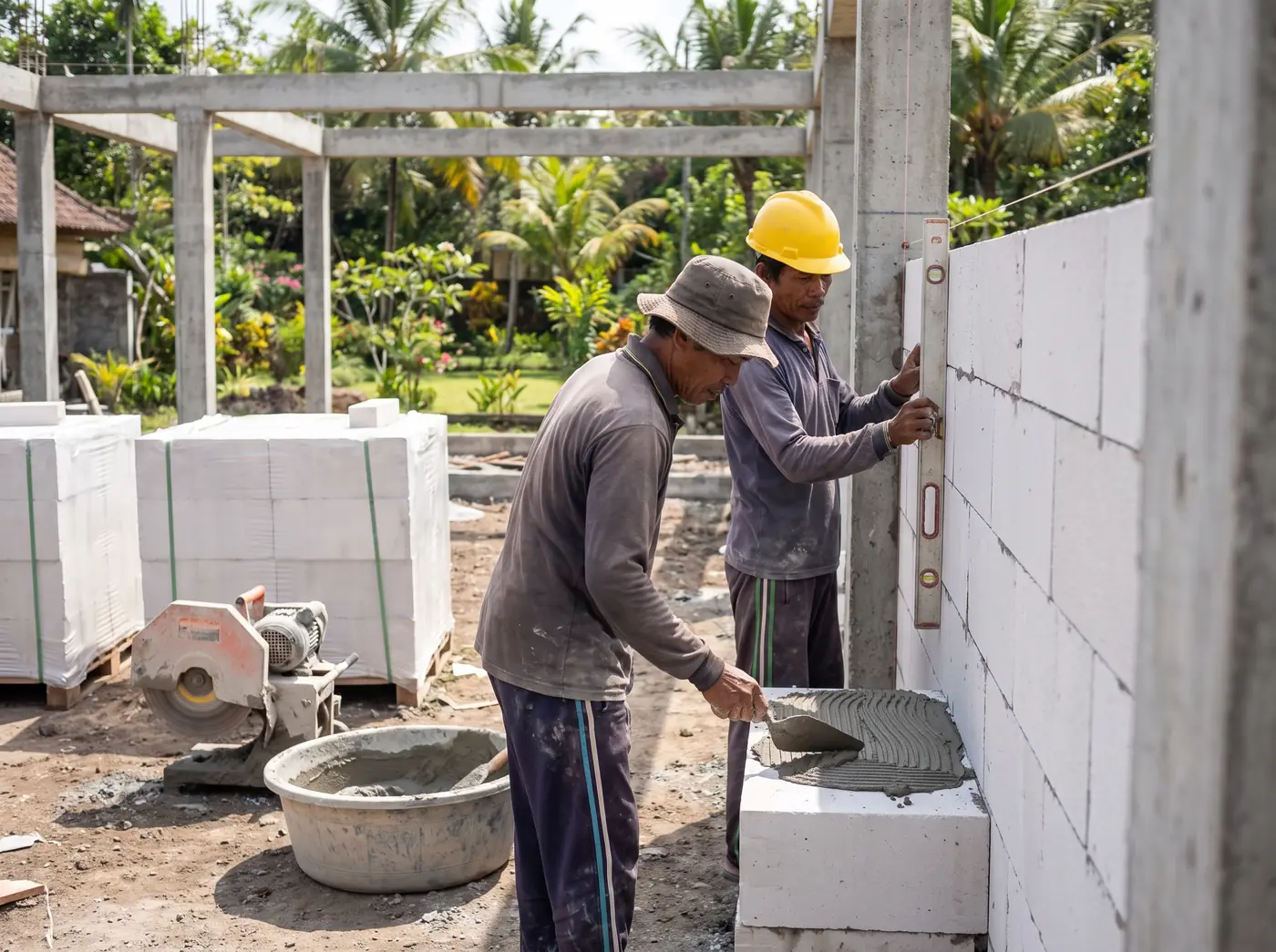
The climate is the specification
Take a screwdriver to a five-year-old building anywhere between Canggu and Uluwatu and the failures are boringly consistent. Render crazed on the western elevation. Rust blooms around the washers on roof screws. A door frame that sounds hollow when you tap it near the floor. None of that is bad luck. It is what happens when materials chosen for a mild climate meet a place that takes 1,700–2,400 mm of rain a year depending on where you stand, delivers 80–100 mm of it in a single hour during a squall, and holds relative humidity between 75 and 90 per cent for months on end.
Four forces do nearly all the damage. Every material decision on this page is really a decision about which of them you are prepared to fight:
- Ultraviolet. The UV index sits at 11 or higher through the middle of most days, all year. Pigments chalk, unstabilised plastics go brittle, and thin polymer coatings powder off within three years.
- Water, and its duration. Volume matters less than the fact that nothing dries properly between January and March. Anything absorbent stays damp long enough for mould, rot and efflorescence to take hold.
- Salt. Within roughly two kilometres of the coast, airborne chloride attacks steel through any break in its coating. Prevailing wind decides the real reach: we have found chloride pitting on fixings three kilometres inland at Berawa, and almost none at the same distance behind a ridge in the north.
- Termites. Subterranean colonies are present on most plots we build on. They are indifferent to what the timber cost.
Add a seismic zone that rewards ductile connections, and clay soils that swell and shrink between wet and dry, and the list of materials that genuinely behave well here gets short.
Walls: AAC, clay brick or batako
Three materials cover almost everything built on the island, and the argument about them is usually held at the wrong level — price per block instead of cost per finished square metre of wall. The blockwork is maybe half the number. Mortar, render thickness, wastage and labour speed make up the rest, which is why the cheapest block does not automatically produce the cheapest wall.
| Wall material | Density | Behaviour in the wet season | Heat | Laid, from |
|---|---|---|---|---|
| AAC (bata ringan) | ~600 kg/m³ | Absorbs water fast if left unrendered; fine once coated and capped during construction | Best insulator of the three; west walls stay cooler | IDR 285,000 / m² |
| Clay brick (bata merah) | ~1,600 kg/m³ | Very forgiving once rendered; tolerates damp cycles well | Moderate mass, holds afternoon heat into the evening | IDR 315,000 / m² |
| Batako (concrete block) | ~1,800 kg/m³ | Dense and stable, but shrinkage cracks telegraph through render if laid green | Highest heat gain of the three | IDR 235,000 / m² |
AAC (bata ringan)
Autoclaved aerated concrete is light enough to cut with a handsaw and laid in a 3 mm adhesive bed rather than a 15 mm mortar joint, which is why an AAC wall goes up roughly twice as fast as brick. Its thermal conductivity is around 0.14 W/mK against roughly 0.8 for dense block — a difference you can feel in an upstairs bedroom at four in the afternoon. The catch is porosity: leave AAC stacked uncovered through a week of rain and it drinks, and a saturated block laid into a wall will shrink and crack the render as it dries. It also needs proper anchors, not ordinary plugs, wherever a TV bracket or a wall-hung basin is going.
Clay brick (bata merah)
Local fired brick varies enormously between kilns, and the variation is dimensional as much as structural. Bricks that are 4 mm out of square force a thicker render coat to hide it, and that render is where the price difference against AAC actually hides. In exchange you get a wall that shrugs off damp cycles, holds fixings anywhere, and is trivially easy to chase and patch in ten years when someone wants to move a socket.
Batako (concrete block)
The cheapest option, and the one most often laid badly. Batako is frequently sold within days of being cast, still curing and still shrinking; laid in that state, it cracks the render on schedule about eight months later. Hollow batako also needs cores filled where fixings or lintels land. It earns its place in boundary walls, plant rooms and back-of-house areas where thermal performance is irrelevant.
Whichever you use, the same three details decide whether the wall stays sound: a reinforced ring beam above and below, control joints at 4–6 m and at every opening, and render mixes that get weaker toward the outside rather than stronger. We build walls in all three materials and will quote the comparison honestly on your drawings — see masonry and wall construction for how we detail them.
Steel: the coating is the material
Structural steel does not fail here because the section was too small. It fails because the protection system was chosen by price. On a coastal site there are only three specifications worth discussing: hot-dip galvanising at 80 microns or more, a proper duplex system (galvanised then painted), and, for exposed architectural work, stainless — 316 grade rather than the 304 that is usually delivered when nobody specifies.
The same logic applies to the small parts, and more urgently. A roof sheet in AZ150 aluminium-zinc coating will outlast a Class 3 screw by fifteen years, which means the roof fails at the fixings while the sheet is still perfect. Near the coast we use Class 4 or stainless fixings as a rule, not as an upgrade. Painted mild steel within sight of the sea is not a structure; it is a maintenance contract that someone will stop paying. Our fabricated and installed structural steelwork starts around IDR 38,000 per kilogram, and the coating specification is the single biggest swing inside that figure.
Concrete and render behave differently at 30°C
Concrete is not automatically durable here, because durability in a marine tropical setting is mostly a function of two things: cover to the reinforcement and how the mix was cured in the first week. We work to 40 mm cover on anything exposed to weather or salt air, 25 mm internally, and we cure wet for seven days — because a slab poured at 32°C with a breeze over it loses surface water so fast that it hydrates only partially, leaving a permeable skin that chlorides walk straight through. The rust-jacking you see on seafront balconies almost always traces back to a 15 mm cover error made in an afternoon.
Mix design, slump discipline and cube testing deserve their own treatment, and we have written one: getting concrete right in a tropical climate covers the K-grades, the curing methods that work here and what to do when rain arrives mid-pour.
Timbers, ranked by how they behave here
Indonesian timber grading uses durability classes, and they are a far better guide than the name on the delivery note. Class I timbers survive ground contact for decades; Class IV and V will not last one wet season outside.
- Ulin (Bornean ironwood), Class I. The benchmark. Extremely dense, effectively termite-proof, and increasingly restricted and expensive. Reserve it for posts in ground contact and marine work.
- Merbau, Class I–II. Stable, hard, good for structure and decking. It bleeds tannin for the first year, which stains pale stone below it — detail the drip lines accordingly.
- Bengkirai (yellow balau), Class II. The practical workhorse for decks and pergolas. Expect surface checking; it needs oiling twice a year to stay brown rather than silver.
- Teak, Class I–II, with a caveat. Old-growth teak is superb. Fast-grown plantation teak with a wide band of pale sapwood is not the same material, and the sapwood is termite food.
- Sengon, albasia, mahogany offcuts, Class IV–V. Formwork and temporary works only. When these appear in a roof structure — and they do — the roof has a five-year clock on it.
Class alone is not protection. Any timber going into a building here should arrive treated, and the treatment should be documented rather than assumed; that is the whole argument in protecting structural timber from termites, and it is why we run borate impregnation from IDR 850,000 per cubic metre as a line item on every build with timber in it.
The small parts fail first
Nobody photographs a sealant joint, and yet silicone is the material we replace most often. Standard acetoxy silicone in a south-facing joint at UV 11 is chalk in three years. Neutral-cure, UV-stable grades cost perhaps 40 per cent more and last three times as long. The same asymmetry runs through the whole category of parts that get chosen last:
- Hinges and door furniture: 316 stainless near the coast, or accept sticky doors by year two.
- Roof screws: neoprene washers degrade under UV; check them at year five, not year fifteen.
- PVC conduit and pipe: UV-stabilised grades for anything exposed, otherwise it shatters when touched.
- MDF and chipboard joinery carcasses: they swell irreversibly at 85 per cent humidity. Marine ply or solid timber in wet rooms, always.
Imported is not automatically better
A recurring conversation on our sites starts with a client wanting a European product because it must be higher quality. Sometimes that is true — good sealants, quality coating systems and decent ironmongery are worth importing. Often it is not, for three reasons.
First, plenty of imported systems are engineered for a different problem. Insulated render systems designed to hold heat in are the wrong instinct in a climate where you are trying to shed it. Gypsum-based products formulated for 50 per cent humidity behave poorly at 85. Composite decking made for European summers can move noticeably more than the timber it replaced when it sits at 55°C on a Bali terrace.
Second, spare parts. A window system with proprietary rollers is fine until a roller fails in year six and the nearest stockist is in another country. We specify hardware we can replace from Denpasar unless there is a strong reason not to.
Third, the local product is often the right one. Indonesian AAC, ready-mixed concrete from a decent batching plant, hot-dip galvanising and Indonesian hardwoods are all competitive on quality and unbeatable on lead time. The genuine imports worth paying for tend to be small, technical and unglamorous: fixings, sealants, membranes, coatings.
What we'd do
Start with your site rather than a catalogue. Measure the distance to the coast and the prevailing wind, because that decides the entire steel and fixing specification. Choose the wall material for the finished wall cost and the room temperature it produces, not the price per block. Insist that all structural timber arrives with treatment documentation. And spend the money you save on the parts nobody sees — sealants, fasteners, coatings, cover to reinforcement — because those are what actually fail.
We build to specifications like these every week, and we will happily mark up your material schedule with what we would change before anything is ordered. If you are at the stage of pricing a whole build, our custom home construction quotes are itemised down to the coating class, so you can see exactly where the durability money is going.
NEED IT DONE?
We do this work
Written by the site team at Bali Construction Works, a Bali construction company running its own crews across 46 trades. Questions about your project? Ask on WhatsApp.