FIELD NOTES · 2026-05-12 · 9 min READ
Epoxy vs polished concrete for Bali floors
Two shopfronts on the same lane in Kerobokan, slabs poured within a month of each other. One got an epoxy coating that blistered before its first birthday; the other was ground and polished and still looks like the day it was burnished. The products were both fine. What separated them was what the slab underneath was doing with water vapour. Resin and concrete floors are one of 46 trades we keep in-house as a full-cycle construction company in Bali.
The failure is almost never the coating
The floor we were called to look at was 320 m² of retail space, poured at the tail of the wet season and coated with a two-part epoxy five weeks later. By month four it carried blisters the size of a fist — soft in the middle, clear liquid inside, popping under a trolley wheel. The applicator blamed a bad batch of resin. The resin was innocent. A probe drilled to 40% of the slab depth read 92% relative humidity: the concrete was still handing over moisture, and the film on top gave it nowhere to go. Vapour pressure did the rest.
That job is why this comparison starts where it does. On this island the choice between epoxy and polished concrete is not first a question of budget or look. It is a moisture question, and slip, chemical resistance, repairability and cost per square metre all queue up behind it.
How wet a Bali slab actually is
The industry rule of thumb is that concrete dries at roughly 25 mm of thickness per month — and that rule quietly assumes 20 °C air at 50% relative humidity, with one face open. Neither condition exists here. Ambient humidity in Bali sits between 75% and 90% for most of the year, so the air is barely thirstier than the slab; through January and February it is often wetter. A 120 mm slab poured in the wet season can still read above 85% internal humidity when someone wants to open the shop in June.
Then there is the ground underneath. Most slabs on the island are cast on sand blinding over compacted fill with no polythene damp-proof membrane, because nobody specified one at the time. A slab like that never finishes drying. It is coupled to a water table sitting 2–4 m down through the rice-field belts of Canggu, Pererenan and Ubud, and capillary action keeps topping it up. You can wait three years and the reading will not improve by much.
Three tests worth the money
- In-slab relative humidity probes. Holes drilled to 40% of the slab thickness, sleeved, capped, left 24 hours, then read. This is the number that governs. Most epoxy systems want 75–80% or lower; moisture-tolerant primers stretch the ceiling to roughly 90%.
- Calcium chloride dome. A weighed dish under a sealed dome for 72 hours, reported as grams of vapour per 1,000 ft² per day. Useful as a second opinion, though it only interrogates the top 20 mm.
- A plastic sheet taped down overnight. Free, crude and worth doing on day one. Condensation under the sheet at breakfast means nobody should be pricing an epoxy floor until the probes have run.
Testing a 300 m² floor properly costs less than grinding off 20 m² of failed coating, which is why every epoxy flooring quote we issue is conditional on readings we have taken ourselves. An applicator who does not ask about moisture is quoting for the invoice, not the floor.
What epoxy actually is
Epoxy is a two-part thermoset — resin plus hardener — that bonds to a mechanically prepared slab and cures into a film. There are three build-ups worth naming, and they behave like different products:
- Roller-applied coating, 0.3–0.5 mm. Primer plus two coats. Cheap, quick, and it telegraphs every trowel mark and patch in the slab underneath.
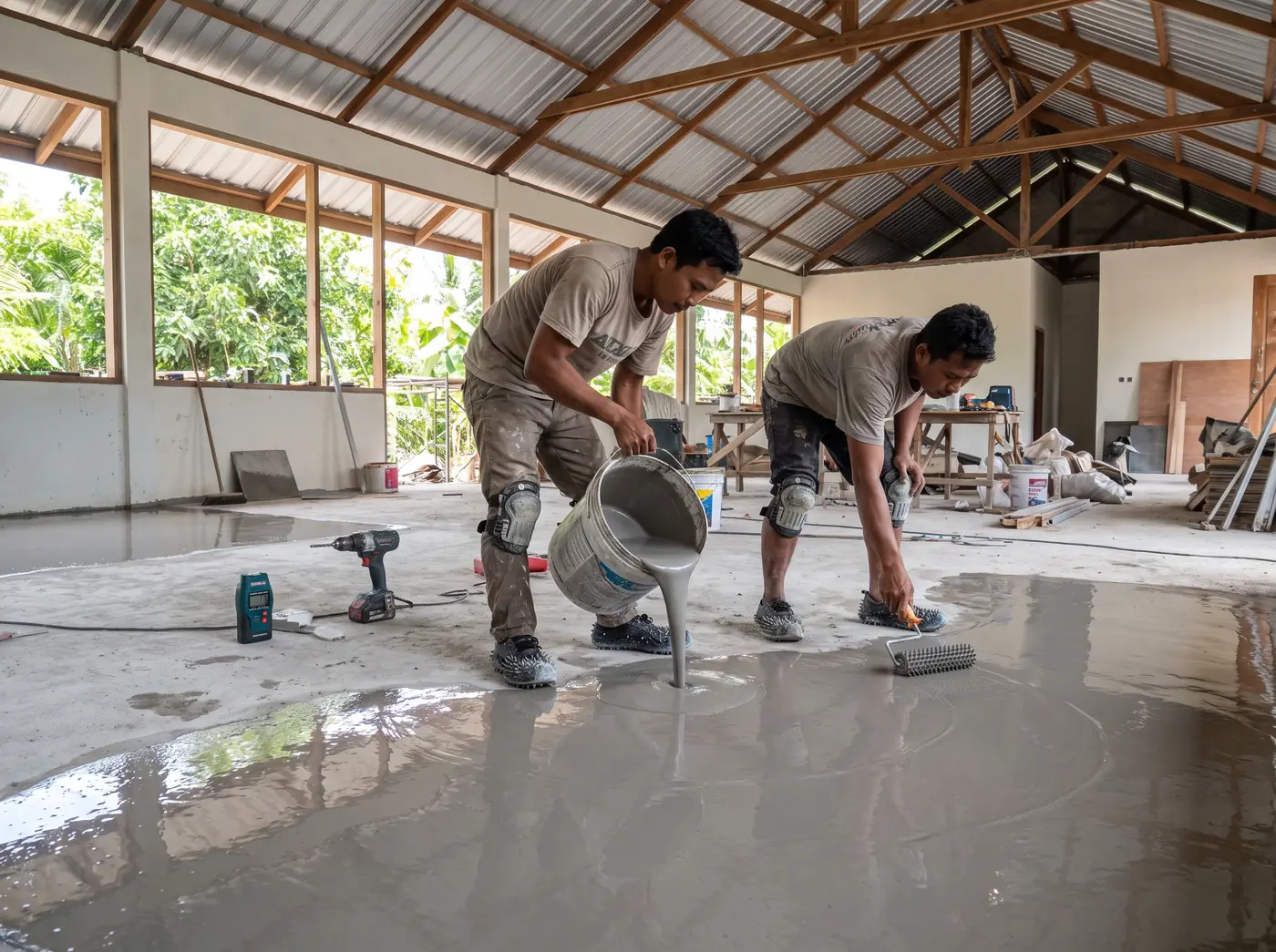
- Self-levelling, 2–3 mm. Poured and spike-rolled. Flattens minor undulation, gives the mirror look people actually want, and tolerates trolley traffic.
- Industrial build-up, 4–6 mm. Broadcast quartz between coats for grip and impact resistance. This is the loading bay, workshop and back-of-house specification.
Preparation decides the bond: diamond grinding or shot blasting to an open, dust-free profile. Acid etching has no place on a damp tropical slab — it leaves salts and moisture behind and buys nothing. Curing is the other trap. Above roughly 85% relative humidity, and whenever the substrate sits within 3 °C of the dew point, amine blush forms as a greasy haze that ruins intercoat adhesion, so early-morning application after a night of rain is exactly the wrong call. Pot life halves too: a resin printed at 40 minutes on a 20 °C tin gives you around 20 minutes in a 30 °C room, and the pot cooks itself faster than that if you mix a full unit and walk away.
One more limit. Standard epoxy ambers and chalks under a UV index that hits 11 or 12 here, so it belongs indoors or under a polyurethane topcoat where daylight floods in. Never on an open terrace.
What polished concrete actually is
Polished concrete is not a coating at all — it is the slab, ground and densified. The sequence runs metal-bond diamonds at 30, 50 and 80 grit to open the surface and flatten it, a lithium silicate densifier that reacts with free lime to harden the matrix, then resin-bond passes at 100, 200, 400 and 800 grit (sometimes 1500) to build gloss. Aggregate exposure is a choice made in the first pass: cream finish takes off almost nothing, salt-and-pepper around 1–2 mm, full aggregate 3–5 mm.
Because there is no film, there is nothing to blister. Water vapour continues to leave the slab through a densified surface, which is precisely why polished concrete is the default answer for a ground-bearing slab with no membrane under it. Sealing, where wanted, uses a penetrating silane or siloxane rather than a film former.
The catch is that polishing needs a slab worth polishing, and that is decided months earlier at the pour. It wants a properly power-floated finish, consistent mix, no random patches, and no plumbing chases hacked in after the fact — every one of those becomes a permanent scar you will read at 800 grit. If you want this floor, say so before the concrete is ordered and design the pour around it, along with the curing discipline a tropical pour needs.
Also worth knowing: a 50 mm semi-dry screed is a levelling layer for tile or vinyl, not a wearing surface — it has neither the cement content nor the aggregate to take a polish. If the structural slab is not the finished floor, the alternative is a bonded topping of at least 50 mm designed and mixed for grinding, which is a different order and a different price.
Head to head
| Criterion | Epoxy | Polished concrete |
|---|---|---|
| Added thickness | 0.3–6 mm depending on build-up | None — it removes 1–5 mm |
| Tolerance of a damp slab | Low; needs testing and often a moisture-suppression primer | High; the surface stays vapour-open |
| Slip when wet | Poor plain, good with broadcast quartz | Poor at high gloss, workable honed at 200–400 grit |
| Chemical resistance | Strong — oils, fuels, most cleaners | Moderate; acids etch it (citrus, vinegar, cola) |
| Thermal shock | Weak under hot-wash kitchens; use PU-cement instead | Unaffected |
| Repair | Patch is visible; full recoat possible if the bond holds | Re-grind the area and blend; damage is rarely visible |
| Daylight and UV | Ambers unless topcoated | Stable |
| Downtime | 3–5 days, dust-free but fume-heavy | 4–8 days, dusty but no cure window |
| Life before intervention | 5–10 years to recoat | 15+ years, re-burnish as needed |
Where each one wins
Reach for epoxy when
You have a garage, plant room, workshop, gym platform, clinic or warehouse where chemical spills, wheel loads or wash-down matter more than looks — and where the slab has been tested and is dry enough, or is upstairs and therefore drying from both faces. Coved, jointless skirtings are a genuine advantage in wash-down rooms: there is no grout line for anything to live in. In commercial kitchens with steam and boiling spills we steer clients to polyurethane cement instead of straight epoxy, because thermal shock lifts films that heat cycles have already fatigued.
Reach for polished concrete when
The floor is on the ground, the slab is new and under your control, the aesthetic suits, and you would rather never think about a recoat cycle. Open-plan houses, cafés, retail and studios all suit it, and the exposed slab keeps working as thermal mass instead of being insulated from the room by a resin film. The honest caveat is acid sensitivity: in food and drink spaces we seal, and we tell owners that a spilled lime juice left overnight will leave a dull patch that needs a local burnish.
Slip is a number, not a feeling
Ask for the rating, not the reassurance. Plain gloss epoxy and 800-grit polished concrete both sit at the bottom of the scale wet — fine in a dry showroom, dangerous inside a doorway where afternoon rain blows in horizontally. Broadcasting 0.5–1.5 kg/m² of graded quartz or aluminium oxide into an epoxy build-up lifts it into R11 territory and changes cleaning habits (you now need a stiff brush, not a flat mop). On polished concrete we stop at 200–400 grit for wet zones and use a penetrating anti-slip sealer, saving the mirror finish for areas that stay dry. Entry mats do more for safety than any coating, and nobody ever budgets for them.
What the two floors cost
| Item | Guide price |
|---|---|
| Epoxy two-part coating, 0.3–0.5 mm | from IDR 185,000 / m² |
| Self-levelling epoxy, 2–3 mm | from IDR 350,000 / m² |
| Industrial build-up with quartz broadcast | from IDR 650,000 / m² |
| Mechanical grind and polish (existing slab) | from IDR 225,000 / m² |
| Seal and maintenance visit | from IDR 145,000 / m² |
| Semi-dry screed, 50 mm, if levels must change first | from IDR 115,000 / m² (IDR 145,000 with mesh) |
Two lines people forget. Preparation is not included in a resin price by default — grinding a contaminated or tiled-over slab back to sound concrete can add as much per square metre as the coating itself. And a moisture-suppression primer, where the readings demand one, is a real cost that a cheaper quote has usually deleted rather than solved.
The order of operations that keeps you out of trouble
- Decide the finished floor before the slab is ordered, not after the walls are up.
- Pour with a mix and a curing regime suited to the finish, and keep chases out of it.
- Let it dry as long as the programme allows, then test — probes, not opinions.
- Match the system to the reading: dry enough for epoxy, or open-surface polish, or a primer that bridges the gap.
- Prepare mechanically, apply inside the dew-point and pot-life window, and protect the floor from following trades.
Skipping step three is what produced the blisters we opened with, and it is the single most common reason we are asked to remove a floor that is younger than the building. Material choice matters, but sequence matters more — the same lesson that runs through everything the climate does to building materials here.
What we'd do
On a new ground-bearing slab with no membrane below it — the normal Bali case — polish the slab and stop fighting physics. Where the room is a garage, plant room, gym or wash-down space, or where the slab is suspended and demonstrably dry, epoxy earns its keep and gives you chemical resistance nothing else matches at the price. Our own flooring crew runs both, tests before quoting either, and will tell you when the honest answer is tile.
NEED IT DONE?
We do this work
Prices and methods in this article are the ones we use on our own sites as a construction contractor in Bali. They are updated when the market moves.