SEC B / STRUCTURAL WORKS
Precast concrete and GRC elements in Bali
Some concrete is better made lying flat in a yard than poured in place off a scaffold. Facade panels, breeze blocks, copings, sills, planters and screen elements come out sharper, denser and far more consistent when they are cast under cover, cured on a schedule and delivered finished. We make them to standard profiles, or to a mould drawn for one building and nobody else's.
- GRC facade panels, breeze blocks, copings and planters
- Custom moulds in timber, GRP or silicone
- Physical sample approved before any production run
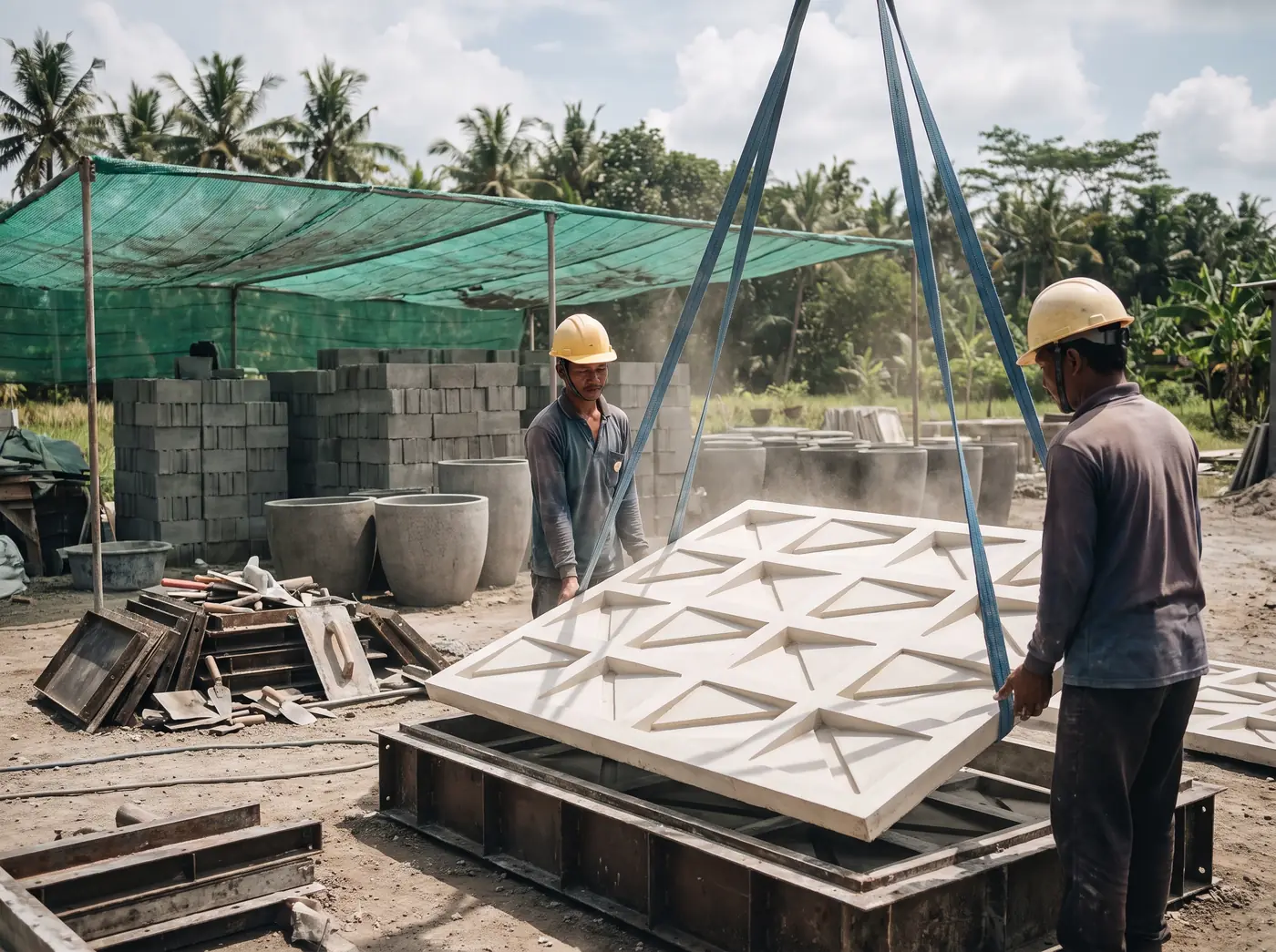
GRC — glassfibre-reinforced concrete — is what makes large architectural elements practical here. A 15 mm GRC panel weighs a fraction of the equivalent solid section, so a facade can hang on light steel rather than lean on structure built to carry it, and a two-metre panel can be lifted by hand instead of by crane. It holds fine detail and crisp arrises, and accepts pigment and texture from smooth grey through sandstone to terrazzo-like finishes.
Traditional precast keeps its place wherever mass is the advantage: copings, balustrades, benches, planters and breeze blocks laid as a structural screen. Both come from the same yard and the same crew, cast in moulds we build in timber, GRP or silicone depending on run length and depth of detail. Sampling always comes first — you approve a physical sample for colour, texture and profile before a production run begins.
Why yard casting beats site casting for architecture
Weather is the argument. An element cast on site in Bali competes with afternoon rain, dust, unpredictable curing and formwork built for a single use, and the results vary from panel to panel in a way a facade displays mercilessly. In the yard, one mould produces a hundred units under cover, cured on a controlled schedule, measured against a template and rejected when they miss it. Colour consistency alone justifies the method: pigment batched by weight matches from the first unit to the last.
The programme benefits as well. Precast production runs in parallel with structural work rather than after it, so panels arrive when the frame is ready to receive them and an elevation goes up in days. Less scaffolding, less wet trade on site, fewer crews queuing for the same face of the building — which on a tight plot in Seminyak or Sanur is often the difference between a sequence that works and one that stalls.
GRC in a tropical climate
GRC suits Bali for one specific reason: weight. Hanging heavy precast off a facade means designing structure to carry it, and coastal humidity means every fixing has to be stainless. At roughly a fifth of the weight, GRC lets an elaborate screen or a panelised facade sit on modest steel with fewer and smaller fixings. Alkali-resistant glassfibre replaces steel reinforcement, so there is no bar to corrode and no cover to lose — which is the exact failure mode that stains conventional precast on coastal buildings.
It is not maintenance-free. GRC moves with temperature, so joints must be designed and sealed rather than butted tight, and back-ventilation matters where panels sit against a wall in permanent shade. We detail the joints, specify the sealant and set fixing tolerances on the shop drawings. Handled that way, a GRC facade here gives decades with washing as its main upkeep.
SCOPE OF WORK
What's included
Design & shop drawings
Element sizes, joints, fixing positions and tolerances resolved on drawings before a mould is cut.
Mould making
Timber, GRP or silicone tooling chosen for the run length, the depth of detail and the finish you want.
Sampling
A physical sample cast and approved for colour, texture and profile before production starts.
Yard production
Elements cast, sprayed or vibrated and cured under controlled conditions, with every unit checked against a template.
Finishing
Acid-etch, sandblast, polish or paint systems applied in the yard, where a site-applied finish would never be even.
Delivery & installation
Handling frames, stainless fixings and installation by our crews, or supply-only with a fixing detail for yours.
PROCESS
How the job runs
- 01
Concept & sampling
We work from the architect's intent to a buildable element, then cast a physical sample for colour, texture and profile approval.
- 02
Mould & shop drawings
Tooling made and drawings issued showing sizes, joints, fixings and tolerances for approval before production begins.
- 03
Production & curing
Units cast and cured in the yard, checked dimensionally against the template, and finished before they leave.
- 04
Delivery & fixing
Elements delivered protected and installed by our crews with stainless fixings, or supplied with a fixing detail for your contractor.
INDICATIVE PRICING
Honest numbers, before the survey
| Scope | Guide price |
|---|---|
| GRC facade panels, supplied | from IDR 1,800,000 / m² |
| Custom mould (tooling) | from IDR 12,000,000 |
| Cast breeze blocks, bespoke profile | from IDR 185,000 / unit |
Quantity spreads the mould cost, so per-unit rates fall with volume; fixed quote after a free consultation and site survey.
Request an exact quoteFAQ
Precast and GRC in Bali — what owners ask
Can you cast a custom breeze block profile?
Yes — bespoke roster patterns are among our most common jobs. A new mould pays for itself from roughly a few hundred units; below that, adapting an existing profile usually costs less. We cast a sample first, and because the tooling is kept, a repeat run for a later phase matches the original.
How is GRC different from ordinary precast?
GRC is a thin shell reinforced with alkali-resistant glassfibre instead of steel bar, so a panel weighs roughly a fifth of the precast equivalent and contains nothing that can rust. That makes large facade panels and deep screens practical on light structure. Heavy load-bearing items — copings, benches, planters — remain better as conventional precast.
Will the colour match across the whole facade?
Within a production run, yes: pigments are batched by weight and units come from the same mould in the same yard. Across runs months apart there can be slight variation, as with any pigmented concrete, so we cast the full quantity together where possible and keep a reference sample from the approved batch.
What do precast and GRC cost?
GRC facade panels run from IDR 1,800,000 per square metre supplied, custom moulds from IDR 12,000,000 depending on size and detail, and cast breeze blocks from IDR 185,000 per unit in a bespoke profile. Mould cost spreads across the run, so quantity moves the per-unit figure sharply. Everything is quoted fixed after a free consultation on the drawings.
RELATED SERVICES
Often booked together
FROM THE BLOG