FIELD NOTES · 2026-06-25 · 9 min READ
Building a commercial cold plunge: specs that matter
A recovery studio in Canggu opened with a beautiful tiled plunge and a chiller chosen by tank volume. At 8am the water read 6 °C. By 4pm, after thirty-odd guests, it read 13 °C and the front desk was processing refunds. Nothing was broken — the plant had simply never been sized for the job the business was selling.
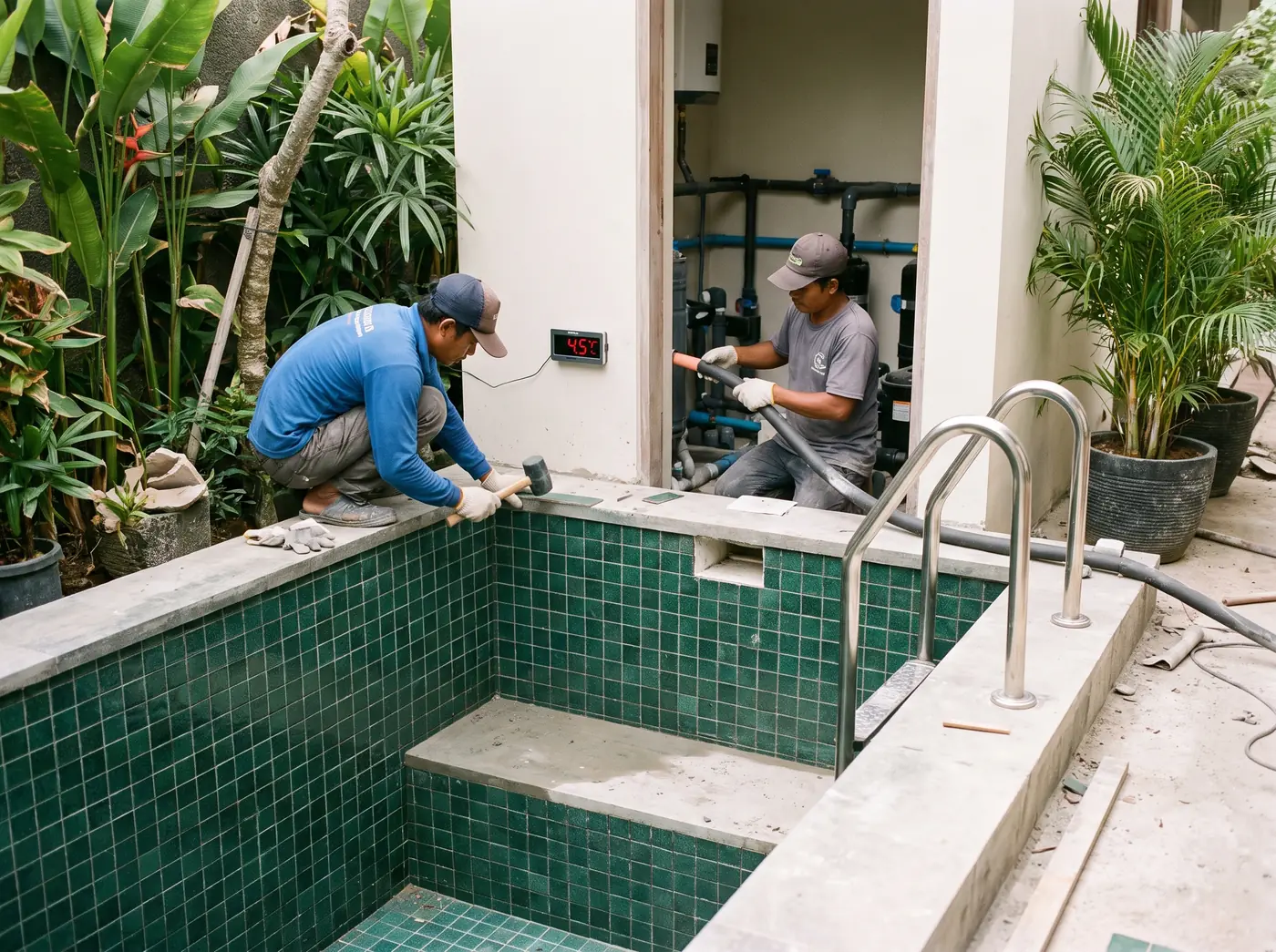
Duty cycle is the specification
Everything that separates a commercial plunge from a home tub comes down to one idea: how much work the plant has to do per day, and how little recovery time it gets. A private plunge is used once or twice, sits under a lid for twenty hours, and can drift a degree overnight without anyone caring. A studio plunge is open from 06:00 to 21:00, takes thirty to sixty immersions, never sees a closed lid during trading, and is being judged by paying guests on a thermometer they can read from the doorway.
| Home tub | Commercial plunge | |
|---|---|---|
| Immersions per day | 1–3 | 30–60 |
| Hours under a cover | 20+ | Often zero during trading |
| Acceptable drift | 2–3 °C | Under 1 °C at the busiest hour |
| Filtration runtime | Intermittent | Continuous |
| Sanitation | A dose when someone remembers | Logged residual, ORP and pH, three times daily |
| Water changes | Every few weeks | Weekly, sometimes more |
| Consequence of failure | A cold shower postponed | Refunds, reviews, a closed service |
Specify for the right-hand column and the plant is boring for a decade. Specify for the left-hand column because the numbers looked reasonable on a supplier's website, and the business absorbs the difference in electricity, callouts and apologies.
Sizing the chiller: the whole calculation
Take a realistic studio plunge: an internal 1.8 × 1.0 m shell with 850 mm of water, so roughly 1,500 litres, held at 6 °C. Fill water arrives at 26–28 °C, the room sits around 30 °C, and the plant cupboard is warmer than the room. Here is the heat that has to be removed continuously, in the units a supplier will not volunteer.
| Heat source | What drives it | Typical load |
|---|---|---|
| Shell losses, insulated | 50 mm of foam under and around the concrete, ΔT of 24 K | 0.10–0.15 kW |
| Shell losses, uninsulated | Bare concrete tied to a hot slab and hot air | 0.50–0.70 kW |
| Open water surface | 1.8 m² uncovered all day: convection and condensation | 0.25–0.30 kW |
| Circulation pump | A 0.55–0.75 kW pump puts nearly all its shaft power into the water | 0.45–0.55 kW |
| Bodies | About 300 W each while immersed; 40 immersions of 3 minutes | 0.6 kWh per day |
| Splash-out and top-up | 2–3 litres leave with every guest and return at 28 °C | 3.0 kWh per day |
Add the continuous terms for an insulated shell — 0.13 + 0.28 + 0.50 kW — and spread the bather-related 3.6 kWh across a 12-hour trading day, and you land near 1.2 kW of steady load, peaking closer to 1.8 kW in a busy hour when six or eight people cycle through. Leave the shell uninsulated and you have added another half kilowatt before anyone has arrived, permanently. Insulation is the cheapest cooling capacity on the market.
Then comes the part that catches most buyers. Chillers are catalogued at convenient conditions — often 12–15 °C water and 25 °C ambient. Ask for 6 °C water while the condenser breathes 33 °C air in a Bali plant cupboard and output falls by 30–40%. A unit printed as 4.5 kW may deliver 3 kW where you are actually installing it. Working backwards from a 1.2–1.8 kW load plus recovery margin, we specify around 3 kW of delivered capacity at design conditions, which is a catalogue rating in the 4.5–5.5 kW band — comfortably more than the half-horsepower and one-horsepower units bundled with home tubs.
Pull-down, and why it happens at night
Cooling 1,500 litres from 28 °C to 6 °C means removing 1,500 × 4.186 × 22 kJ, or about 38 kWh. At 3 kW of real delivered capacity that is roughly 13 hours. So a weekly dump-and-refill is an overnight operation, not a mid-morning one, and the operating schedule has to say so. A studio that refills at 09:00 opens with warm water and blames the equipment.
The electrical load nobody adds up
At that duty the compressor draws around 1.4–1.6 kW, the circulation pump 0.75 kW, and ozone or UV another 100–200 W — call it 2.5 kW continuous, or 12 amps single phase, sustained through the trading day. Plunges are usually the last item added to a fit-out, long after the supply was agreed, and we regularly find them landing on a board that has nothing left to give. Sort the load schedule during the electrical package, not after the tiles are on.
Turnover and sanitation
A 1,500-litre plunge can take as many bathers in a day as a 40,000-litre pool. Per litre, the organic load — sweat, sunscreen, sand, hair — is an order of magnitude worse than anything a swimming pool deals with, and cold water does not sterilise anything. It slows biology down; it also slows chlorine chemistry down, so a residual that looks adequate on a test strip is working more slowly than the same figure in a 30 °C pool.
- Turnover. Design for the whole volume passing the filter every 30–60 minutes. For 1,500 litres that is 1.5–3 m³/h, which sets the pump and pipe sizing, not guesswork.
- Filtration. A 20–25 µm bag or cartridge that a staff member can change in under five minutes without tools. If servicing is awkward it will not happen daily, and in a plunge it needs to.
- Oxidation. Ozone or UV in line, backed by a light free chlorine or bromine residual around 0.5–1.0 ppm, ORP held at 700–750 mV, pH 7.2–7.6.
- Logging. Three readings a day, written down. It is what a serious operator does, and it is the first thing we would want to see if a guest ever complained about water quality.
- Fresh water. A full dump and refill weekly at minimum, more often at high throughput. Build the schedule around the 13-hour pull-down.
Drainage, plant space and access
Dumping 1,500 litres in ten minutes is a 9 m³/h flow, and a 40 mm waste pipe will not take it. We run a 50–63 mm gravity dump line to a floor gully with a proper fall, size the discharge point for the whole volume, and — this matters — keep chlorinated water out of any biological treatment system. A weekly slug of chlorine into a bio septic kills the bacteria doing the work there, so the dump goes to stormwater or a sized soakaway, agreed with whoever designed the wastewater system.
The plant cupboard is the other thing drawn too small. A 3 kW chiller rejects around 4.5 kW of heat, and if that heat stays in the cupboard the machine cools its own condenser air until capacity collapses. We give it ducted or louvred ventilation, keep the internal ambient under 35 °C, allow 600 mm of working space at the service face, put a floor drain and a light in there, and fit unions and isolation valves so a pump can be swapped in an hour rather than a morning. Pipe runs stay under about 8 m and get insulated: uninsulated PVC between plant and plunge is a heat exchanger working against you.
Shell and finishes
We build plunges as reinforced concrete boxes, typically 150–200 mm walls in K300 with waterstops at the construction joints, because the shell is a structure that will be held 24 degrees below ambient for its whole life. That means paying attention to the pour and the cure the same way you would for any structural concrete in this climate. Then, in order:
- Crystalline waterproofing plus a membrane, and a 48-hour flood test with marked levels before a single tile goes down.
- Insulation — 50 mm of closed-cell board under the base and around the walls, before backfill or screed.
- Screed falling to the dump point so the shell empties fully and dries.
- Porcelain tile or glass mosaic set in epoxy adhesive and epoxy grout. Cementitious grout in a cold, constantly wet, chemically dosed box fails inside a year; this is not the place to save two million rupiah.
- Coved internal corners, non-slip nosings on the steps, a grab rail, a seat at 400–450 mm so water sits at shoulder height, and 316 stainless for every fitting because chlorine and coastal air punish anything less.
In the plant room we lay a resin floor for the same reason we do it in any wash-down space — it copes with spillage and takes a hose. Which system suits depends on how dry the slab is, and that is a longer conversation covered in our comparison of epoxy and polished concrete.
The five failures we are called to fix
- Chiller sized on volume instead of duty. The plunge holds temperature at opening and loses the fight by lunchtime.
- No insulation. Half a kilowatt of avoidable load, every hour, for the life of the installation.
- Condenser heat trapped in a cupboard. A 4.5 kW space heater sharing a box with the machine that has to overcome it.
- Chlorinated dump water into a bio septic. Two systems failing for the price of one, and a smell that arrives about a fortnight later.
- Filter housings you need two spanners and a torch to open. Whatever is awkward stops being done in week three.
What it costs
| Scope | Guide price |
|---|---|
| Single commercial plunge, built and commissioned | from IDR 95,000,000 |
| Twin contrast setup: plunge plus hot bath or sauna pairing | from IDR 165,000,000 |
| Chiller and filtration package alone | from IDR 55,000,000 |
| Service visit, chemistry and mechanical check | from IDR 1,250,000 |
| Monthly maintenance contract | from IDR 2,500,000 |
Running cost is the number to put in the business plan alongside those: roughly 25–35 kWh a day for a single well-insulated plunge in Bali conditions, plus filters, chemicals and water. Servicing is not optional at this duty — the same discipline we apply to hot tubs and spas across the island keeps a plunge inside its temperature band and its warranty.
What we'd do
Write down the throughput you intend to sell before anyone quotes plant: immersions per hour at peak, trading hours, and the temperature you will advertise. Size the chiller from that at real conditions rather than catalogue ones, insulate the shell, give the plant cupboard air, and build the dump-and-refill window into the roster. We build commercial plunges from the slab up and hand over the heat load calculation with the keys — if the numbers say your business needs a smaller bath and a bigger chiller, that is the version we would rather build.
NEED IT DONE?
We do this work
Written by the site team at Bali Construction Works, a Bali construction company running its own crews across 46 trades. Questions about your project? Ask on WhatsApp.