SEC A / DESIGN & PRE-CONSTRUCTION
Demolition and site clearing in Bali
Before anything gets built, something usually has to go — an old losmen past saving, a half-finished concrete skeleton from someone else's abandoned project, or a tangle of scrub and root systems hiding the real ground level. We demolish and clear with the same discipline we build with: services confirmed dead, salvage sorted before the excavator swings, waste leaving in documented truck loads, and a level pad ready for setting-out.
- Manual and machine demolition, any access
- Sorted waste streams, concrete crushed for reuse
- Level pad handed over ready for setting-out
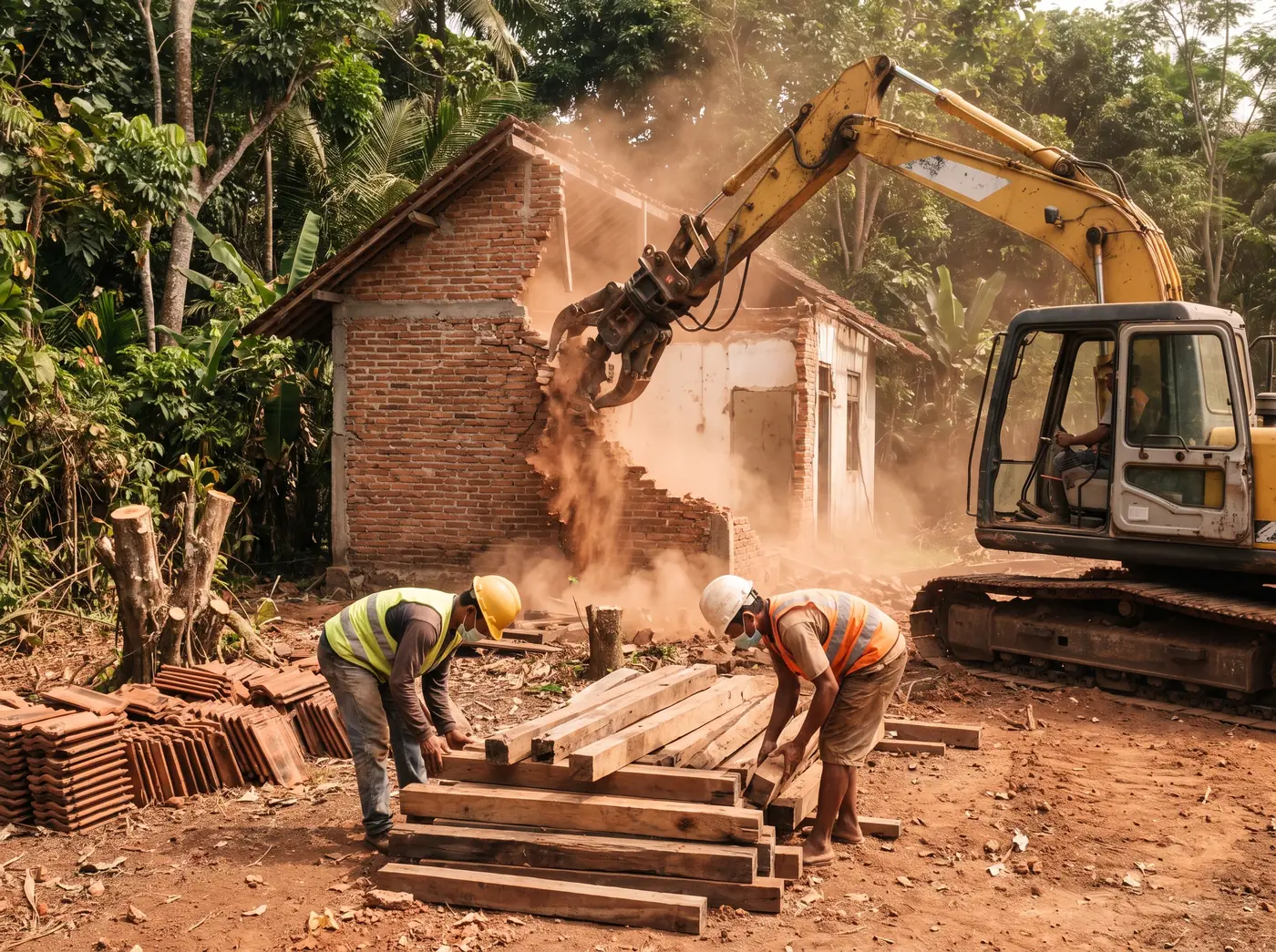
Sequence is everything. We soft-strip by hand first, recovering what has value — teak doors and frames, roof tiles, steel, working fixtures — because in Bali there is a second life and a buyer for most of it. Then machines take the structure down in a planned order, with water suppression for dust and working hours agreed with the banjar before we start. Tight lanes are normal here; where a big excavator can't reach, mini machines and breakers finish the job.
Waste leaves the site sorted, not mixed: concrete and masonry crushed for reuse as compacted fill or road base, steel to recyclers, green waste chipped rather than burned, and only the true remainder to licensed disposal. Trees are removed roots and all where structures will stand — buried root balls rot into voids that settle under slabs years later. You receive photo reports throughout and a final grade checked against survey benchmarks.
Demolition in Bali is a logistics problem
Taking a building down is rarely the hard part. Getting it off the plot is. Many Bali sites sit on lanes barely wider than the truck, which caps load sizes and multiplies trips — a modest 200 m² house becomes twenty-plus truck movements, each negotiating scooters and ceremony processions. We plan haul routes and timings with the banjar, schedule around the ceremony calendar rather than fighting it, and in the wet season we track mud onto nobody's road: wheel-wash and sweeping are line items, not afterthoughts.
Shared and adjoining structures need care too. Where a boundary wall stays, we cut the connection with saws rather than shock it with breakers, and we photo-document neighbouring walls before starting — the record that keeps relationships and deposits intact.
Where the waste actually goes
Bali has nowhere left to hide waste, and we don't try. Concrete and brick rubble gets crushed and reused — on most projects as compacted fill under new floor slabs or as sub-base for the access road, which cuts both disposal trips and the fill you'd otherwise buy in. Steel and aluminium go to recyclers and are credited against your invoice. Green waste is chipped for mulch or removed for composting, never burned on site.
What genuinely can't be reused travels to licensed disposal, and every truck that leaves is logged: date, load type, destination. The log lands in your final report next to before-and-after photos and the pad level survey. If you're building with us next, the same report becomes the starting record for earthworks — one less unknown under your foundation.
SCOPE OF WORK
What's included
Pre-demolition survey
Structure, hazardous materials and services checked; neighbours and the banjar informed before work.
Service disconnection
Power, water and septic lines located, disconnected and confirmed dead before the first hammer.
Soft-strip & salvage
Doors, timber, tiles, steel and fixtures recovered by hand and credited or handed to you.
Structural demolition
Machine and manual take-down in planned sequence, with water suppression for dust control.
Clearing & grubbing
Vegetation, stumps and root systems removed so nothing organic rots and settles under your slab.
Haul-off & level pad
Sorted loads to recyclers and licensed tips; the pad graded, compacted and levelled to benchmarks.
PROCESS
How the job runs
- 01
Site walk & quote
We survey the structure, access and salvage value, then quote fixed — demolition, clearing and haul-off itemised.
- 02
Permits & disconnection
Notifications, neighbour documentation and confirmed disconnection of power, water and septic.
- 03
Strip, demolish, clear
Salvage first, then sequenced take-down and root clearing with dust and traffic control.
- 04
Haul-off & handover
Sorted loads leave with a documented log; you take over a levelled, compacted pad.
INDICATIVE PRICING
Honest numbers, before the survey
| Scope | Guide price |
|---|---|
| Building demolition (per m² of floor area) | from IDR 275,000 / m² |
| Site & vegetation clearing | from IDR 35,000 / m² |
| Haul-off, sorted and documented | from IDR 850,000 / truck |
Access, structure type and salvage value move the number — fixed after a free site survey.
Request an exact quoteFAQ
Demolition in Bali — what owners ask
How long does it take to demolish a house?
A single-storey 150–250 m² house typically takes one to two weeks including clearing and haul-off; tight access or hand-only demolition can double that. The honest schedule driver is truck logistics, not the machine — we tell you the trip count when we quote, so the timeline makes sense.
Do I need a permit to demolish?
Notification and local coordination are always needed, and formal approvals apply in some cases — especially where demolition is part of a wider redevelopment. We handle notifications and banjar coordination as part of the job, and where your rebuild needs approvals we fold the demolition into that programme.
What happens to materials worth saving?
They're stripped by hand before machines start. Teak doors, frames, roof tiles, steel and working fixtures either stay with you or are sold on and credited against the invoice — on older buildings salvage can offset a noticeable share of the cost. You approve the salvage list before anything leaves site.
Can you clear land without demolition?
Yes — vegetation clearing is its own service from IDR 35,000/m²: scrub, trees, stumps and root systems out, ground rough-graded and ready for survey and design. Where buildings will stand we remove root balls completely, because organic material left buried becomes the soft spot your slab finds later.
RELATED SERVICES
Often booked together
FROM THE BLOG