FIELD NOTES · 2026-03-16 · 9 min READ
Bore piles vs strauss piles in Bali
Both methods put a reinforced concrete column in the ground and both carry your building. The difference is what they can reach, what they need to get on site, and how fast they work. On a surprising number of Bali plots, the cost per pile ends up almost identical.
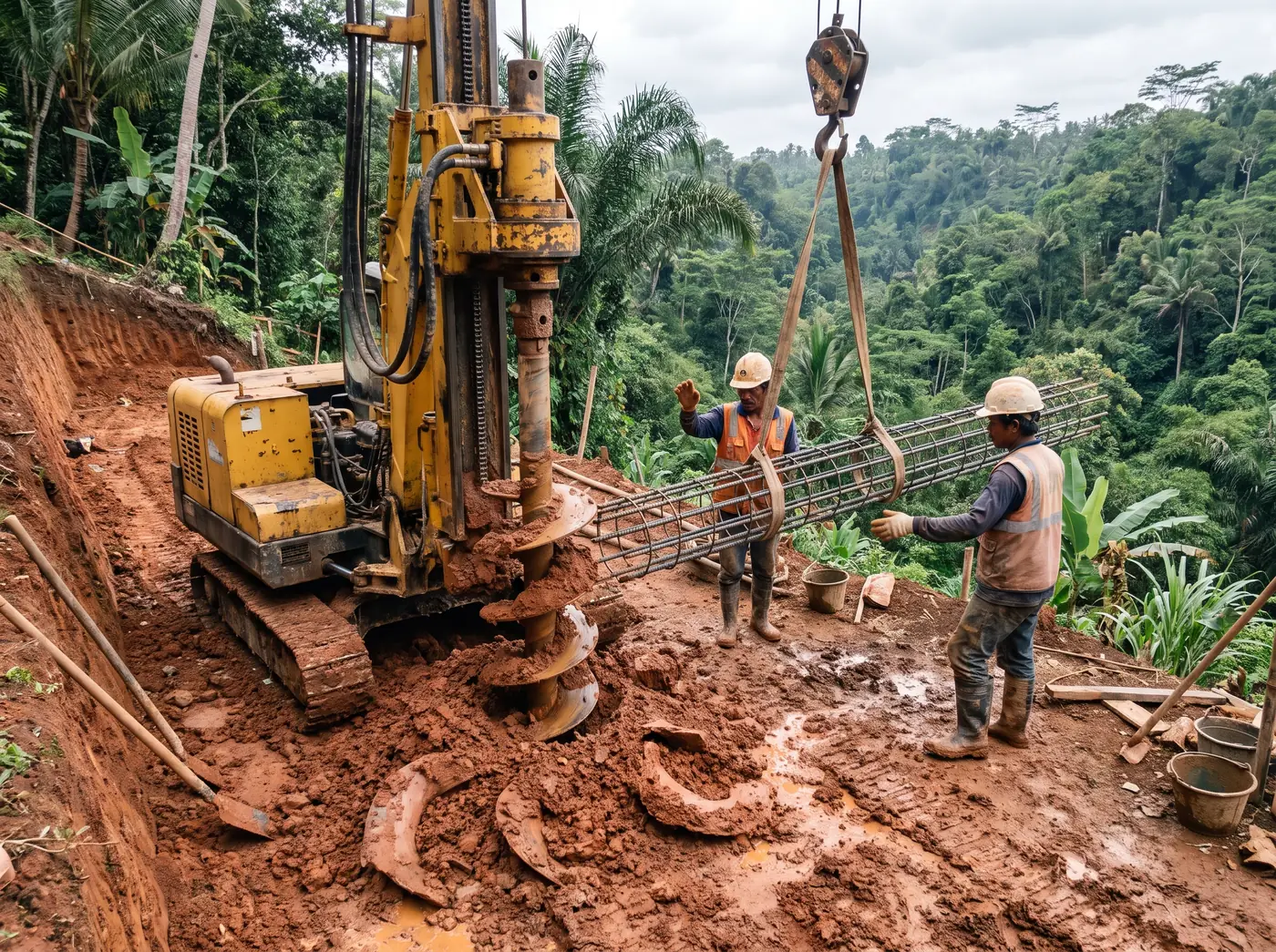
Six men and a handle, or eight tonnes of rig
On a plot off a gang in Umalas, a strauss crew works with a cross handle, a set of rods and a bucket of water. Everything they own came in on a pickup and was carried the last forty metres by hand. Two kilometres away on a wider road, a crawler rig with a continuous auger is putting down a twelve-metre pile every forty-five minutes and filling a skip with wet spoil.
Both are bored piles: a hole is drilled, a reinforcement cage goes in, concrete follows. Neither is driven, so neither shakes the neighbour's wall — which is why almost all piling on this island is bored rather than hammered. What separates them is reach, access and pace, and the choice is usually made by the site rather than by preference.
Two ways to make the same hole
Strauss piles, hand-augered
A gang of four to six turns a helical auger on rods, adding water in stiff clay and lifting spoil out with a bailer. In loose ground a temporary steel casing follows the bit down to stop the walls falling in. Common diameters are Ø25–40 cm, with Ø30 the workhorse, and the honest practical depth is 6–12 metres — beyond that the rods become unmanageable and progress collapses. Reinforcement is typically four to six D13 bars with D8 spirals; concrete goes down a funnel and tremie pipe rather than being dropped, which is the detail that separates a sound pile from an expensive column of segregated aggregate.
A Ø30 cm pile taken 8 m into medium clay carries roughly 15–25 tonnes working load, so columns often get two or three piles under a shared cap. Guide price is from IDR 475,000 per metre, and a hand gang arrives in a vehicle rather than on a low-loader.
Machine-bored piles
A mini crawler rig with an auger or drilling bucket handles Ø40–60 cm as standard and reaches 20–30 m. Where sand or gravel wants to collapse, the rig runs temporary casing or a bentonite slurry to hold the bore open; below the water table, concrete is placed by tremie from the toe up so it displaces water rather than mixing with it. A Ø40 cm pile at 12 m into firm ground will typically carry 40–60 tonnes, which usually means one pile per column instead of three.
The rig itself weighs eight to fifteen tonnes and needs somewhere firm to stand, room to turn, and a route in. Guide price is from IDR 725,000 per metre with mobilisation from IDR 8,500,000 — a fixed cost that matters a great deal on a small job and disappears on a large one.
Head to head
| Strauss (hand-augered) | Machine-bored | |
|---|---|---|
| Typical diameter | Ø25–40 cm | Ø40–60 cm, up to Ø80 |
| Practical depth | 6–12 m | 20–30 m |
| Working load per pile | 15–25 t (Ø30 at 8 m) | 40–60 t (Ø40 at 12 m) |
| Access needed | A one-metre gap and a place to stand | 3–3.5 m width, firm platform, turning space |
| Headroom | Works under about 3 m; rods are short | Mast height, typically 8 m or more |
| Output per working day | 2–4 piles per gang | 40–80 m of pile |
| Spoil | Small, mostly bailed and barrowed | Bulk, often wet — needs a pit and haul-off |
| Struggles with | Gravel, boulders, rock, deep sand below water | Narrow lanes, tight plots, low bridges |
| Guide price | from IDR 475,000 / m | from IDR 725,000 / m plus mobilisation |
Quality control is identical whichever method you choose, and it is worth writing into the contract: concrete cubes taken per pour and crushed at 7 and 28 days, plastic spacers on the cage so the steel sits central instead of resting against soil, and — the check that catches most problems — reconciling the concrete actually placed against the theoretical volume of the hole. A pile that swallows 30 per cent extra has a cavity or an over-cut section; one that takes noticeably less has an obstruction, and both need answering on the day rather than after the cap is cast. Pile heads then get cut down to sound concrete before the cap steel is tied.
Access decides more often than geology
Half the piling decisions we make in south Bali are settled before anyone discusses the ground. The gang serving a plot in Kerobokan is 2.2 m wide with a temple wall on one side, or there is a culvert on the approach that will not take a low-loader, or the only route in passes a compound where a ceremony is scheduled for the week you wanted to mobilise. A rig that cannot reach the plot has no cost advantage at any depth.
Three practical checks before you assume a machine can work:
- The route, not the site. Measure the narrowest point of the whole approach, including overhead cables and low branches, and check what the last culvert is built from.
- Standing ground. A rig on soft paddy clay after a week of rain sinks. Budget a working platform of compacted material, and a mini excavator with operator from IDR 2,650,000 per day to build it and to handle spoil.
- Spoil space. Machine boring generates roughly 0.16 m³ of loose spoil per metre of Ø40 pile, so 300 m of piling is close to 50 m³ — ten to twelve truckloads at about IDR 850,000 each, and a slurry pit if the ground is wet.
Ground conditions that rule one out
Hand augering stops where the material stops yielding to a blade. Cemented gravel, coral limestone fragments and the boulder beds you find near old river courses will end a strauss pile two metres short of where the design wanted it, and a pile that stops short is not a shorter pile — it is a different structure. Deep sand below the water table is the other limit: the hole caves as fast as it is cleaned unless casing is driven all the way, which hand crews can rarely sustain past six or seven metres.
Machine rigs handle all of that, but they have their own losing conditions: dense limestone that needs rock tools rather than an auger, and any site where the platform cannot be made firm without more earthwork than the piling itself. In both cases you want the answer before mobilisation, which comes from the sondir or borehole data discussed in why a soil test comes first — cone refusal depth and layer descriptions tell us plainly which method will reach the founding stratum.
What it actually costs on a real footprint
Take a two-storey house with 24 column positions on former paddy: soft clay to about 7 m, firm ground from 8 m. Two credible schemes:
- Strauss. Two Ø30 cm piles per column at 9 m — 48 piles, 432 m at IDR 475,000, about IDR 205 million. Two gangs finish in eight to ten working days.
- Machine-bored. One Ø40 cm pile per column at 12 m — 288 m at IDR 725,000 plus mobilisation, about IDR 217 million. The rig is off site in four to six days.
Within five per cent of each other. That is the point most quotes obscure: the per-metre rate looks decisive, but pile count, depth and cap size move together, and the totals converge. So the real tie-breakers become programme, access, spoil handling, and the pile caps and ground beams that follow — priced with the rest of the foundation works rather than as a separate adventure.
Where the numbers genuinely diverge: below 12 m, hand augering is no longer an option at any price, and on a small job — six piles for a pavilion — mobilising a rig makes the machine option a third more expensive per pile.
Slope sites, where it gets interesting
On the Bukit — Uluwatu, Bingin, the cliff plots behind Balangan — the building steps down terraces a rig cannot climb. The usual answer is hand piles on the lower terraces and machine piles wherever the access road still reaches, tied together with beams designed for the level change. Two extra rules apply on any slope. Every pile must pass through the fill or creeping surface layer into undisturbed material below, because a pile socketed only into moving ground moves with it. And drainage has to be solved at the same time, since saturated slopes are the mechanism behind most retaining wall failures in the wet season. Piling and retaining are one design problem on a hillside, not two trades in sequence.
Programme on a terraced site is also its own animal. Materials arrive by wheelbarrow or chute, concrete often comes in by hand from a mixer parked above, and a wet-season week can cost three working days. We price cliff plots on realistic output, not on the flat-site rates that make a first quote look attractive and the final invoice look like a negotiation.
What we'd do
Get the depth to firm ground from test data first, then measure the narrowest point of the access road. If the founding layer is within 10 m and the lane is tight, hand piles win on cost and disruption. If it is deeper, or the site is open enough for a rig to work cleanly, machine piles will be faster and often no dearer once pile counts are compared honestly. We run both crews and quote both ways when a site is genuinely borderline — it is the only way to see which one your plot actually favours.
NEED IT DONE?
We do this work
Need this done rather than read about it? Our Bali construction company quotes every scope in writing after a free site survey — see the 46 services.