FIELD NOTES · 2026-07-09 · 9 min READ
Getting concrete right in a tropical climate
A truck of K300 leaves the plant at 09:20. It reaches a site off a Pererenan back lane at 10:35, having idled through traffic in 33°C heat. The mix has stiffened, someone reaches for the hose, and a slab designed for 30 MPa quietly becomes a 24 MPa slab. Nobody records it.
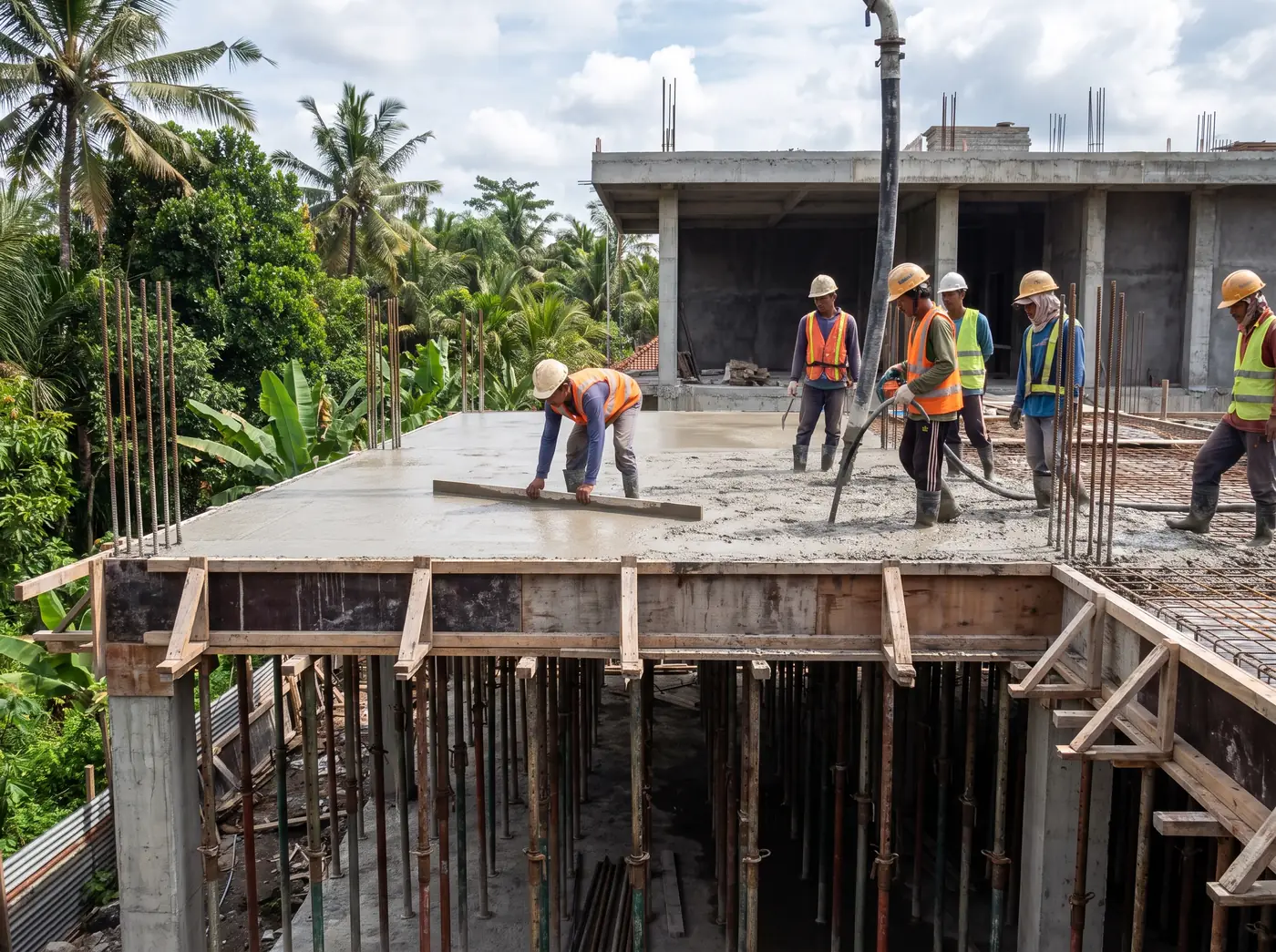
Heat is the variable nobody prices in
Concrete is a chemical reaction with a temperature coefficient, and Bali runs that reaction hot. Ambient sits at 30–34°C through the middle of the day, the formwork and rebar can be 45°C or more after two hours of direct sun, and mix water arrives at whatever the storage tank has been baking at. Every one of those inputs speeds up hydration.
Fast hydration sounds efficient and is not. Higher placing temperature gives higher early strength and lower final strength — a mix placed at 35°C typically finishes several percent below the same mix placed at 22°C — because the reaction products form quickly and unevenly instead of building a dense structure. It also shortens the workable window: what a site treats as ninety minutes of open time becomes forty, which is why the hose comes out.
The practical responses are ordinary and cheap. Shade the aggregate stockpile. Keep the mix water in a covered tank, not a black drum in the sun. Dampen formwork and rebar before placing so they do not draw water from the mix. Pour early — we start large slabs at 06:30 and aim to be finishing by 11:00 — or after 15:00. And use a retarding plasticiser to buy workability rather than adding water. That single substitution, on our reinforced concrete work, is the difference between a design mix and a hopeful one.
K-grades in plain numbers
Indonesian sites specify concrete as K-grades: the characteristic compressive strength in kg/cm², measured on 15 cm cubes at 28 days. International drawings use fc′ in MPa on cylinders, which is a different test on a different specimen, so the two are not interchangeable.
| Grade | Cube strength | Approx. cylinder fc′ | Where it belongs |
|---|---|---|---|
| K175 | ~17.5 MPa | ~14 MPa | Blinding, kerbs, non-structural fill |
| K225 | ~22.5 MPa | ~18 MPa | Light slabs on grade, minor works |
| K250 | ~25 MPa | ~21 MPa | Small residential footings, ground slabs |
| K300 | ~30 MPa | ~25 MPa | Standard structural grade: columns, beams, suspended slabs |
| K350–K400 | ~35–40 MPa | ~29–33 MPa | Transfer beams, pools, water-retaining and marine-exposed elements |
Two notes that save arguments. First, the exposure condition often matters more than the number: a K300 with a low water-cement ratio and proper cover will outlast a K350 with 20 mm of cover in salt air, because durability here is governed by chloride and carbonation reaching the rebar. On coastal work we specify 40–50 mm cover to the outermost bar and check it with spacers, not with eyes. Second, K-grade alone does not describe a mix — cement content, aggregate size and admixture matter, and a "K300" batched by shovel count on site is a label rather than a specification.
Water is not free: the w/c discipline
The water-cement ratio is the one number that decides both strength and durability, and it is the easiest thing on a site to ruin. We work to 0.45–0.50 for structural elements and below 0.45 where water-tightness matters.
The arithmetic is unforgiving. Adding 20 litres of water per cubic metre to a stiffening truckload — half a bucket per wheelbarrow, which looks like nothing — lifts the w/c ratio by roughly 0.05 and costs something in the order of 15–20% of the 28-day strength. It also increases bleed, shrinkage and permeability, so the element cracks more and lets chloride in faster. There is no version of this trade that is worth making.
What we do instead: order the correct slump for the placing method, carry a superplasticiser on site for retempering workability, and give the crew explicit authority to reject a load rather than water it. On big pours a concrete pump — from IDR 7,500,000 for the day — pays for itself by removing the reason people add water in the first place, which is that the mix will not travel down a barrow run in the heat.
Slump, and what happens between the plant and your site
Slump is a workability measurement, not a quality measurement, but it is the fastest early warning you have. Typical targets: 8–12 cm for foundations and slabs placed by barrow, 10–14 cm for pumped work, 12–16 cm for congested columns and shear walls where the vibrator cannot reach everything.
On Bali sites the recurring problem is transit time. Ready-mix from a plant in Denpasar to a site in Ubud or the Bukit can take an hour before it even meets the traffic, and slump falls measurably over that journey in this heat. So we set the target at the point of discharge rather than at the plant, test the first load and every third one after that, and log it. A cone test takes four minutes and settles disputes that otherwise surface at 28 days.
Ready-mix or site-mix
Ready-mix is batched by weight with consistent aggregate, and it is what we use for anything structural where a truck can reach. Where lanes are too narrow — common in Canggu, Ubud and older Sanur streets — the options are pumping from the nearest reachable point, a mini-mixer shuttle, or properly controlled site batching. Site mixing is acceptable only with weigh-batched proportions, a calibrated water measure and a sealed cement store; volume batching by shovel is not, and we have core-tested plenty of shovel-batched slabs that came back below K200. The same principle applies further down the build, where our semi-dry screed crews batch by weight for exactly this reason.
Curing: seven days, and the methods that survive here
Curing is keeping water in the concrete while it hydrates, and the tropics work against it in two directions. Sun and wind evaporate surface water in minutes; high humidity then convinces everyone that curing is happening by itself. It is not. Evaporation from a fresh slab under sun and a light breeze can exceed 1 kg/m² per hour, well past the threshold at which plastic shrinkage cracks appear before the concrete has set.
- Ponding — the most reliable for horizontal slabs: bund the edges and hold 25 mm of water for seven days. In the wet season the sky helps.
- Wet hessian under plastic — the standard for beams, columns and anything vertical; hessian alone dries out by lunchtime.
- Curing compound — acceptable where water access is difficult, but never on surfaces that will later receive screed, epoxy or a bonded membrane, because it is a bond breaker.
- Formwork left in place — the cheapest curing available for columns and walls; we leave vertical forms on longer here rather than stripping them at 24 hours to reuse.
Seven days minimum, ten for water-retaining elements. Concrete cured for two days reaches perhaps 70–80% of the strength of the same mix cured for seven, and the surface layer — the part that resists chloride — is the part that suffers most.
When it rains mid-pour
In the wet season this is a scheduling assumption, not an accident. Our protocol is fixed before the first truck arrives:
- Tarpaulins, poles and squeegees on site before the pour starts, not fetched when the sky darkens.
- Light rain on unfinished concrete: cover, stop finishing, and never trowel rainwater into the surface — it raises the w/c ratio exactly where durability matters most.
- Heavy rain: stop, cover, and form a proper construction joint at a location the engineer has pre-agreed, usually near a point of low shear rather than mid-span.
- Water on top of green concrete gets squeegeed off the edge, never brushed back in.
- Before resuming, the joint is cleaned to sound aggregate, wetted, and treated with a bonding slurry or agent.
Foundations flooding mid-pour is a separate problem with a separate answer: dewatering and blinding before any structural concrete, which is one reason soil and water-table data belong in the programme early, as we argue in choosing a foundation for Bali soil conditions.
Cube tests and the paperwork that protects you
Cube testing is cheap, and it is the only evidence you will have if a slab is questioned. We take a set of six 15 cm cubes per pour or per 5 m³ of structural concrete, whichever is more frequent, cure them alongside the element, and break them at 7, 14 and 28 days. The 7-day result typically runs at 65–70% of the 28-day figure, which gives an early warning while formwork decisions are still reversible.
Each pour record on our sites carries the date and time, ambient temperature, truck docket numbers, slump at discharge, cube identification and the curing method used. If a 28-day break comes in low, that record tells us whether the cause was the mix, the transit, the added water or the curing — and if it is genuinely ambiguous, we core the element and test the core rather than argue. That paperwork travels with the handover pack for the structure, alongside foundation records from our foundation works. It is also what an insurer or a future buyer will ask for.
What we'd do
Book the pour for the early morning, order the right slump for the placing method, and put a written ban on site-added water with a plasticiser available instead. Cure for seven days by ponding or wet hessian, take cubes from every pour, and keep the log. Structural concrete in place — formwork, rebar and K300 — runs from IDR 7,500,000/m³, with suspended slabs from IDR 1,650,000/m²; the discipline above costs almost nothing on top of that and is the entire difference between the strength you specified and the strength you got. Our crews pour to this protocol as standard, and we are happy to hand the method statement to an owner building with someone else.
NEED IT DONE?
We do this work
This guide is published by the engineers of a full-cycle construction company in Bali — the same team that quotes and builds the work described above.