FIELD NOTES · 2026-05-28 · 9 min READ
Does your Bali property need lightning protection?
A strike near a villa in Pererenan last February did not start a fire, break a tile or wake anyone up. It killed the fibre modem, the pool pump drive, two air-conditioning boards, the gate motor and a solar inverter. Replacing them cost more than a complete lightning and surge installation would have — which is the shape of nearly every case we are asked to assess afterwards.
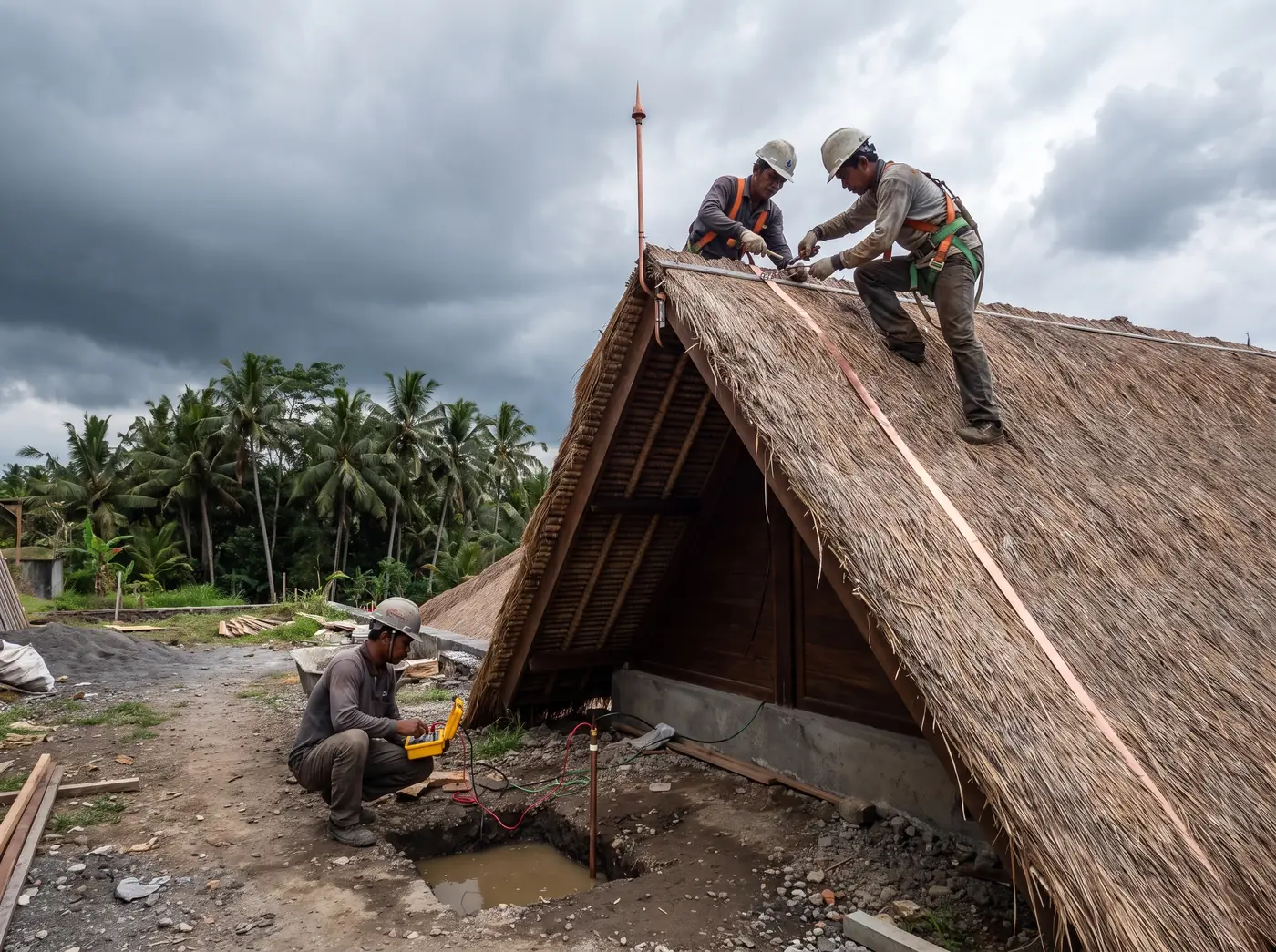
Start with what the sky here actually does
Indonesia sits among the most lightning-prone places on the planet, and Bali is not the quiet corner of it. Depending on where you are, the island records roughly 75 to 120 thunderstorm days a year — fewest on the dry Bukit peninsula and the north-east coast, most on the southern slopes rising towards Batukaru and Agung, where afternoon sea breeze meets terrain and builds cells almost daily from October through April. For comparison, much of northern Europe manages 20 to 30. Flash density across the island typically runs in the region of 8–16 strikes per square kilometre per year.
The second number matters more than the first. A direct strike on a specific building is still statistically uncommon; the damage we are called out to is overwhelmingly caused by strikes up to a kilometre away, coupling into the property through the overhead PLN supply, the telecom line, an irrigation cable or the reinforcement of the building itself. Rough industry accounting puts something like nine out of ten lightning insurance claims in that second category. It is why lightning protection and surge protection are two different jobs, and why buying only one of them disappoints people.
Score your own building
Before quoting anything, we walk the site with a mental version of the table below. It is a simplified take on the risk assessment inside IEC 62305, which weighs strike probability against what a strike would cost you.
| Factor | Raises the risk when… |
|---|---|
| Relative height | Your roof, water tower or rooftop deck is the tallest thing within 50 m |
| Isolation | The building stands in open rice field, on a ridge line or at a cliff edge |
| Trees | Coconut palms or a kapok tree overtop the roof within 10–15 m — a struck tree side-flashes to the nearest earthed metal |
| Roof form | Large metal roof area, steel trusses, rooftop plant, a solar array |
| Supply route | A long overhead PLN spur feeds you, rather than a short underground service |
| Electronics value | Inverters, VSD pool pumps, deep-well pump controls, automation, AV, CCTV, EV charging |
| Occupancy | Guests and staff on site, rooftop terraces, an outdoor pool in use during storms |
| Cost of downtime | A restaurant, gym or villa business that cannot trade without power and internet |
Three or more of those in play and a full system is straightforwardly worth its cost. One or two, and the sensible spend is surge protection at the board plus honest earthing. None of them — a single-storey house in the middle of a dense Seminyak block with an underground supply and modest electronics — and we will tell you to save the money. We do turn work down on this basis; a system sold on fear rather than exposure is a bad advertisement for us six years later.
What a real system contains
A complete installation has four parts, and every one of them has to be right for the other three to matter.
1. Air termination
The bit people picture: rods, a mesh over a flat roof, or a catenary wire between masts. What decides layout is the rolling-sphere method — imagine a sphere of 45 or 60 m radius, depending on the protection class, rolled over the building. Wherever it touches, a strike can land, and that is where a terminal goes. Chimneys, water tanks, rooftop AC condensers, aerials and pergola corners all need thinking about, not just the ridge. The covering underneath changes the fixing detail rather than the layout — clay tile, metal sheet and concrete decks each take terminals and conductor clips differently, which is worth reading alongside our comparison of tropical roofing materials.
2. Down conductors
At least two on anything but the smallest building, spaced roughly 15–20 m around the perimeter, in 50 mm² copper tape or 8 mm round conductor, routed on the outside of the structure by the shortest sensible path. Bends stay gentle — a tight 90° corner encourages the current to jump the corner instead of following the wire. Each run gets a test joint so the installation can be measured later rather than admired.
3. Earth termination
This is where most of the systems we inspect fall down. The target under Indonesian practice is an earth resistance below 5 Ω, verified with a fall-of-potential or clamp test and issued as a certificate with the actual figure on it. Bali's volcanic soils vary wildly: damp clay in the rice belts can reach the target with two 3 m rods, while dry limestone on the Bukit sometimes needs a ring electrode, deep-driven rods, several metres of trenched conductor or a bentonite backfill to get there. Every electrode sits in an accessible test pit, because an earth you cannot measure is an earth you are guessing about.
4. Equipotential bonding
The part nobody photographs. Metal roof sheets, gutters, balustrades, steel trusses, water pipes, the pool structure, the PLN earth and the lightning earth all get bonded together so that during a strike everything rises to the same potential for a few microseconds. Separate, unbonded earths are worse than none — they create the voltage difference that produces a side-flash through a wall, and that flash is what starts fires and destroys whatever equipment happens to be in the path.
If your roof is metal or steel-framed, bonding is not optional and needs coordinating with the roof build-up rather than being drilled in afterwards — which is also part of the argument in our comparison of steel versus timber roof trusses.
Surge protection comes in tiers
Air terminals defend the building. Surge protective devices defend everything plugged into it, and they work as a coordinated set:
- Type 1 at the origin of the installation, sized for a direct-strike waveform, where there is a lightning protection system or an overhead supply. This is the heavy one.
- Type 2 in each distribution board, clamping what gets past Type 1 to roughly 1.5 kV or less. If you only ever fit one device, this is it.
- Type 3 at sensitive equipment — the AV rack, the automation cabinet, the inverter.
- Data and signal paths. Fibre or copper telecom, coax, CCTV runs, PV strings on the DC side and the pool-pump control cable. In our post-strike inspections the modem is the single most common casualty, because a surge arrived down a line nobody protected.
Two installation details make the difference between a device that works and a device that decorates a board. Leads must be short — total connection length under about half a metre, because the inductance of a long tail throws away most of the protection. And the device must be earthed to the same system as everything else. Modules degrade every time they absorb energy, so they carry a status window or a remote-signal contact; we check them at each electrical inspection and swap cartridges rather than whole units. Where we are already doing the electrical installation for a build, adding coordinated surge protection to a distribution board is a marginal cost, which is the cheapest moment it will ever be.
The honest note about ESE terminals
Plenty of suppliers in Bali sell early streamer emission terminals with claims of a 50, 80 or 107 m protection radius from a single mast. The physics behind those radii has not held up in independent field testing, and several national standards bodies decline to recognise the claimed advantage. We install them when a client asks, and we size the protected zone as if the device were a conventional Franklin rod. If a quote is significantly cheaper than everyone else's because one ESE mast is said to cover the whole property, that is not a discount, it is a smaller system with a bigger claim attached.
Five things that are not true
- "Lightning never strikes the same place twice." Tall isolated objects get hit repeatedly. The tower on the ridge above you may take several strikes a season.
- "A rod attracts lightning to my house." An air terminal does not meaningfully change the probability of a strike in the area; it decides where the current goes once one arrives — down a copper conductor rather than through your wiring.
- "We have a grounding rod, so we're covered." An earth rod on its own protects nothing above ground, and unbonded to the rest of the installation it can make side-flash more likely, not less.
- "It's a concrete building, so it's safe." Reinforced concrete does protect people well. It does nothing for the electronics, because the surge arrives along cables, not through walls.
- "We unplug things when a storm comes." Someone has to be there, awake, and willing to do it during every storm for the next decade — including the ones that happen while the villa is between guests.
What it costs
| Scope | Guide price |
|---|---|
| Villa system: air terminals, down conductors, earthing, bonding, certificate | from IDR 12,500,000 |
| Commercial system: hotel, gym, restaurant or multi-block site | from IDR 28,000,000 |
| Earthing remediation on an existing building | from IDR 4,500,000 |
| Distribution panel rebuilt with coordinated SPDs | from IDR 8,500,000 |
Set those against a replacement round of inverter, pump drive, two AC boards and a modem, which lands in the same range as the whole villa system — and against the fortnight of not trading while parts are shipped in. Most Indonesian household policies treat lightning damage to electronics as a limited or excluded item, so read yours before assuming someone else carries the risk.
What we'd do
If your building is the tallest thing around, sits in the open, has a metal roof, or runs an inverter and a well pump you cannot replace in a week, install the full system and insist on a measured earth resistance under 5 Ω on paper. If none of that applies, fit coordinated surge protection at the board and on the data line and leave it there. Our crews do both, we measure before and after, and we hand over the test results whether or not they flatter the job — lightning protection and earthing is one of the few trades where the certificate is the product.
FAQ
Quick answers
How do I know whether my earthing is any good?
Only by measuring it. A fall-of-potential or clamp test gives an actual figure in ohms; anything above 5 Ω on a lightning earth needs work, and we have measured existing installations at 40 Ω and worse. The test takes under an hour, needs an accessible test pit at each electrode, and ends with a certificate stating the value. Remediation — deeper rods, a ring conductor, conductive backfill — starts from IDR 4,500,000 depending on soil.
Does a metal roof protect the building by itself?
No. Sheet steel will carry current, but a strike can puncture thin gauge, and without bonded down conductors that current will find its own way to earth through gutters, fixings, pipework or wiring. A metal roof is an asset once it is properly bonded into a designed system, and a liability when it is left as an unearthed conductor sitting on top of your house.
Will lightning protection stop my electronics from dying?
Not on its own — the two problems have different solutions. Air terminals, conductors and earthing handle a direct strike to the structure. Nearby strikes that induce surges into the PLN supply, the telecom line or long outdoor cable runs are stopped by coordinated surge protective devices at the board and at the equipment, plus bonding so that everything shares one potential. Fit both, or expect to keep replacing boards.
NEED IT DONE?
We do this work
Need this done rather than read about it? Our Bali construction company quotes every scope in writing after a free site survey — see the 46 services.