FIELD NOTES · 2026-10-01 · 8 min READ
Tempered vs laminated glass: which goes where in a Bali villa
Tempered glass is four to five times stronger than ordinary glass and breaks into small, blunt pieces; laminated glass may crack but stays in one piece, held together by its interlayer. In a Bali villa, use tempered glass for doors, showers and low windows, and laminated or toughened-laminated glass wherever glass is overhead or guards a drop — skylights, glass roofs and balustrades. Thicknesses, the heat-soak test and 2026 prices are below.
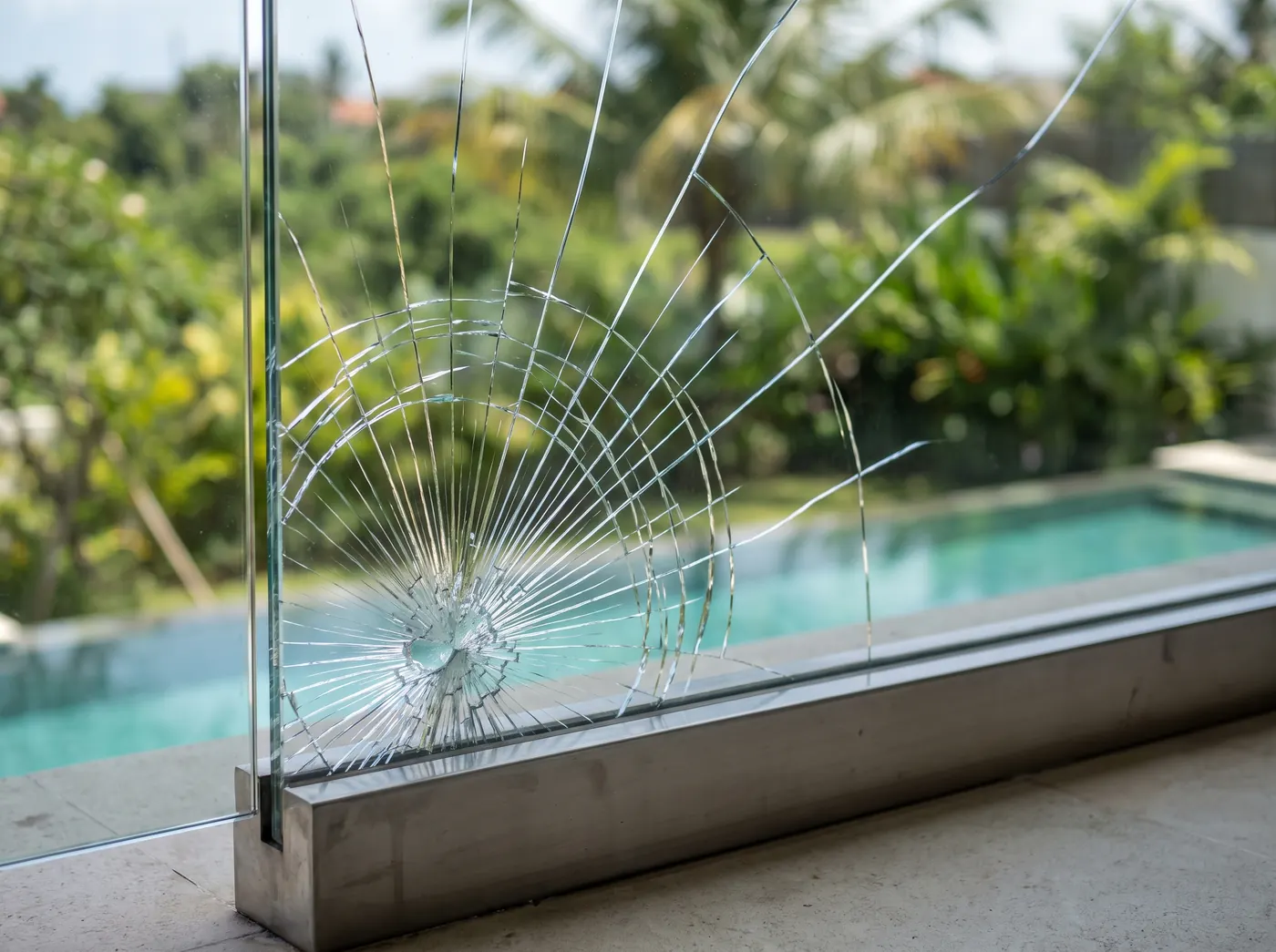
How each type is made — and how it breaks
Tempered (toughened) glass is ordinary float glass heated to over 600 °C and cooled quickly with air jets. The surface ends up in compression, which makes the pane four to five times stronger in bending and much more resistant to heat stress. When it does break, it breaks completely, into small cube-like pieces that are unlikely to cause deep cuts. Because the whole pane is under stress, it cannot be cut or drilled after tempering — every hole and notch is made first.
Laminated glass is two or more panes bonded with a plastic interlayer, usually PVB. It is not necessarily stronger, but when it breaks the pieces stay stuck to the interlayer and the panel stays in the frame. That is why it is used overhead, for security and for noise. The panes themselves can be ordinary or tempered; tempered panes laminated together — toughened laminated glass — combine both properties and are standard for frameless balustrades.
Where each one belongs in a villa
| Location | Recommended glass | Why |
|---|---|---|
| Sliding and swing doors | Tempered 8–10 mm, or laminated | People walk into doors; safety glass is not optional |
| Windows near the floor | Tempered or laminated | A low pane can be fallen against or kicked |
| Shower screens | Tempered 8–10 mm | Stiff enough to stand frameless, safe if broken |
| Balustrades and glass railings | Toughened laminated, e.g. 13.52 or 17.52 mm | Stays in place if a pane breaks — it still guards the drop |
| Skylights and glass roofs | Laminated, at least the inner pane | Broken tempered glass overhead falls on people; laminated stays up |
| Pool fences | Tempered 12 mm or laminated | Impact from furniture and play; heat-soaked recommended |
| Security-sensitive ground-floor glazing | Laminated | The interlayer holds the pane together and slows entry |
For balustrades, the reason is simple: a tempered panel that shatters leaves an open edge above a drop, while a laminated panel that cracks keeps guarding it until it is replaced — exactly what the photo above shows. Prices for glass railings by system are in our glass railing cost guide.
Spontaneous breakage and the heat-soak test
Occasionally a tempered pane shatters on its own, weeks or years after installation, with nobody near it. The usual cause is a microscopic nickel sulphide inclusion from manufacturing that slowly changes volume until it breaks the stressed glass. It is rare, but on large panes, overhead glass and balustrades it is a risk worth removing. A heat-soak test reheats tempered panes in an oven for several hours so that most panes with inclusions break in the factory instead of on your terrace. We recommend heat-soaked glass for balustrades, pool fences, large door leaves and big shower panels.
Thickness guide
| Glass | Typical use in a villa |
|---|---|
| 5–6 mm tempered | Windows, small fixed panes |
| 8 mm tempered | Sliding door leaves, small fixed shower panels |
| 10 mm tempered | Shower doors and screens, large door leaves, partitions |
| 12 mm tempered | Pool fences, frameless partitions, some balustrades with a top rail |
| 6.38–10.38 mm laminated | Security and acoustic windows, small skylights (inner pane) |
| 13.52 mm toughened laminated (6+6) | Balustrades on spigots, standoff fixings |
| 17.52 mm toughened laminated (8+8) | Frameless balustrades in a base channel, larger spans |
Thickness is decided by the size of the pane, how it is supported and the load on it — a balustrade must take a person leaning or falling against it. Treat the table as a starting point; the specification for a specific panel comes from its size and fixing.
What the difference costs
| Glass (supply, per m²) | Typical 2026 price in Indonesia |
|---|---|
| Clear float 5 mm | IDR 110,000–200,000 |
| Tempered 8 mm | IDR 440,000–750,000 |
| Tempered 10 mm | IDR 540,000–1,050,000 |
| Tempered 12 mm | IDR 600,000–1,400,000 |
| Laminated 4 + 4 mm | about IDR 1,100,000 |
| Laminated 5 + 5 mm | about IDR 1,250,000 |
| Toughened laminated 6 + 6 mm | about IDR 1,650,000 |
| Toughened laminated 10 + 10 mm | about IDR 2,950,000 |
These are glass-only supply prices for standard sizes. Installed systems cost more, because the price also covers the frame or hardware, fabrication of holes and edges before tempering, transport, lifting and fixing. In our guide prices that is already included — for example frameless balustrades from IDR 3,900,000 per metre and shower enclosures from IDR 8,900,000 on our frameless glass systems page.
How to tell what glass you already have
Tempered glass made to a standard usually carries a small permanent mark in one corner, showing the manufacturer and the standard it was tested to. No mark does not prove the glass is ordinary, but on an older villa it is a reason to check. Two more clues: look at the pane through polarised sunglasses at an angle, and tempered glass often shows faint dark stripes or spots left by the cooling jets; and look at the edge, where laminated glass shows a thin line of interlayer between the panes.
If a door or a low window in your villa turns out to be ordinary float glass, it is worth replacing even if nothing is broken. A child running into a sliding door is the classic accident, and ordinary glass breaks into long, sharp shards. Replacing a door leaf with tempered glass is a small job — see window and door repair.
Skylights and glass roofs need a different rule
Overhead glass is the one place where tempered glass alone is the wrong answer. If a tempered pane breaks overhead, thousands of small pieces fall into the room below; a laminated pane sags but stays in its frame until it is replaced. For skylights and glass roofs the inner pane — the one above people — should be laminated, and on large spans the whole unit is usually toughened laminated. Glass roofs also need a fall of a few degrees so rain and leaves run off instead of sitting on the seals, and the frame needs drainage like any window.
Low-E, tinted and acoustic options
Either type can carry a coating or tint. Low-E and solar-control coatings cut the heat that comes through large west-facing glass without making rooms dark; tinted glass does the same less selectively. Laminated glass with an acoustic interlayer reduces road and aircraft noise noticeably — often a better answer for a bedroom near the airport approach than double glazing, as we explain in double glazing in Bali.
FAQ
Quick answers
Is tempered glass safe for a balustrade?
Single tempered glass is used with a top rail in some systems, but for frameless balustrades we recommend toughened laminated glass. If a tempered panel breaks, it falls out completely and leaves an open edge; a laminated panel cracks but stays in place and keeps guarding the drop.
Can tempered glass be cut on site?
No. Tempered glass shatters if it is cut or drilled after tempering, so every size, hole and notch is made in the factory first. That is why shower screens and glass doors are measured after the tiles and frames are finished.
Why did my tempered glass shatter by itself?
Usually because of a tiny nickel sulphide inclusion in the glass, or edge damage from installation or a knock. The heat-soak test removes most panes with inclusions before they are installed, which is why we recommend it for large and overhead panels.
Is laminated glass better against burglars?
Yes. Laminated glass cracks but holds together, so getting through it takes time and noise. Tempered glass is strong but, once broken, the opening is clear. For ground-floor doors in quiet areas laminated glass is the more secure choice.
NEED IT DONE?
We do this work
This guide is published by the engineers of a full-cycle construction company in Bali — the same crews that supply, install and repair the work described above.