FIELD NOTES · 2026-07-21 · 9 min READ
Pool losing water? Evaporation vs a real leak
The autofill valve hisses a little longer every week, the chlorine never quite holds, and somebody mentions that pools just lose water in the tropics. Sometimes that is true. More often there is a 3 mm split in a return line under the deck, and it has been running for eight months.
Start with the number, not the theory
Water loss is measured in millimetres of depth per day, and the conversion is convenient: one millimetre off the surface of one square metre is one litre. A 4 × 10 m pool losing 5 mm a day is losing 200 litres a day and 1.4 m³ a week, which shows up as roughly 25 mm on the tile line every five days.
What counts as normal here depends on season and exposure more than most owners expect:
- Wet season, sheltered courtyard pool: 2–3 mm/day. Humidity sits at 85–90% and the air can barely take more water.
- Dry season, ordinary garden pool: 4–6 mm/day. Lower humidity and steady afternoon breeze do most of it.
- Exposed ridge or beachfront pool, August: 7–10 mm/day. Wind is the strongest single driver of evaporation, well ahead of air temperature.
- Heated pool or spa, uncovered: add 50–100% to any of the above. Warm water evaporates hard, which is why an uncovered spa can drop 15 mm overnight and be perfectly healthy.
- Waterfall or sheer-descent running: two to three times the still-water rate while it runs, plus whatever the wind carries onto the deck.
Two mundane culprits get blamed on leaks every week. Filter backwashing dumps 0.5–1 m³ each time and if the pool boy does it on a Tuesday you will read it as a Tuesday leak. And a busy pool with six people in it splashes out more than most people believe. Both are worth eliminating before anyone books a detection visit. A sustained loss above about 6 mm/day, in the wet season or with the pool unused, is the point at which we stop calling it evaporation.
The bucket test, done properly
This costs nothing, takes a day, and answers the only question that matters first. It works because the bucket and the pool sit in the same air, in the same sun, and therefore evaporate at the same rate.
- Switch the autofill off, or tie the float up. Any automatic top-up makes the test meaningless.
- Bring the pool to its normal operating level.
- Put a 10–20 litre bucket on the second step so it sits partly submerged — that keeps the water in it at pool temperature. Weight it with a stone so it cannot shift.
- Fill the bucket with pool water to about 50 mm below its rim.
- Mark both levels with tape: the water inside the bucket, and the pool level on the outside of the bucket.
- Run the pool exactly as normal for 24 hours. No swimming, no backwashing, no topping up.
- Compare the two drops. Equal, or within a millimetre or two, means evaporation. If the pool has dropped 3 mm or more further than the bucket, you have a leak.
Then run it a second time with the pump switched off completely for 24 hours. That single extra day splits the problem in half before any equipment comes out, because the plumbing is only pressurised when the pump runs.
- Worse with the pump running: pressure side — return lines, the filter, heater or chiller unions, the equipment pit itself.
- Worse with the pump off: suction side, or the shell. Skimmer line, main drain line, or a crack that only draws when the water is still.
- The same either way: the shell, the tile line, or a fitting that leaks regardless of pressure.
Read the level where it stops
If a leak is bad enough to lower the pool overnight, let it. Where the water settles is a diagnosis in itself — it stops falling at the level of the hole.
| Where the level settles or what you see | Most likely source |
|---|---|
| Stops at the mouth of the skimmer | Skimmer throat crack or the faceplate seal between the skimmer body and the shell — the single most common leak we find |
| Stops a few centimetres below the tile line | Bond beam crack, failed grout along the waterline, or a return fitting at that height |
| Stops level with the pool light | Light niche seal or the conduit running out of the back of it |
| Keeps dropping towards the main drain, or empties | Shell crack, main drain sump, or the hydrostatic relief valve |
| Air bubbles from the returns, pump losing prime, gauge fluctuating | Suction line leaking above the water table — air is being drawn in where water should be |
| A permanently soggy patch or unusually green grass on one line route | Buried pipe leak; the plants find it before you do |
| Coping stones dropping, pavers moving, hollow sound under the deck | A long-running leak washing fines out of the bedding — structural, and no longer just a water bill |
| Rising chemical demand, cloudy water, scale on the equipment | Constant dilution by fresh top-up water; a symptom, not a cause |
| Damp ceiling or wall below an upper-floor or rooftop pool | Shell waterproofing or a penetration through it — investigate immediately, not next month |
Why Bali pools leak in the first place
Some of it is ordinary: a solvent-welded joint made in a rainstorm never fully cures, a fitting is over-tightened during a rushed handover, a tile setter fills a crack instead of reporting it. The rest is local.
Plenty of pools here sit on cut-and-fill platforms carved into slopes. If the fill was not compacted in proper layers, it consolidates for years, and the shell and its rigid pipe runs settle unevenly on top of it. Add clay that swells through January and shrinks through August, and the buried plumbing gets worked back and forth every season. Tremors do their share. So does concrete placed badly in 32 °C heat — shells poured without cold joints planned, cured for a day instead of a week, and cracked before they were ever filled, which is exactly the failure mode described in how concrete behaves in this climate.
There is a hazard in the other direction too. Never drain a pool during the wet season without checking the hydrostatic relief valve first. With a high water table and an empty shell, groundwater pressure can lift the whole structure out of the ground — we have seen a pool floated 200 mm out of level by a week of rain. And on a sloping site, a leaking pool is not only losing water: it is quietly saturating the fill behind whatever holds the terrace up, which is one of the mechanisms behind retaining walls that fail in the rainy season.
What a detection visit actually does
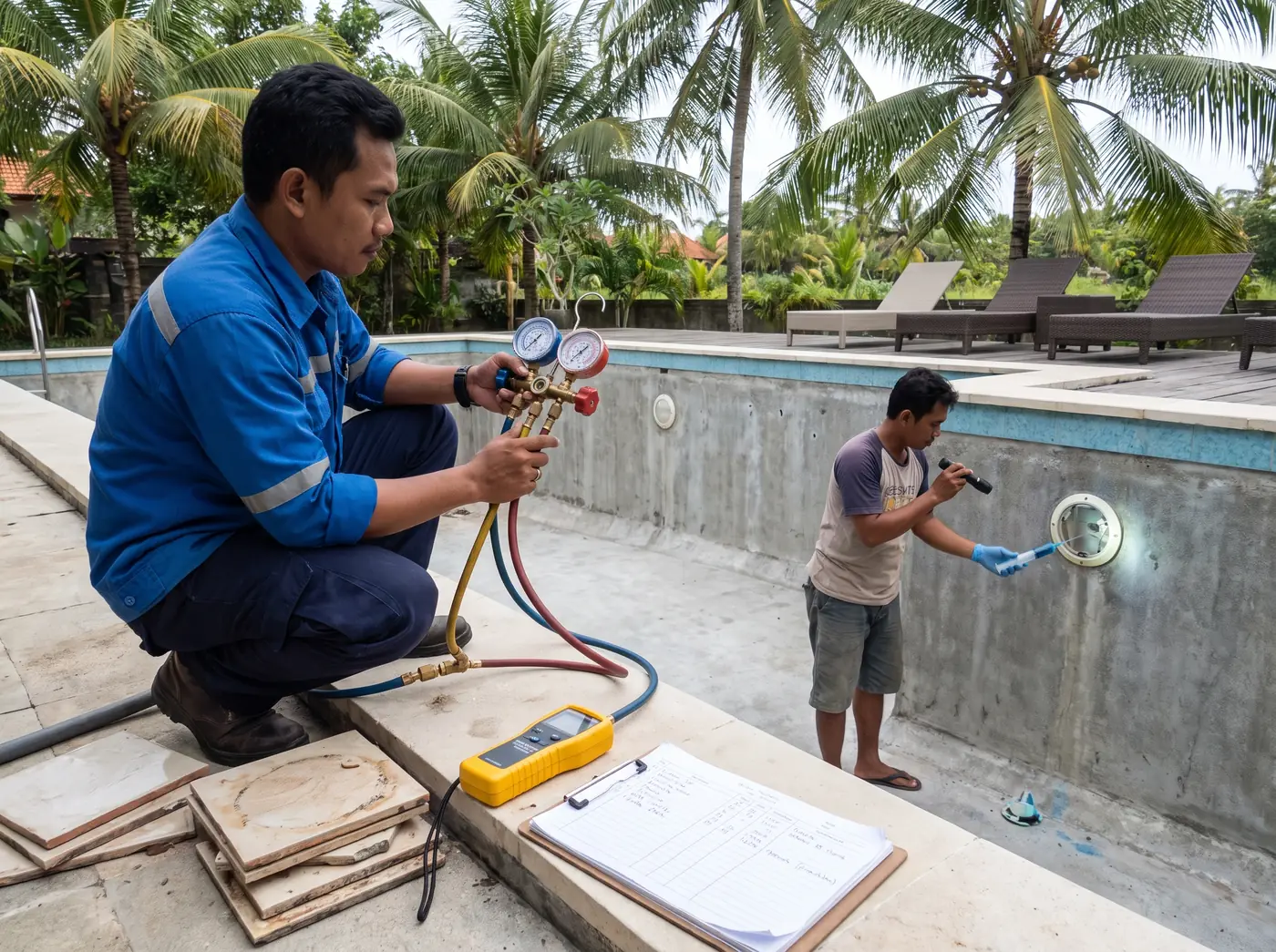
A proper survey is a sequence of eliminations, not a walk around with a torch. On a typical villa pool it runs three to five hours:
- Static isolation. Plug the skimmer and main drain lines and watch the level again. If the loss stops, the leak is in the plumbing; if it continues, the shell is in the frame.
- Line pressure testing. Each line individually to 1–1.5 bar, held and timed. A line that will not hold pressure for fifteen minutes is a line with a hole, and the rate of drop tells us roughly how large.
- Dye testing. With the pump off and the water dead still, dye released at skimmers, returns, light niches, steps and any visible crack. Water moving into a hole pulls the dye with it, visibly.
- Acoustic listening. A pressurised leak makes noise. Ground microphones and hydrophones locate a buried break within a metre or so, which is the difference between lifting four tiles and lifting the whole deck.
- Camera where it earns its place. In long or complicated line runs, a push camera confirms the break and its distance before anyone cuts anything.
- A written report. Photographs, a marked-up plan, the pressure figures, and a repair scope. You should be able to hand it to any contractor, including one who is not us.
Guide pricing: a full detection survey from IDR 3,500,000, an individual line pressure test from IDR 1,850,000, and a typical fitting repair from IDR 4,500,000. If the pool serves a rental property, do the survey between guests — dead-still water is a requirement, not a preference.
Repairs, and what they honestly cost
Most leaks are small jobs once they are found. Skimmer and return-fitting repairs, the largest single category, start around IDR 4,500,000 and involve removing a few tiles rather than resurfacing anything. A buried line break is priced by access: under a garden bed it is straightforward, under a stone terrace it is a stone job as much as a plumbing one, and relaying a failed line in flexible pipe often beats chasing repeated repairs on brittle old PVC.
Shell cracks are the ones people fear, and mostly they should not. A live crack in a concrete shell can be resin-injected from IDR 650,000 per metre and sealed permanently — the same injection work we do in basements and lift pits. Full re-tiling is occasionally the right answer, but we quote it only when a survey shows a substrate that has genuinely failed. Where the surrounding coping and stone has been stained or undermined by months of seepage, restoring the stonework is usually the larger half of the bill.
Spas and hot tubs follow the same logic with tighter tolerances, since a small volume at high temperature loses proportionally far more. Those we handle under spa servicing, where the leak triage sits alongside the heater, pump and chemistry work rather than being a separate visit.
What we'd do
Run the bucket test twice — once with the pump on, once with it off — before spending a rupiah. Note where the level settles if you let it fall, and check the ground along the line routes for the soft patch the grass has already found. If the pool is losing more than 6 mm a day with nobody swimming, book a detection survey rather than accepting a top-up habit: a 5 mm-per-day leak on a 40 m² pool is 73 m³ a year, plus the chemicals and the slow damage to whatever is under the deck. Our crews do detection and the repair that follows, and we will tell you when the answer is genuinely just August.
FAQ
Quick answers
How much water loss is normal for a pool in Bali?
Between 2 and 6 mm of depth a day, depending on season and exposure — that is 80 to 240 litres a day on a 4 × 10 m pool. Sheltered pools in the wet season sit at the bottom of that band; exposed clifftop and beachfront pools in August reach 7–10 mm. Sustained loss above 6 mm/day, with the pool unused and no backwashing, is worth investigating.
Can you find a leak without draining the pool?
Yes, and we prefer to. Detection is done with the pool full: line isolation and pressure testing, dye at the fittings, and acoustic listening for buried breaks. Draining a pool in the wet season is actively risky, because groundwater pressure under an empty shell can lift it. Repairs are then targeted to the point we located.
My autofill runs constantly — is that proof of a leak?
Not on its own, but it hides the evidence. Turn the autofill off and run the bucket test for 24 hours to get a real figure. Also rule out backwashing, which dumps 0.5–1 m³ each time, and heavy splash-out. If the pool still drops 3 mm or more further than the bucket, the loss is going somewhere it should not.
NEED IT DONE?
We do this work
Prices and methods in this article are the ones we use on our own sites as a construction contractor in Bali. They are updated when the market moves.