FIELD NOTES · 2026-10-01 · 9 min READ
Why windows and sliding doors leak in Bali's rainy season
When a window or sliding door leaks in Bali, the glass is almost never the problem. Water gets in through blocked drainage, a flat sill, a split joint between frame and wall, worn seals where sliding leaves meet, or cracks in the render above the frame. Wind-driven rain pushes water uphill, which is why a door that stays dry in a shower leaks in a squall. Below: the seven causes we find most often, how to tell them apart, what each fix costs and a checklist for October.
Why Bali rain finds every gap
A European window is designed for rain that falls. Bali rain in the wet season arrives with wind, in bursts of 50–100 mm an hour, and hits the facade almost horizontally under the eaves. Wind pressure on the outside of a window pushes water up and through any path it can find — up the inside of a sill, along a sealant joint, through the corner of a frame. A window that has been dry for eight months can start leaking on the first stormy evening in November without anything having changed except the weather.
That is also why leaks are hard to trace: the place where water appears inside is often not where it gets in. Water that enters at a frame corner can run inside the profile and come out at the opposite end of the sill; water that enters through a crack above the window can run down inside the wall and appear at the window head. Guessing leads to silicone smeared everywhere, which usually blocks the drainage and makes the leak worse.
The seven causes, in the order we find them
- Blocked weep holes and drainage slots. Every sliding window and door collects some water in its bottom track by design; slots at the front let it out. Sand, leaves, dead insects and paint block them, the track fills and overflows inwards. The cheapest leak to fix and the most common.
- A flat sill, or no upstand on a sliding door. If the sill does not fall to the outside, or the inside edge is no higher than the outside, wind simply blows the water over it. Common on doors installed flush with the floor without a drain in front.
- Failed perimeter sealant. The joint between frame and wall moves every day as the frame heats and cools. Ordinary acrylic or cheap silicone splits within a year or two in Bali sun, and rain runs straight into the wall behind the frame.
- Worn brushes and interlock gaps on sliding doors. Where two sliding leaves meet, a pair of brush seals and the interlock profile keep the rain out. Brushes flatten, interlocks on light sections flex in the wind, and a gap opens from top to bottom.
- Open frame corners. Aluminium frames are cut and joined at the corners with cleats. If the corners were not sealed during fabrication, water inside the profile escapes through them — often into the wall below the window.
- Shrunken glazing gaskets. Cheap PVC gaskets that hold the glass harden and shrink in UV, leaving gaps at the corners of the glass. Water runs into the sash and, if the sash drainage is blocked, into the room.
- Water from above. Cracks in the render above the window head, a missing head flashing, a leaking parapet or gutter: water runs down inside the wall and appears at the window. Here the window is the victim, not the cause.
How to find the leak: the hose test
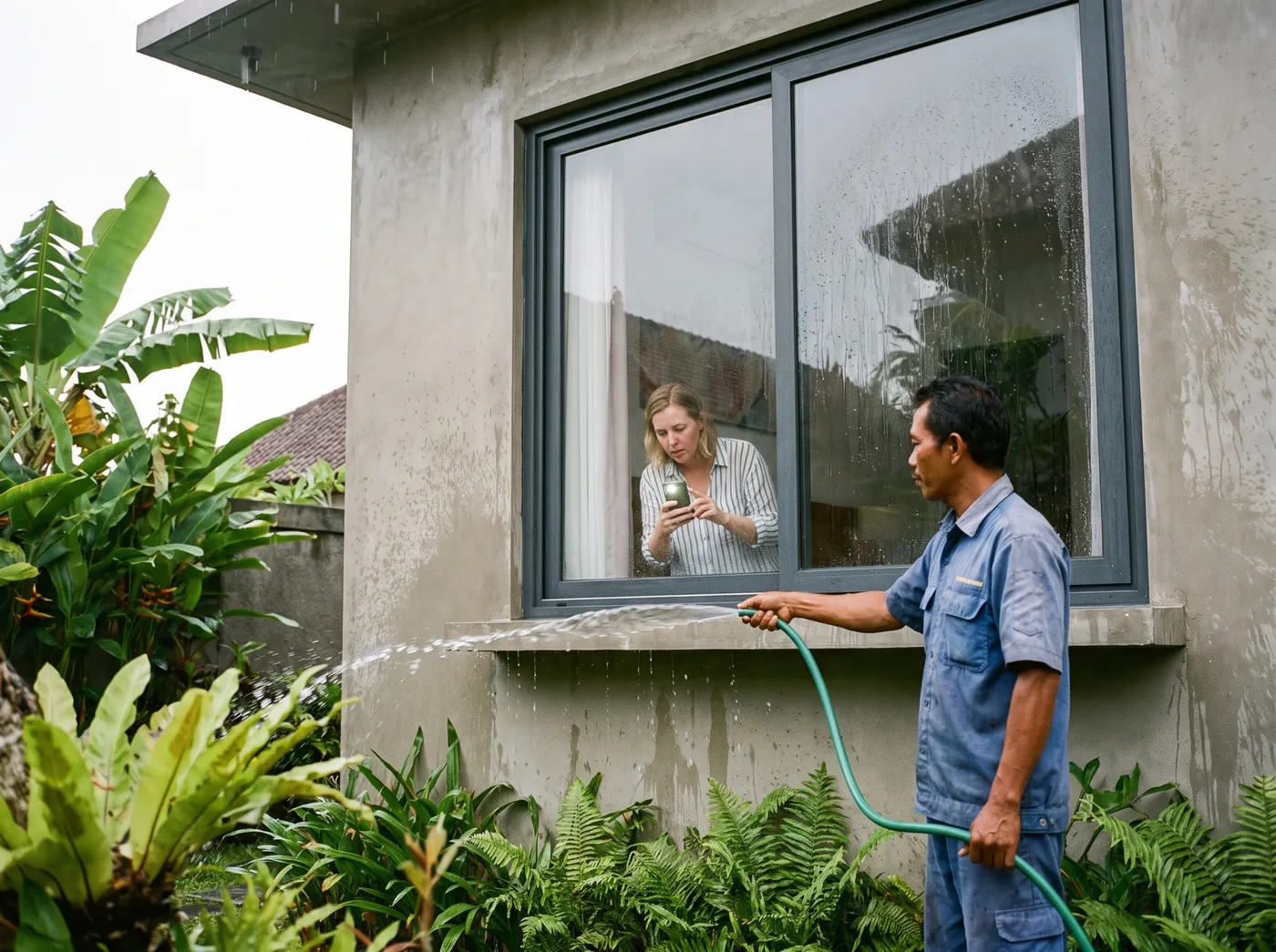
The method professionals use is simple, and you can do a version of it yourself. Two people: one outside with a garden hose on a normal spray, one inside with a torch and a dry tissue.
- Start at the bottom of the window and wet only one zone — the sill — for five minutes. Inside, watch the sill, the track and the floor.
- If it stays dry, move up: the bottom corners, then the vertical joints and interlocks, then the head of the frame, then the wall above.
- Never start at the top and never spray the whole window at once — you will not know which zone leaked.
- Do not use a pressure washer. It forces water past seals that are working, and it can damage them.
When the water appears, you know the zone. If nothing leaks under the hose but the window leaks in storms, the cause is usually wind pressure on a sill without an upstand, or water entering higher up the wall — that needs a test with water and air pressure together, or a look at the wall and roof above.
What each fix costs
| Cause | Usual fix | Guide price |
|---|---|---|
| Blocked drainage | Clean tracks, open and test the weep holes | part of the IDR 450,000 diagnostic visit |
| Failed perimeter sealant | Cut out, clean, backer rod, neutral-cure sealant | from IDR 650,000 per opening |
| Worn brushes, dropped leaf | New brushes, rollers and track cap, leaf re-levelled | from IDR 950,000 per leaf |
| Open frame corners, shrunken gaskets | Corners sealed from inside the frame, gaskets replaced | priced per opening after the test |
| Frame too light, sill wrong for the exposure | Replacement frame with a proper sill and flashing | windows from IDR 3,450,000 / m², doors from IDR 4,250,000 / m² |
| Water from the wall or roof above | Render crack repair, head flashing, parapet or gutter repair | priced with the wall or roof repair |
Most leaks we trace are in the first three rows — a few hundred thousand rupiah to fix properly, not a new window. The details of each repair are on our window and sliding door repair page.
Why more silicone makes it worse
The usual first attempt at a leaking window is a bead of silicone along every joint inside and out. On a sliding window or door this often seals the drainage slots shut, so the water that always collects in the track can no longer get out — and the leak gets worse. Silicone over a dirty or wet joint also fails within months. A proper reseal means cutting the old joint out, cleaning and drying the surfaces, putting a backer rod in deep joints and using a neutral-cure sealant rated for movement and UV.
When repair stops making sense
Repairs work while the frame is sound. Replacement is the better money when the aluminium is corroded through at the corners, when the sections are so light that the leaves flex in the wind whatever you seal, when timber sills are rotten or termite-damaged, or when the opening was built with no fall and no upstand and the door faces the weather. In those cases we fit a new frame into the existing opening with a sill that drains and a flashing that sheds water — the detailing explained on our aluminium doors page.
Before the rainy season: a 15-minute checklist
- Vacuum the bottom tracks of every sliding window and door.
- Pour a cup of water into each track; it should drain out through the front slots within a minute.
- Check the sealant between frames and walls, inside and out, for splits and gaps.
- Look for hairline cracks in the render above window heads and for stains below sills.
- Slide every door: if it needs more than one finger, the rollers are going.
- Check that gutters and roof outlets above big glazed walls are clear.
If any of those fail, October is the month to fix them — before the first storm, and before every installer on the island is booked.
FAQ
Quick answers
Why does my window leak from the top of the frame?
Usually the water is not coming through the window at all: it enters through a crack in the render above, a missing head flashing or a roof or parapet leak, runs down inside the wall and appears at the window head. A hose test that starts low and moves up shows whether the window or the wall above is the source.
Why does my sliding door leak at the bottom corners?
The bottom corners are where the track water collects. Blocked drainage slots, a sill with no fall or upstand, or unsealed frame corners let it out inwards. Cleaning and testing the drainage is the first step; if the sill itself is wrong for an exposed door, it needs rebuilding.
Can I fix a leaking window with silicone?
Only if the leak is a failed perimeter joint, and only if the old sealant is cut out and the joint cleaned first. Silicone smeared over a sliding window often blocks its drainage slots and makes the leak worse.
How much does it cost to fix a leaking window in Bali?
A diagnostic visit with a hose test costs IDR 450,000, credited against the repair. Resealing one opening starts from IDR 650,000, and a roller, brush and track service on a sliding door from IDR 950,000 per leaf. Replacement is only needed when the frame itself has failed.
NEED IT DONE?
We do this work
This guide is published by the engineers of a full-cycle construction company in Bali — the same crews that supply, install and repair the work described above.