FIELD NOTES · 2026-08-23 · 6 min READ
How to vet a construction company in Bali: 12 checks before you sign
Anyone with a pickup truck and a borrowed crew can call himself a builder on this island. The distance between a solid Bali construction company and an expensive mistake shows long before the first bag of cement — in paperwork, payment terms, and how the office reacts to twelve uncomfortable questions.
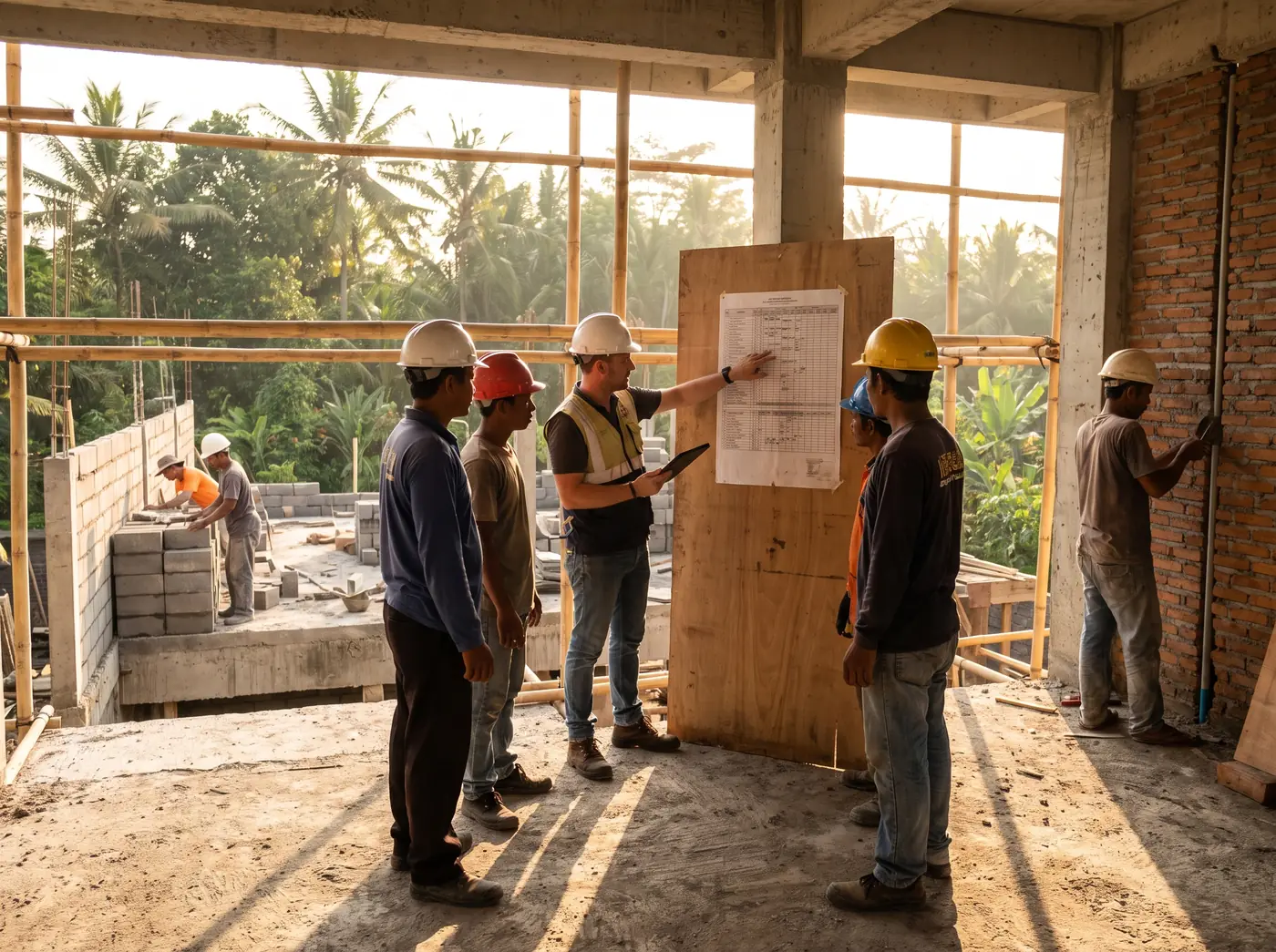
Paper: what a legitimate construction company in Bali can show you
1. A registered legal entity
The word contractor here covers everything from a registered PT — a limited company with a deed, a business registration number (NIB) and a tax ID — down to a foreman assembling day labour by phone. Ask for all three and check they carry one name — the name on your contract and on the bank account you pay. A real entity can sign for permits, honour a warranty and be pursued in court. A phone number can do none of those things.
2. A contract written for your project
Two pages of template prose protect nobody. You want scope tied to numbered drawings, a milestone schedule with dates, penalties for delay, a defects liability period and a written variations procedure — because changes, not the original scope, are where budgets die.
3. Payments that follow finished work
A mobilisation payment of 10–20 percent is normal. Everything after it should be released against a verified stage — foundations complete, structure complete, roof on — never against calendar dates, and 5 percent should stay held until the defects period closes. A schedule built this way costs an honest builder nothing and disarms a dishonest one entirely.
4. An itemised RAB with quantities visible
The RAB — rencana anggaran biaya — is the Indonesian bill of quantities: every line with a quantity, a unit rate and a total, detailed enough to be repriced line by line. Insist on the full version, not a one-page summary. You are testing transparency more than arithmetic: a company that shows its maths expects to be checked.
Proof: testing a Bali construction company's track record
5. Addresses, not albums
A portfolio proves that somebody once photographed a handsome building. Addresses prove who built it. Ask for three completed projects you can drive past, with the year each finished. Hesitation on this question says more than any brochure.
6. Twenty minutes on a live site
Ask to stand on a project currently under way. You are reading habits, not concrete: reinforcement stored off the ground, formwork running straight, a site board that matches reality, workers in helmets rather than flip-flops. A disciplined site is hard to stage for a visitor.
7. Photos of the stages nobody can see any more
Serious builders photograph reinforcement before every pour and pipework before walls close, because that archive settles arguments. Ask to see it for a finished project. If it does not exist, your build will not have one either.
8. References you choose yourself
Ask for the full client list and pick whom to call yourself, instead of accepting the two names offered. One question does the work: what went wrong, and how fast was it put right? Every build hits problems. “Nothing ever went wrong” is not a reference — it is a script.
Delivery: will your general contractor in Bali answer in month six
9. Reporting you could follow from abroad
Most owners run at least part of a Bali build from another country, which makes the reporting rhythm the project itself: weekly photo reports mapped to the schedule, a named site engineer with agreed response times, spending reconciled against progress at every stage. Before signing, ask to see an actual weekly report from a current job — not a promise of one.
10. Warranty and insurance, in writing
A structural warranty in years, a defects period in months, BPJS enrolment for the crew, third-party cover for the neighbours. Then the test question: if a worker is injured or the wall next door cracks, who pays — by contract, not by goodwill?
11. The exclusions list
Hidden costs rarely hide in the lines you read; they live in the lines nobody wrote. Have the company state in writing what the price does not include — scaffolding, temporary power and water, materials transport, design revisions, final cleaning. An evasive answer here is a preview of every invoice to come.
12. One contractor across the trades
Walk any troubled project and the defects cluster at the joints between trades — where structure hands over to plumbing, where the roof lands on walls someone else built. When every crew answers to a different boss, each of those joints becomes yours to referee. A full-cycle general contractor in Bali owns the interfaces instead: one schedule, one quality standard, one party accountable end to end. It is the reason our services run from first survey to handover under a single contract.
Red flags that end the conversation
- A deposit above 30 percent. Fifty percent up front is not a deposit — it is your leverage changing hands before a single block is laid.
- “We can start tomorrow.” Crews worth hiring are booked weeks ahead. Instant availability means an empty order book, or your money bridging someone else’s unfinished job.
- No contract on offer, cash preferred. If paperwork feels optional before you pay, imagine how optional it becomes afterwards.
- A bid 25–30 percent under all others. The gap returns later as variations — or as the price of a second company finishing what the first abandoned.
- The name keeps changing. Quote from one name, contract from another, bank account in a third. Walk away.
What we'd do
Run all twelve checks before any money moves, and keep every answer in writing — this list is exactly how we would vet a construction company in Bali, ourselves included. Start with the entity documents, walk one live site, call one owner you picked. To point the same checklist at us, our completed projects are published with locations, and you can contact us for the rest — the entity paperwork, a sample RAB and last week’s site report. We wrote the list because we pass it.
NEED IT DONE?
We do this work
This guide is published by the engineers of a full-cycle construction company in Bali — the same team that quotes and builds the work described above.